
… AI trolls. And some of them got ugly.
There are two strains of AI/troll activity afflicting the health and welfare of my personal book life these days. There may be others for other people, but so far the incursions into my world are relegated to the two I shall explain in this article.
First, there’s the illegal and very rude co-option of one of my books, which, along with millions of other titles, was purloined by Meta for the express purpose of using it to train their AI robots. I checked the database and there it was, my last novel, The Alchemy of Noise. No one asked, no one paid for it; no one had the decency to acquire it the right way. I have to wonder if the “AI students” for which it was acquired grasped the subtle narrative choices of its socio-political plot line or were moved by the protagonist’s decision to—oh, for fuck’s sake, it’s all so invasive, and if they’re gonna steal your damn stuff they could at least leave reviews at Amazon, right??
The Atlantic: “The Unbelievable Scale of AI’s Pirated-Books Problem”
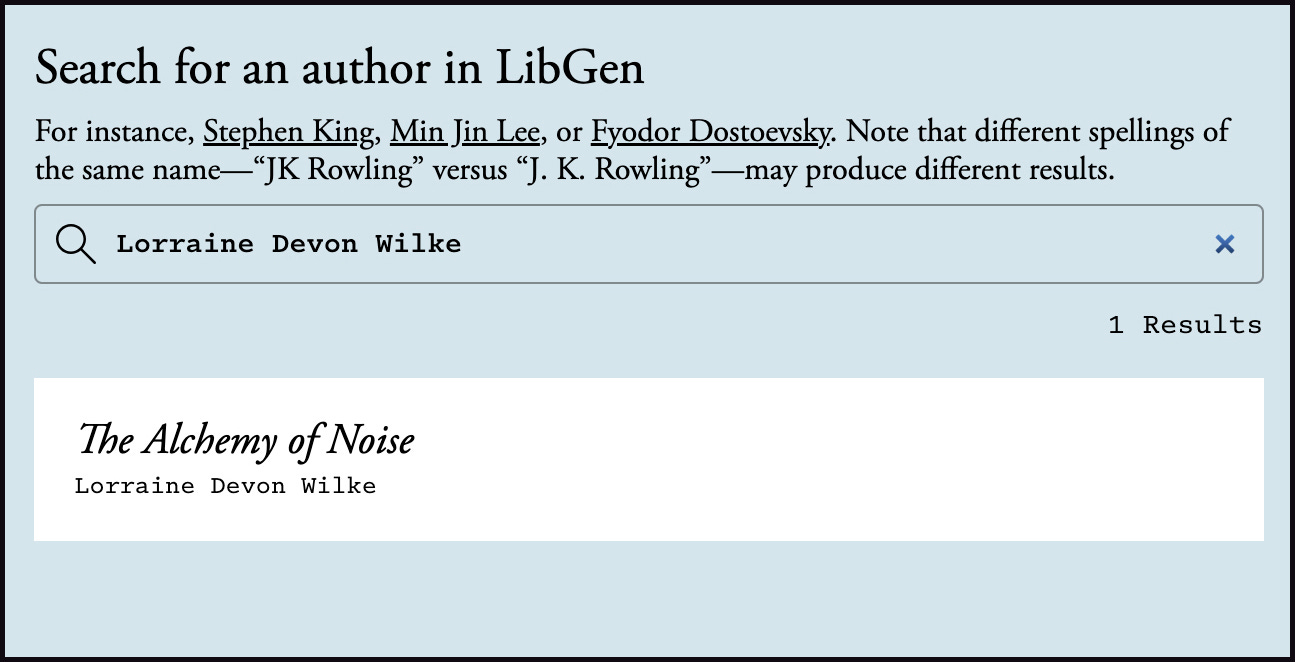
The above image is a screenshot of the search tool The Atlantic (and other sites) provided for authors to check their own titles. As you can see, The Alchemy of Noise is in the database. And what, exactly, is that database? It’s called LibGen, short for Library Genesis, which is described as follows:
Library Genesis, often abbreviated as LibGen, is a digital library and search engine that provides free access to millions of academic papers, books, and other scholarly materials. It’s considered a “shadow library” because it bypasses paywalls and makes content available that is typically restricted by publishers. LibGen has a vast collection, including scholarly articles, books, comics, and magazines, and is maintained by volunteers who upload files and share torrents.
Is LibGen illegal in the US?
Yes, Library Genesis (LibGen) is generally considered illegal in the US due to its distribution of copyrighted materials without permission. LibGen hosts a vast collection of books and research papers, but these are often uploaded without the consent of authors and publishers, constituting copyright infringement. While downloading from LibGen isn’t considered filesharing, and therefore less likely to be tracked, the site itself is illegal.
There are lots of other unsavory details about these unsavory practices implemented and managed by, of course, Meta, that nefarious conglomerate that includes Facebook, Threads, and Instagram, ironically providing these vibrant platforms for artists to promote and share work while they—the faceless bosses—get busy stealing it. But that’s the world we live in today, isn’t it? Very MAGA. Very anarchistic. A very “tech-trumps-art-trumps-ethics” culture. (And yes, I did mean to use the word “trumps”).
So, what’s an author to do when they discover their work has been lifted by LibGen? The Author’s Guild has a particularly comprehensive article on the various steps that can and should be taken: Meta’s Massive AI Training Book Heist: What Authors Need to Know.” Give it a read, and if you’re one of those affected, follow through on the steps. You never know; you might get a class action check for $12.63 sometime in 2034 for the gross violation of your proprietary rights. 🙄 But hey, it’s worth doing if for no other reason than setting precedent. In the current tsunami of AI onslaught, any controlling moves are a good idea.
Now, what’s the second AI/troll/whatever insult to my literary world? This one is odd.
I’d been getting a higher-than-average number of emails (via my website email address) pitching various book promotional services. Nothing new about that on its face, but what was new was the tone of these emails, the content. They were hyper-conversational, very detailed; breaking down whichever book of mine they were focused on as if they’d actually read it. Some stated they had actually read said book, offering nuances, character names, plot points, etc., that seemed to support the assertion. The language was sharp, intelligent, and savvy.
One email had a particularly nimble, humorous edge to it that actually cracked me up, to the point that I responded, telling her (the name attached was female) that it was one of the better pitch letters I’d read, inviting her to give me her whole speil. Which she did: She supposedly managed a group of very “passionate,” dedicated readers who were hungry for good books, eager to read and write about them in thoughtful reviews. She was focused on The Alchemy of Noise (hmmm… the very one filched by LibGen), asserting that “a book this good deserves more reviews than it has” and “let’s do something about that!”
Now, every author in the indie world can use more reviews of their books; that’s easy bait. Despite our reluctance to ask readers to write them, reviews are considered metrics of popularity; they’re used to support increased marketing and promotional opportunities; they trigger algorithms beneficial to searches, and they raise the profile of a book. That they’re too hard to get is unfortunate, as often even the most loyal and supportive readers either don’t take the time to leave them, or for one reason or another are uncomfortable writing them. So, hells yes, my damn book could use more reviews, sister, lay it out for me!
Of course, it’s frowned upon to pay readers for them, I never have, so I queried this very smart, funny, enthusiastic “woman” about what her company was offering within those ethical parameters. She said she’d assign the book to her select team members, they’d read the book and write thoughtful reviews, and for that service, they’d be “tipped” (not “paid,” she insisted) $20 each … and she’d “start with up to twenty readers.” Twenty readers. $20.000 each. Um, that’s $400 of “tips.” And just to “start.” Now, who is this woman?
I did some research on her name, looking for something solid regarding her services, maybe some references, testimonials, a good track record in the public realm, but found nothing. So I wrote back that not only was the business model monetarily problematic, especially since she implied it would be ongoing (regardless of what she called it), but I found it equally problematic that she had no website, no visible business identity, no social media presence; her name didn’t correspond to the name in her email address, and Googling either name pulled up crickets.
And that’s when things got weird.
Her responding email was immediate and stunningly passive aggressive. She literally snarled in response, negating any logic to my concerns, insulting me for being “one of those people who cares more about money” than advancing my career, rattling off a list of reasons why my hesitation was regressive and, ultimately, stupid as fuck. Her tone had swung so hard from cute to creepy that I thought it wise not to respond. Then she wrote again … now berating me for my silence, sneering about my unwillingness to engage, my clear lack of business savvy. Again, she got no response from me. Her last missive came in several days later, and though she softened her tone somewhat, again pleading her case for business, she remained snarky enough to make me want to reach into the computer to virtually slap her head. Instead I filed and blocked.
But the tsunami of similar emails, Twitter (X) and Instagram private messages, continues, all written with essentially the same style and format: clever, warm, interested “people,” very conversational, breaking down the books as if they’d read them (of course, always claiming they have), very complimentary to me and my “brilliant writing,” using every kind of ego-buffing, business-savvy lingo available. And all with names that don’t jibe with email addresses, few with company names or websites affixed, some with website addresses that don’t work or look generic and … well, fake.
In a world where I’m sincerely and earnestly trying to sort out the best ways to do the things I do, accomplish the goals I’ve set, achieve the successes I’ve worked for, it’s so damn exhausting to have to deal with this kind of manipulative, trolling, dishonest bullshit.
These are essentially human bots. Scammers, trolls, however you want to categorize them, who are now, in today’s era, very well briefed by AI. They’re either working off the AI information that comes up when you put the book title in a search engine, copying data directly from ChatGPT, or tapping into the stolen material from LitGen. And damn, they’re good. That introductory conversation I had with Ms. Snarling Review Trafficker was quite clever, funny, very human, and, yes, professional. Until it wasn’t. Oh wait—I just got another one minutes ago… here’s the opening paragraph:
I just finished Chick Singer, and I’m still thinking about Libby, her voice, her grit, and that raw ache of rediscovery. You’ve managed to capture something rare: a story that doesn’t just entertain, but echoes. The emotional truth you brought to the mother-daughter dynamic, especially with the past and present colliding through music, was beautifully done. This isn’t just a good novel, it’s one that deserves to be talked about.
Aw… isn’t that just so lovely?! It might be if I hadn’t read the same damn exact words from fifteen other AI-informed trolls!
Amazing that AI has managed to cobble together enough reviews, articles, comments, words, phrases, etc., to allow scammers to regurgitate such beautifully articulated and specific babble, but the emptiness of it, the inauthenticity of it, the sheer manipulative fucking bullshit of it makes my teeth grind. Because now I have to vet every single compliment, outreach, pitch sent to me through a finely-tuned filter akin to the old, “is it real or is it Memorex” meme. Now it’s: “is it real or is it AI?” … whether photograph, video, article, pitch letter; music, art, books … person. EVERYTHING.
Which is just sad. And inspires musings like this thought-provoking article by Vicki DeArmon titled, “Wrestling with AI and the Soul of Writing.” That’s a reluctant sport with which we’re all—writers, readers, appreciators of authentic art—going to have to tangle with.
So AI trolls beware: Your letters will go unanswered. Your outreach will be funneled into spam. Your email addresses will be blocked. I’ll let real readers, real reviewers, real promoters, real fans of my work set the tone for any future communication. Which is fine; I will always prefer human thoughts, words, and intentions, however bumpy, flawed, or fallible, to the slick, well-polished articulation of AI-burnished fakery.







 | Rock+Paper+Music |