
And I fully embraced my mother’s mantra…
I quit drinking. I wasn’t an alcoholic, it wasn’t January, and it was a really long time ago, but the ubiquitous “Dry January” memes of late brought it to mind so I decided to throw-in on a trending topic.
Back in my younger days, the “post-college rock & roll have to live out the cliché of hard-drinkin’ rocker chick on the road” days, I fashioned myself as a hardrivin’ drinker. But even then I was a pussy about it: Jack & Diet Coke, Black or White Russians, Bailey’s & coffee, those were my drugs of choice … hardcore, right?
Even more hardcore is the fact that past one drink—literally, just one of those sweet spirits—I was a mess. Nausea, head spinning, heart pounding; couldn’t sleep, queasiness, and then a migraine for days… yay, so much FUN, so yes, let’s do carry on … self-immolation as a drinking game.
By my thirties, and after countless epic hangovers—though luckily I never hurt myself or others, even if there were mornings I wondered who I might need to apologize to—it became patently clear I was someone who should not drink. I couldn’t hold it and it always, always, made me sick. Likely I had an allergy to it, as there was no amount that didn’t get my heart pounding and head aching. Even a spoonful of Grand Marnier Mousse with a touch too much liqueur triggered the dreaded effect. So, one queasy morning, after taking far too long to come to this clearly obvious decision, I decided to stop drinking. Period. Anything. At all. Ever. At any time. Done.
And that was it. I wasn’t a drinker.
It’s now been decades and I have to say, I don’t miss it. I don’t even think about it. Sure, a spicy Bloody Mary, a frosty margarita, or my old standby, a Black Russian, might tickle memory receptors from time to time, but all I have to do is think about the inevitable aftermath and it’s, “I’m good, thanks!” At this point, I don’t even have to go there. It’s just past tense.
Now it appears I’m in vogue, as “Dry January” discussions are everywhere. Given that, I was curious about its origins, of which I knew nothing, so I did a little research. Some background, via NPR:
People use the term ‘Dry January’ to refer to their effort to cut alcohol out for the entire month.
But the “official” challenge began across the pond in the U.K., according to Richard Piper, CEO of Alcohol Change UK, the organization that started the official version.
Alcohol Change UK’s mission is to reduce the harm caused by alcohol.
“We never tell people how much or how little to drink. We want to empower people to make that choice themselves,” Piper says. “We do that by our behavior change programs like the dry January program.” …
In 2013 Alcohol Change UK made its Dry January challenge official and trademarked the name. This official challenge includes an app, daily email and online peer support groups – all with the goal of supporting participants in this challenge, Piper said.
It’s now in its 13th year and has grown with more than 1 million downloads on their app, according to Piper.
I find that encouraging.
Beyond the more general bullet points they and others point out, the particular risks for women with alcohol have also been widely covered in recent years. There’s even a genre in literature that’s focused on the topic:
‘Drinking until I passed out’: Quit Lit targets women’s sobriety “A new genre of storytelling focuses on alcohol dependence and is helping some women curtail drinking or quit altogether.” The Washington Post
A site/app called Sober.com features a convenient reading list: Quit Lit Review: 11 Books to Help You Get and Stay Sober.
And of course, the medical community has weighed in, assert their unequivocal (and somewhat controversial) stand. This from the World Health Organization:
No level of alcohol consumption is safe for our health: The risks and harms associated with drinking alcohol have been systematically evaluated over the years and are well documented. The World Health Organization has now published a statement in The Lancet Public Health: when it comes to alcohol consumption, there is no safe amount that does not affect health.
That first sentence hits hard, doesn’t it? To read the whole piece click here. It’s sobering… (pun intended).
Given that, it seems my epiphany of yore was prescient. I don’t say that with arrogance but rather gratitude. I was fortunate to come to my decision before I hurt myself or someone else. Before I bungled jobs, ruined relationships, adversely impacted my family, or irrevocably damaged my health. I feel like my spirit guides (play on words?), who clearly worked overtime to circumvent those effects, finally opened my eyes to the folly of imbibing in something that was “a fun buzz” for a minute or two but ultimately kicked my ass for far longer.
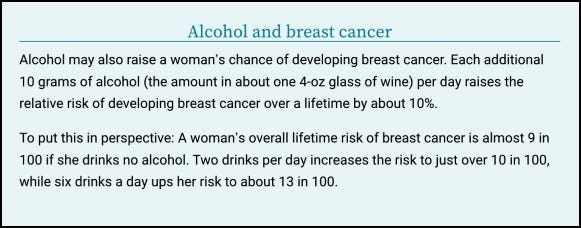
And why the WHO declaration resonates with me specifically is that I’ve had my own health scare, not related to alcohol, per se, but still … being informed that your biopsy came back positive and you’re now obligated to endure well-known rituals attendant to that diagnosis is a wake-up call like no other. Once you’re done with all that (and it’s a lot), you can never again take your health for granted. I pay more attention to what’s required to protect the “clean bill” I’ve returned to, to hedge my bets towards living the long life I intend as a strong, robust, hardy gal singing rock and roll into my nineties. And, as has been made clear by my oncologist and other scientists I’ve read and listened to, women are at greater risk of alcohol harm than men… that can’t help but have impact.
“The evidence is clear: women who drink are at greater risk than men for a range of alcohol-related health problems, including liver disease, heart damage, cancer, and mental health issues. These risks are amplified by biological differences, social behaviors, and evolving drinking patterns. For women, even moderate alcohol consumption can have serious long-term consequences, making awareness and prevention vital.”
Since I’ve been-there-done-that and don’t wish to ever do-that again, that information only solidifies the decision I made years ago.
It has, however, been an interesting journey, being someone who doesn’t drink. In a culture, a country, a time when drinking is so prevalent, so accepted, so everyday it appears in most TV shows and films, is de rigueur at dinner parties and gatherings, and largely expected at any celebration or ceremony, I am an anomaly. I’ve learned it can actually trigger anxiety when you say, “No, thanks,” to a drink. I’ve elicited wide eyes of wonder when refusing a champagne pour. I’ve had hosts insist, “Just a little red for the main course.” I’ve garnered supposedly knowing (and inaccurate) whispers of, “Oh, you’re in the program,” from people who either were in the program or forgot it’s supposed to be anonymous. Some have outright blurted, “Not even a splash?” followed by, “How do you have any fun?” Which makes me smile.
Because they didn’t know my mother.
Both my parents were surrounded by drinkers growing up. An older brother, in my father’s case. My mother was basically raised by a loving family of heavy drinkers. In both cases they lost many of those folks to alcohol-related illnesses, likely the reason neither were drinkers themselves. My father would occasionally enjoy a beer or glass of red wine, and my mom was known to sip the infrequent Sloe Gin Fizz, but alcohol was never a component of our family activities. My mother even made it a mantra: “You don’t have to drink to have fun!” she’d exclaim, and though it took me a few years of really bad hangovers to meet her on that field, I now wear that mantra like a cloak.
Maybe it’s my particular personality—or the fact that my parents made having fun our birthright—that her mantra works for me when it might not for others, but whatever the reason, I’m grateful for that too. I don’t want to need alcohol to “loosen up.” Don’t want to require a buzz to enjoy my circumstances. I hate the thought of not remembering what we talked about last night or wishing I’d done this and not that. I want to be clear-headed at all times, bracingly aware of my surroundings and the people I’m with. Sharp and cognizant of what’s being said, the nuances of the moments I’m in, the beauty of my surroundings. I couldn’t, and didn’t, do that when I was drinking. I don’t think anyone can.
But I get it, the social proclivity. We’ve been groomed, acclimated, almost trained to see drinking as so commonplace and customary that the act of not drinking is almost seen as more subversive than drinking. And yet, as politicians (many of whom surely drink without hesitation) debate the health issues of pot and CBD, and are horrified by opioids and the ravages of other drugs, the pervasive and deleterious effects of our most beloved and common drug—alcohol—garners little attention. Something to think about …
But that’s it, I’m done. I’ve probably annoyed some of you to no end, but I hope those on the cusp of considering these points consider them further. I’ve had too many people in my life suffer greatly because of alcohol, and probably some in my current life whose health and welfare are being negatively impacted even if they don’t know it—or won’t face it—yet. I’d like to see a shift in public perception, much as what happened with smoking. How what was once considered “cool,” accepted, and socially ubiquitous was discovered to be profoundly unhealthy and ultimately became undesirable (though I am noticing it creeping more and more into our TV and film entertainment again, which is not good). Perhaps someday the truth of alcohol will awaken those who care about such things, enough to shift their thinking to embrace the notion that “you don’t have to drink to have fun.”
Happy New Year, my friends, and with January just starting, let’s raise a glass of Pellegrino to my mother’s mantra!


 | Rock+Paper+Music |
You must be logged in to post a comment.