’How’s Your Book Doing?’ and Other Post-Publication Questions

Every step in the process of birthing a book has a life of its own:

Imagining the book. Writing the book. Editing the book. Querying the book. Not querying the book. Publishing the book. Celebrating the publishing of the book. Then marketing and promoting the book. And marketing and promoting the book. Still marketing and promoting the book…

I repeat that last one because it seems that once your book has been put out into the world (however it gets there), the relentless demand from that moment forward to promote and market the living hell out of said book is the worst— I mean, the most exhausting, overwhelming, often confusing—part of being an author in the year 2025. Or any year. Ever.

I’ve had four novels published. The first two I self-published (2014 and 2015). The third I hybrid published (2019, She Writes Press). The fourth was published this year by Sibylline Press, a small traditional publisher with a marketing buy-in. I love all four of those books. They truly are like my children; each individual and specific. Each gestated with love and devotion. Each brought into the world with high hopes and unlimited dreams. And each as demanding and unpredictable as any child can be.

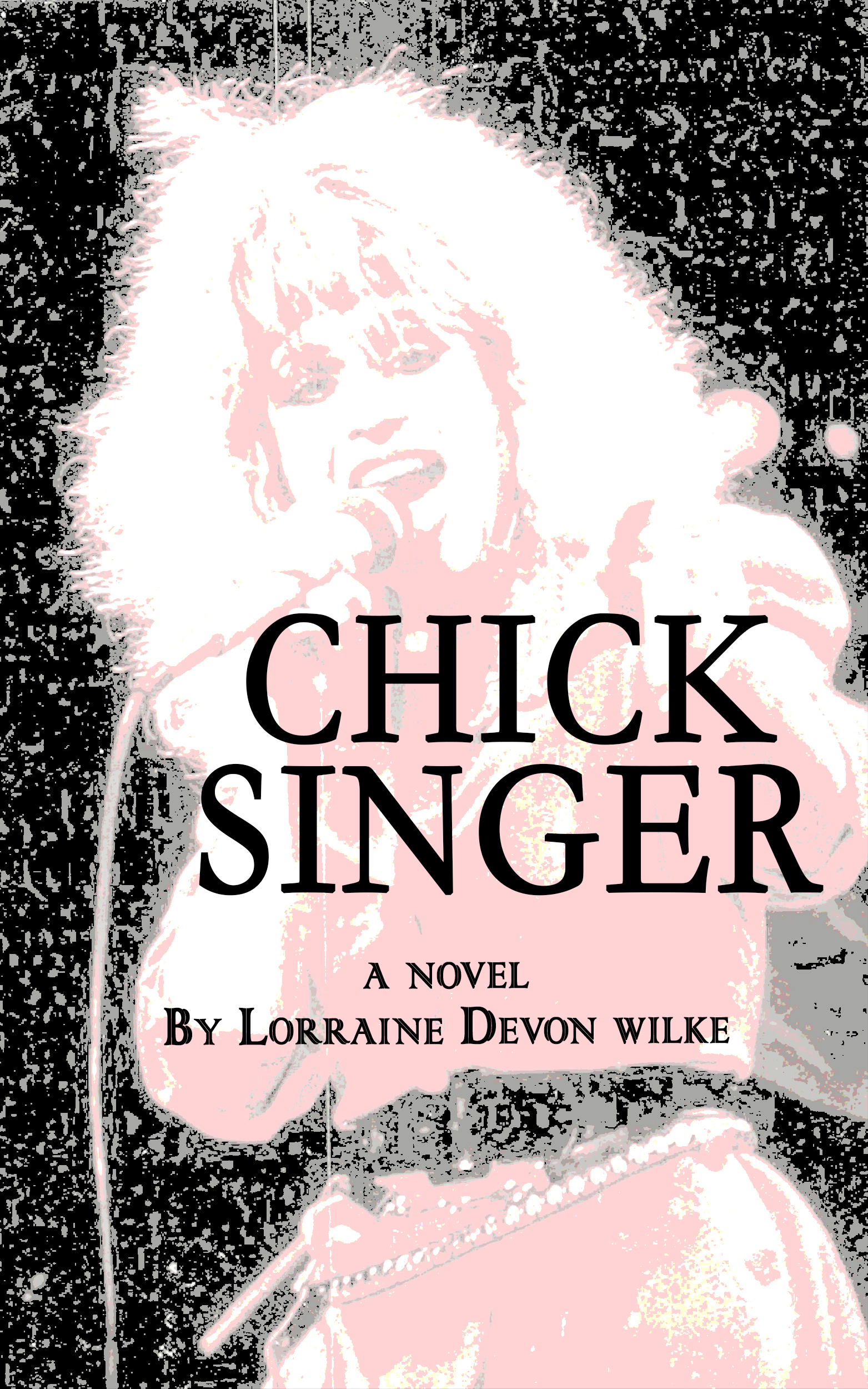
My last book, Chick Singer, came out in early April, and since then I’ve been asked innumerable times, “How’s your book doing?” My answer is always the same:

I don’t know.

I don’t know because we’re not yet up to the publisher’s first reporting period. I don’t know because despite enthusiastic responses via texts, emails, private messages, social media, and in person, the book has not accrued many reviews on Amazon or anywhere else (are people just not reviewing books these days or am I being gaslit about “how much I loved it”??). I don’t know because despite my relentless flogging of said book via social media and everywhere else, I see countless other authors and books also getting prodigiously flogged, and how can I compete with that onslaught of excellent books, sparkling authors, inventive promotional events, with then a whole new season of countless more of all that? I don’t know that either.

I can just do … well, me. My book. However I do that. I’ve done it three other times with varying degrees of success, yet, to be honest, I am a tad flummoxed as to how and why results have been somewhat different this go-around. Different time, maybe? Changes in the industry? Readers responding differently after decades of supporting indie authors? Whatever the cause, I still very much want my latest novel to soar and so I adjust and pivot as needed to respond to the changing … whatevers.

One way I’m doing that is by putting aside any “opening weekend” mentality, deciding that, regardless of when the industry determines a book has aged into “backlist title” territory, I’m going to take the entire post-publication year to treat this book like the newbie is it. We don’t deem a one-year-old child to be a has-been, old news, a backlist kid, do we? Even if another child arrives at some point, that year-old entity continues to elicit our passionate love and support; hence, my book of 2025 is going to be treated as a cherished new child until … I dunno, until whenever I decide.

Of course, this doesn’t mean media, bookstores, or reviewers are going to go along with my year-long rollout, but I’m going to do my damnedest to bring them along on the ride. Which means I have to get creative. Be indefatigable. Relentless. Even innovative. We’ll see what I come up with and how it all goes.

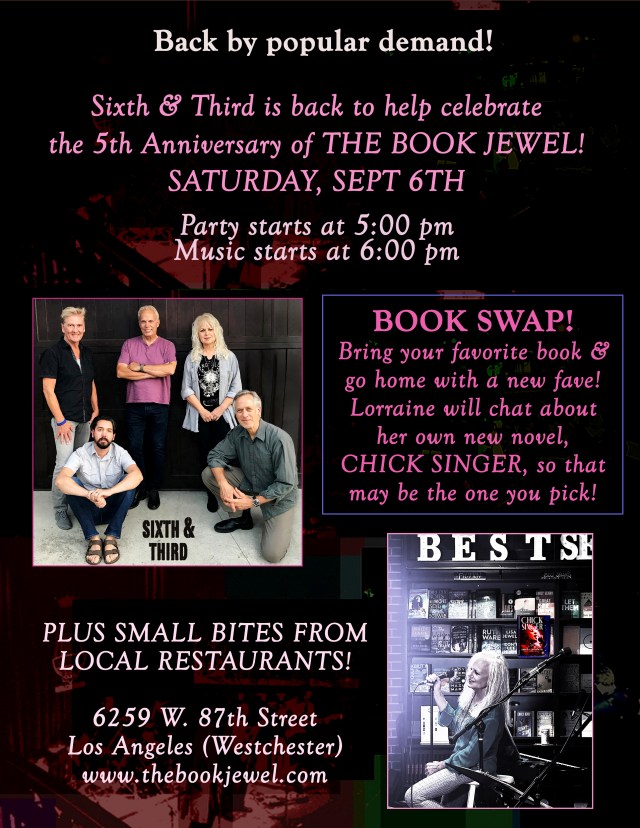
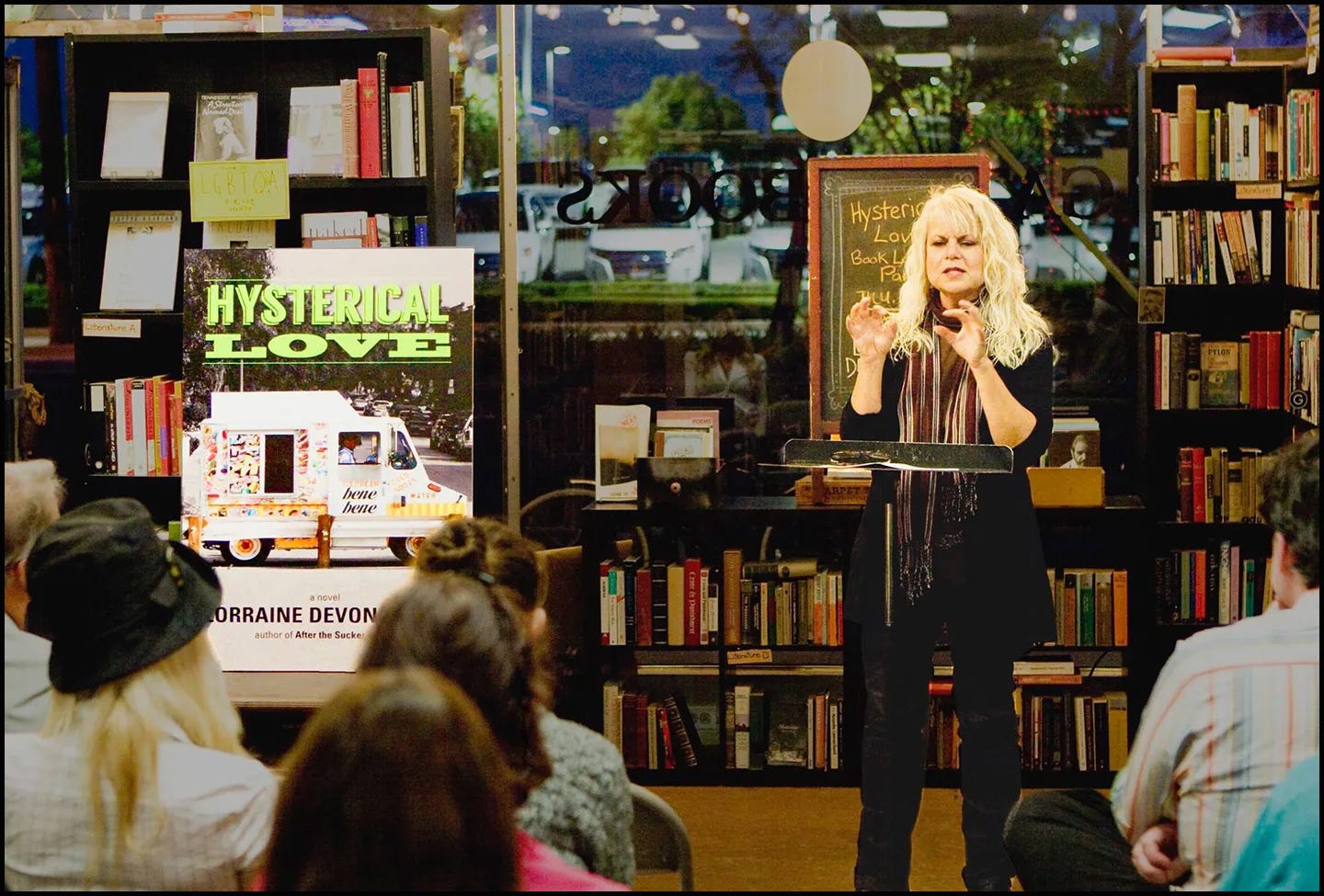
As a first step, I’ve pulled another side of my creativity into service: my music. Having been a singer my entire life, including during the wild and wooly ‘80s, it was suggested by a clever bookstore manager that—since Chick Singer revolves around a former ‘80s rock singer suddenly thrust back into the secrets and dreams of that era—it would be a great tie-in to have my band play before and after the book presentation. I was thrilled by the idea, my band worked up shiny new versions of my old ‘80s tunes, and the event was a smashing success. So much so that the store invited us back to play (and for me to present my book again) at a party celebrating their 5th anniversary. I sold more books, there was cake, and people danced … another smashing success.

This kind of innovative promotion seems to me to be a very good idea … if you’ve got a band and a book about rock & roll singers! If you don’t, the idea would be to explore whatever tie-ins make sense for your book. I’m seeing Facebook posts from authors who’ve done just that: a princess-themed party for a romance novel about a princess, environmental speakers at the book event for a novel focused on climate change; poets brought in for a book presentation about a wandering poet. Creative, fascinating, engaging. This is the kind of promotion I like seeing and like doing. I plan to keep my own “creative promotions” going long enough to inspire continuing, increasing traction for Chick Singer.

But, ultimately, publishing a book is much like gift-giving: you do your best to present an absolute top-notch item (your stellar story, buffed, shined, and edited), you wrap it as artfully as possible (gorgeous cover and book design), you offer it with enthusiasm and confidence (“I do hope you like it!”), and then … well, then you let it go. And just as you don’t keep checking if they ever wore that blouse you gifted, or “if you like those earrings I gave you?”, you can’t keep pulse-checking with people who promised to write a review but didn’t, or said they’d buy the book but “keep forgetting,” or promised to suggest it to their book club but haven’t yet. You can only do your best to gently nudge, to promote; to follow-up, follow-through with media resources, and keep exploring new, interesting ways to amplify and shine more light on your work. Then you trust what you’ve put in motion and move on.

But to answer the title question: if I were to hazard a guess about Chick Singer’s reception out in the wide, wide world, based on media reviews, delighted emails, phone calls, texts, social media posts, and bookstore conversations, I’d say it’s been very well received. People have enjoyed it, been moved by it, entertained by it. And that, really, is the most essential goal, isn’t it? Whether we crack that elusive bestseller list, accrue countless reviews, sell bundles, or win awards and kudos from influential people, knowing the ones who bought it and read it “really loved it” … well, that’s gold. That’s the prize. That’s (almost) enough for me.

I’d still like to crack that damn bestseller list someday …

Originally published in Women Writers Women’s Books.

Books & Bands: Celebrating The Book Jewel

Music, singing, songwriting, my band, parties in bookstores … these things make me happy. And in a delightful mash-up of all the above, my band will be entertaining party-goers celebrating the 5th Anniversary of one of the most creative, welcoming, inventive indie bookstores around, The Book Jewel.

It’s interesting how, during these trying times politically, people still want to get out and celebrate; gather with friends, experience art, feel joy, shake off the doldrums and anxieties that seem to endlessly swirl around us. I appreciate when people show up at gigs, join me at a show, text me about a new art exhibit, or just want to get out on a walk. We need to break away from noise and clatter.

In my last Substack piece I mentioned that my readers tend to less interested, however, in reading about these things, more focused on political analysis and opinion. So when people do join the party, so to speak, do read the piece on music or publish, do share articles about new, great places to eat, I’m encouraged. Because, as I’ve said countless times, we’ve got to find balance. Never more essential that in this mad moment…

So if you’re in the Los Angeles area next Saturday night, I hope you’ll come join us for this celebration of a fantastic indie bookstore. I promise it’ll be a rockin’ good time!


Then They Came For My Books

… AI trolls. And some of them got ugly.
Photo by Joshua Hoehne on Unsplash

There are two strains of AI/troll activity afflicting the health and welfare of my personal book life these days. There may be others for other people, but so far the incursions into my world are relegated to the two I shall explain in this article.

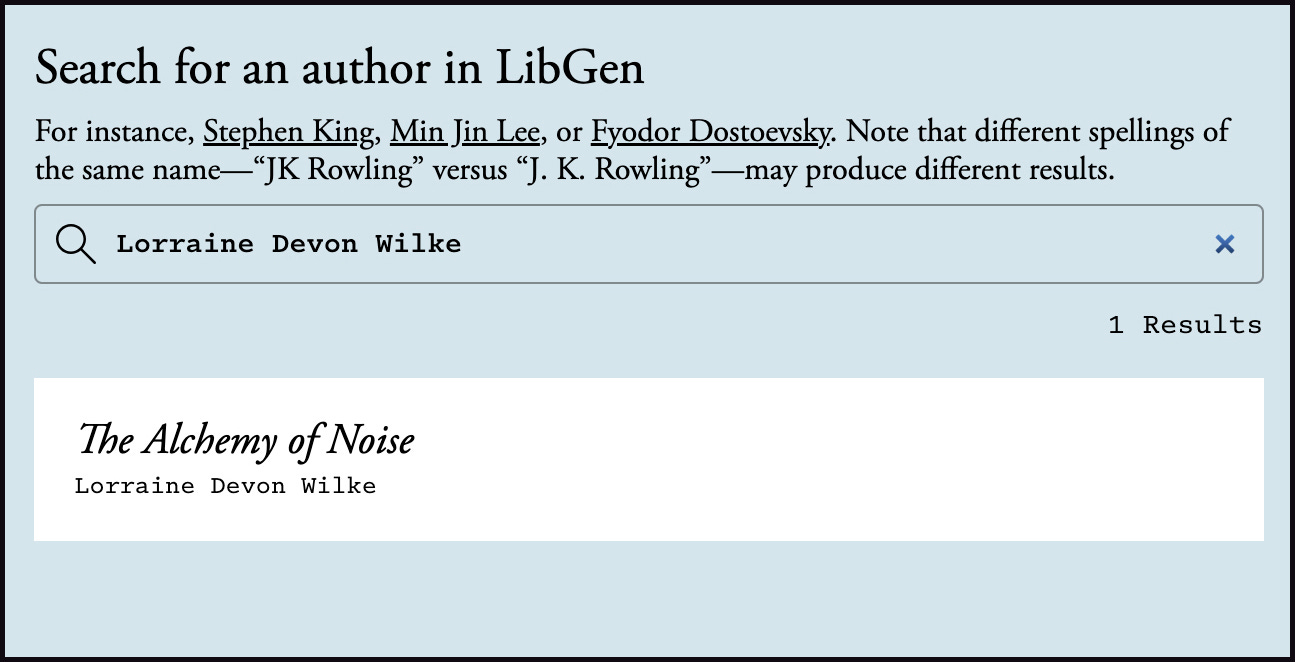
First, there’s the illegal and very rude co-option of one of my books, which, along with millions of other titles, was purloined by Meta for the express purpose of using it to train their AI robots. I checked the database and there it was, my last novel, The Alchemy of Noise. No one asked, no one paid for it; no one had the decency to acquire it the right way. I have to wonder if the “AI students” for which it was acquired grasped the subtle narrative choices of its socio-political plot line or were moved by the protagonist’s decision to—oh, for fuck’s sake, it’s all so invasive, and if they’re gonna steal your damn stuff they could at least leave reviews at Amazon, right??

The Atlantic: “The Unbelievable Scale of AI’s Pirated-Books Problem

Search the LibGen database HERE.

The above image is a screenshot of the search tool The Atlantic (and other sites) provided for authors to check their own titles. As you can see, The Alchemy of Noise is in the database. And what, exactly, is that database? It’s called LibGen, short for Library Genesis, which is described as follows:

Library Genesis, often abbreviated as LibGen, is a digital library and search engine that provides free access to millions of academic papers, books, and other scholarly materials. It’s considered a “shadow library” because it bypasses paywalls and makes content available that is typically restricted by publishers. LibGen has a vast collection, including scholarly articles, books, comics, and magazines, and is maintained by volunteers who upload files and share torrents.

Is LibGen illegal in the US?

Yes, Library Genesis (LibGen) is generally considered illegal in the US due to its distribution of copyrighted materials without permission. LibGen hosts a vast collection of books and research papers, but these are often uploaded without the consent of authors and publishers, constituting copyright infringement. While downloading from LibGen isn’t considered filesharing, and therefore less likely to be tracked, the site itself is illegal.

There are lots of other unsavory details about these unsavory practices implemented and managed by, of course, Meta, that nefarious conglomerate that includes Facebook, Threads, and Instagram, ironically providing these vibrant platforms for artists to promote and share work while they—the faceless bosses—get busy stealing it. But that’s the world we live in today, isn’t it? Very MAGA. Very anarchistic. A very “tech-trumps-art-trumps-ethics” culture. (And yes, I did mean to use the word “trumps”).

So, what’s an author to do when they discover their work has been lifted by LibGen? The Author’s Guild has a particularly comprehensive article on the various steps that can and should be taken: Meta’s Massive AI Training Book Heist: What Authors Need to Know.” Give it a read, and if you’re one of those affected, follow through on the steps. You never know; you might get a class action check for $12.63 sometime in 2034 for the gross violation of your proprietary rights. 🙄 But hey, it’s worth doing if for no other reason than setting precedent. In the current tsunami of AI onslaught, any controlling moves are a good idea.

Now, what’s the second AI/troll/whatever insult to my literary world? This one is odd.

I’d been getting a higher-than-average number of emails (via my website email address) pitching various book promotional services. Nothing new about that on its face, but what was new was the tone of these emails, the content. They were hyper-conversational, very detailed; breaking down whichever book of mine they were focused on as if they’d actually read it. Some stated they had actually read said book, offering nuances, character names, plot points, etc., that seemed to support the assertion. The language was sharp, intelligent, and savvy.

One email had a particularly nimble, humorous edge to it that actually cracked me up, to the point that I responded, telling her (the name attached was female) that it was one of the better pitch letters I’d read, inviting her to give me her whole speil. Which she did: She supposedly managed a group of very “passionate,” dedicated readers who were hungry for good books, eager to read and write about them in thoughtful reviews. She was focused on The Alchemy of Noise (hmmm… the very one filched by LibGen), asserting that “a book this good deserves more reviews than it has” and “let’s do something about that!”

Now, every author in the indie world can use more reviews of their books; that’s easy bait. Despite our reluctance to ask readers to write them, reviews are considered metrics of popularity; they’re used to support increased marketing and promotional opportunities; they trigger algorithms beneficial to searches, and they raise the profile of a book. That they’re too hard to get is unfortunate, as often even the most loyal and supportive readers either don’t take the time to leave them, or for one reason or another are uncomfortable writing them. So, hells yes, my damn book could use more reviews, sister, lay it out for me!

Of course, it’s frowned upon to pay readers for them, I never have, so I queried this very smart, funny, enthusiastic “woman” about what her company was offering within those ethical parameters. She said she’d assign the book to her select team members, they’d read the book and write thoughtful reviews, and for that service, they’d be “tipped” (not “paid,” she insisted) $20 each … and she’d “start with up to twenty readers.” Twenty readers. $20.000 each. Um, that’s $400 of “tips.” And just to “start.” Now, who is this woman?

I did some research on her name, looking for something solid regarding her services, maybe some references, testimonials, a good track record in the public realm, but found nothing. So I wrote back that not only was the business model monetarily problematic, especially since she implied it would be ongoing (regardless of what she called it), but I found it equally problematic that she had no website, no visible business identity, no social media presence; her name didn’t correspond to the name in her email address, and Googling either name pulled up crickets.

And that’s when things got weird.

Her responding email was immediate and stunningly passive aggressive. She literally snarled in response, negating any logic to my concerns, insulting me for being “one of those people who cares more about money” than advancing my career, rattling off a list of reasons why my hesitation was regressive and, ultimately, stupid as fuck. Her tone had swung so hard from cute to creepy that I thought it wise not to respond. Then she wrote again … now berating me for my silence, sneering about my unwillingness to engage, my clear lack of business savvy. Again, she got no response from me. Her last missive came in several days later, and though she softened her tone somewhat, again pleading her case for business, she remained snarky enough to make me want to reach into the computer to virtually slap her head. Instead I filed and blocked.

But the tsunami of similar emails, Twitter (X) and Instagram private messages, continues, all written with essentially the same style and format: clever, warm, interested “people,” very conversational, breaking down the books as if they’d read them (of course, always claiming they have), very complimentary to me and my “brilliant writing,” using every kind of ego-buffing, business-savvy lingo available. And all with names that don’t jibe with email addresses, few with company names or websites affixed, some with website addresses that don’t work or look generic and … well, fake.

In a world where I’m sincerely and earnestly trying to sort out the best ways to do the things I do, accomplish the goals I’ve set, achieve the successes I’ve worked for, it’s so damn exhausting to have to deal with this kind of manipulative, trolling, dishonest bullshit.

These are essentially human bots. Scammers, trolls, however you want to categorize them, who are now, in today’s era, very well briefed by AI. They’re either working off the AI information that comes up when you put the book title in a search engine, copying data directly from ChatGPT, or tapping into the stolen material from LitGen. And damn, they’re good. That introductory conversation I had with Ms. Snarling Review Trafficker was quite clever, funny, very human, and, yes, professional. Until it wasn’t. Oh wait—I just got another one minutes ago… here’s the opening paragraph:

I just finished Chick Singer, and I’m still thinking about Libby, her voice, her grit, and that raw ache of rediscovery. You’ve managed to capture something rare: a story that doesn’t just entertain, but echoes. The emotional truth you brought to the mother-daughter dynamic, especially with the past and present colliding through music, was beautifully done. This isn’t just a good novel, it’s one that deserves to be talked about.

Aw… isn’t that just so lovely?! It might be if I hadn’t read the same damn exact words from fifteen other AI-informed trolls!

Amazing that AI has managed to cobble together enough reviews, articles, comments, words, phrases, etc., to allow scammers to regurgitate such beautifully articulated and specific babble, but the emptiness of it, the inauthenticity of it, the sheer manipulative fucking bullshit of it makes my teeth grind. Because now I have to vet every single compliment, outreach, pitch sent to me through a finely-tuned filter akin to the old, “is it real or is it Memorex” meme. Now it’s: “is it real or is it AI?” … whether photograph, video, article, pitch letter; music, art, books … person. EVERYTHING.

Which is just sad. And inspires musings like this thought-provoking article by Vicki DeArmon titled, “Wrestling with AI and the Soul of Writing.” That’s a reluctant sport with which we’re all—writers, readers, appreciators of authentic art—going to have to tangle with.

So AI trolls beware: Your letters will go unanswered. Your outreach will be funneled into spam. Your email addresses will be blocked. I’ll let real readers, real reviewers, real promoters, real fans of my work set the tone for any future communication. Which is fine; I will always prefer human thoughts, words, and intentions, however bumpy, flawed, or fallible, to the slick, well-polished articulation of AI-burnished fakery.


linktr.ee/lorrainedevonwilke

A Writer’s Life is a Roller Coaster. How Best to Avoid Whiplash

When I was in grade school, my class participated in a special pullout session to watch an interesting documentary about noted anthropologist Louis Leakey. I was mesmerized throughout, so when we were assigned to write an essay immediately afterwards, I jumped in, flush with enthusiasm. 

Photo by hannah grace on Unsplash

Imagine, then, the blow of getting my paper back with a big “D+” circled in red with the sharply worded comment: “Much copied material!” Which was shocking (and inaccurate), given that it was written about a movie I’d just watched, with no reference materials to tap, and not a word of it from anywhere but my own fertile mind. It seems I’d enjoyed the film enough that I retained much of the information and wove that into my analysis and review. “Wasn’t that what I was supposed to do?” I internally caterwauled. Yet when I confronted the teacher to assert my plagiaristic innocence, she refused to believe “a child your age could have written anything as cogent and well thought-out as this,” and my hideous grade held. Talk about a back-handed compliment! 

I kept that essay with its big, circled “D+” as a reminder of just how misguided and off-the-mark much about writing (and writers) can be. As both an art form and an industry, it’s rife with opinions, instructions, rules, mandates, perceptions, and demands that often, and sometimes quite loudly, contradict each other. And while we, the writers, are driven to express our narrative impulses from the purest places of creativity, most of us also want to be humble and open, learn from experts, and build goodwill in hopefully sustaining relationships. So when we get hit with those many contradictions and confusions—often found in “rules of writing” lists, personal critiques, and advice we don’t necessarily agree with but feel we probably should—there’s a struggle to know what to accept, what to reject, when to get a second opinion, and when to just shut up and do that page-one rewrite. 

All of these options and elements comingle in the swooping up-and-down roller coaster life that is a writer’s. You know, that ride we clamor onto in pursuit of fulfilling our dream, building a career, working toward excellence, and finding success. It’s a ride that’s unpredictable and exhilarating, terrifying and whiplashing; one that, when it takes off, leaves us unsure of whether to raise our hands and scream in delight, or demand someone stop the damn thing and let us off. 

Though it’s been over a decade since I finished my first novel, I still find myself shaken at times on that ride. Jostled, as I continue to sharpen my writing skills, query agents; evolve my thinking on options in the publishing industry, even work with other writers to help them polish their own work. I think (I hope) I have come to a place where I have thick enough skin, deep enough wisdom, and much less reliance on magical thinking, but I’m still amazed at how many of the questions I asked—or was asked—years ago that are still being asked today: 

  • Is self-publishing the kiss of death? (No
  • Does it really matter what our book covers look like? (Yes)
  • I can’t afford an editor; can I put my book on Amazon anyway? (You can but definitely shouldn’t without professional editing and formatting.)  
  • Can anyone but romance writers find an agent? (I’m not clear on that … I just got a rejection letter from an agent I queried 2.5 years ago; it took her that long to even acknowledge my submission!)
  • Are we allowed to call ourselves writers if we haven’t published anything yet? (If you’re writing, I say you’re a writer.)
  • I heard that Stephen King said writers shouldn’t watch TV; did he say that and is he correct? (I don’t know if he actually said that. If he did, it might have been taken out of context. If it wasn’t, no, he’s not correct.)
  • How many books do we need to write a year to be considered successful? (The metric of “success” has nothing whatsoever to do with how many books you write a year… or ever.)

The list goes on, but let me leap on that last one, as it’s a question that sparked a recent conversation with a writer friend of mine. It had taken her a good many years to fully develop, write, fine-tune, and ultimately prepare her current book for publication, and yet she kept reading about other writers who were cranking out three, four, even five books in a year, which astounded and confused her. “How can they manage that when it’s taken me so long to do my one? Is it possible some of us only have one story in us?”

She said she’d posited the question in her writing class and got lots of feedback: some commiserated with her query, wondering and feeling similar things. Others admitted that though they did publish more frequently, not all they wrote was particularly memorable (she thought that was bracingly honest, as did I!). And there were a few who took umbrage with her phrase “cranking out,” asserting they could write several books a year without any loss of quality. I weighed in with something like this: 

“I totally understand your dilemma. And you’re not alone. I’ve taken years between my books and long ago decided that’s just the way it is for me. I’m not interested in quantity over quality, and for me to write what I perceive to be a quality book takes time, with lots of rewrites and editing and more rewrites, and with that sort of protocol you literally can’t crank out several books a year.

“I have seen some people crank out two, three, sometimes four books a year, and maybe they’re good enough for some readers, but upon further inspection I’ve found many don’t hit the mark for me. Often they’re quick and formulaic, sometimes lacking thoughtful editing or proper copy-editing. But it’s a choice people make, both as writers and readers.

“You do your thing, feel and tell your stories, however many or few you have, and don’t worry about the rest. You’re good.”

And I stand by that. Though, frankly, I don’t know why that debate persists. It shouldn’t. It’s a personal choice. Unless you signed a deal agreeing to a certain number of books for a publishing company (and then congrats to you!), how many books you write is as personal a matter as how much you weigh, how many children you want (or don’t), or why you suddenly hate musicals. That it’s become a flashpoint amongst writers is strange to me, whether it’s that weird point-of-pride for some who do “crank out” several books a year, or a “shame cudgel” for those who don’t, can’t, don’t want to. Both decisions are valid. Neither is more meritorious than the other. So let’s parse how to avoid the whiplash triggered by that particular roller coaster dive.

It can sometimes be hard for writers to take the long view of their art and the industry that encompasses it. Some put heart and soul into the work, believe in it, love it as they’d love a child. Others see it as less about love and more about commerce, using their skills and creative output to build income and popularity. Some fall somewhere in between. I think you have to, first, figure out where you see yourself on that spectrum, then construct a writing protocol and business plan that aligns with what you decide. Once you candidly and honestly do that, it gets easier to find answers to the issue discussed in your writing  group … or any questions that arise over time.

Things like: What do I prioritize in terms of where I spend my time and money? How much critique do I need and want; how much do I seek out; how much do I implement? Which rules feel organic and productive; which are non-applicable to me? What publishing model suits how I want to do this? How many stories do I have to tell; how many books do I feel compelled to write?

No one can answer those questions for you, and anyone who tells you there’s only one way to achieve or perceive success—whether creative, critical, or commercial—is wrong. There are many ways, just as there are many versions of success. Though I’d certainly love all the perks best-selling authors enjoy as much as the next person, more important to me is telling the stories I want to tell the way I want to tell them: how they flow, how they feel, what they say, how the books look, how they’re presented in the marketplace, and so on. If that comes with perks, yippidy do dah! If it only comes with my sense of artistic pride and personal satisfaction, so be it. I can live with that.   

Odds are you can too. You simply have to define your goal, decide your path, then buckle in for the journey you design to get there. Hopefully, you can enjoy the ride, get to your destination in one piece and succeed without pulling a muscle … you might even ask to be taken around again! 

— ———

Additional read: THE ART & CRAFTINESS OF CRITIQUE:  Women Writers Women’s Books, February 25, 2022

Chick Singer: How Creativity Became a Lifeline

These past ten days since the election have been brutal, certainly those of us who worked and hoped hard for the more joyful, optimistic outcome. For many, the results cratered their forward motion, and left them fighting to even stay afloat (see How to Survive a Rip Tide … and live to see another election). At the end of the day, creativity is what keeps me sane, for many reasons. And because I know art has the power to lift us up, I’m shifting my focus at this moment from election madness to my latest creative project:

Writing has always been a balm for me. Whether pounding out letters I never sent, winding my way through the puzzle of song lyrics, crafting essays and op-eds that spoke my mind and heart, or taking on the heft of a novel, immersing myself in the art and craft of writing has truly, without hyberbole, kept me sane. 

My latest novel, Chick Singer, has been signed by Sibylline Press, and will be released (in print, audio & ebook) via their Sibylline Digital First imprint in March 2025, and that is something that not only cheers me greatly!

The story was birthed from one of those random “what ifs?”, the kind that sticks; the kind you can’t stop thinking about, that tickles your brain until you follow the thread to some ultimately satisfying fruition. In this case, it was a prompt based on my wild, rollercoastering, exhilarating years in rock & roll, and went something like this: “What if somebody secretly posted your old ‘80s music online and it went viral?”

I remember laughing, thinking that would, indeed, be random, but the idea sparked a bigger idea, one that carried me into the world of “Libby Conlin”—her band, her family, her life, her dreams, her secrets—all of which led to Chick Singer. It’s a story that has percolated through various iterations, engaging the input of many wonderful readers, consultants, editors, and advisors, all of whom contributed to a “satisfying fruition” in novel form. To give you a snapshot of its story:

Logline: A former ‘80s rock singer is forced to excavate her mysterious past when her boomeranging adult daughter secretly—and successfully—posts her old music online.

Rock & roll stardom is something you dream about when you’re young, and for Libby Conlin the ‘80s and all their wild promise are ancient history. What pulls her attention now is the unexpected arrival of Bridget, her newly divorced daughter who’s home again despite their historically fractious relationship and the chaos it inspires. And, as if predestined, life quickly turns upside down when Bridget’s application to a local art school involves anonymously posting Libby’s old music online, music that’s good enough to garner the attention of industry gatekeepers. When Libby’s mysterious past—and all its dark secrets—comes roaring into the present, the reconfiguration of everything and everyone in her orbit is both bittersweet and life changing. 

placeholder cover

When fascination with rock & roll remains a never-ending draw, CHICK SINGER steps onto that stage with its raucous exploration of a complex mother/daughter relationship set against a backdrop of music, dreams, and love—and the art of redefining all three.

If you’d like to keep up with the process as it moves toward publication, you can tap its page on my website, and of course I’ll be posting pertinent updates from time to time here and on my socials.

linktr.ee/lorrainedevonwilke

Banning Books and the ‘Stupidfying’ of America

Let’s face it: America is getting stupider.

At least a good chunk of it is. And I know that’s not a word: stupider. Neither is “stupidfying.” But somehow the very idiocy of those fits the current, frothing state of American culture, which, in recent days, has been behaving badly at school board meetings, hissy-fitting against lifesaving vaccines; even—despite the original Nazis and Fahrenheit 451 being set firmly in the past—banning and burning books with impunity.

As they say on Twitter: WTF, America?

Do right wing adults want their children to be undereducated? Is that the goal? Or is the intent to pretend if one bans a book they actually have the power to make it invisible, like a toddler who closes his eyes believing he can no longer be seen?

Photo by Freddy Kearney on Unsplash

It is a confounding task, sorting out the stupidity of regression; the stunning, ignorant, backwardness of outlawing thought by ascribing nefarious traits to literature, most of it classic and brilliantly rendered. Because it seems that, as we advance as a society, as we purportedly modernize and evolve as members of the human race in the 21st century, a contingent of conservative, likely hardcore Christian, certainly right wing indoctrinated, Americans has decided to put their feet down, dammit, and halt progress. All this evolution, change, diversity, sexual identification, pronouns, asserting rights, freedom of expression, all so au courant these days, is just NOT GOING TO BE TOLERATED.

Teach children the unvarnished, unwhitewashed history of America? Are you kidding? All that truth about slavery and genocide and the decimation of Native lands and brutalization of bodies of color is just going to make our fragile white kids “uncomfortable,” feel “guilty” and “shamed.” So, no, absolutely not. We’ve branded that unvarnished, unwhitewashed history of America as “critical race theory” (again, WTF?) and decided it’s dangerous, upsetting, and possibly enlightening— I mean, possibly frightening—to our kids.  We will stamp our feet and legislate our schools to death so that nonsense like that will not be inflicted on those tender children.

(Phew… dodged that bullet, red America.)

They’re already making regressive headway on the “women’s right to body autonomy” front, with SCOTUS tilted right and long held Republican notions of small government that stays out of our body parts being shelved for a more invasive GOP that crawls into wombs to vote on what the hell is going on in there. Apparently the process of pregnancy, despite requiring a man’s full participation—or at least his sperm count—has been designated as “women stuff,” and, given conservative definitions of women as “those softer, less-self-determined humans men get to control,” body autonomy (for women, that is) is not a priority, nor does it subscribe to conservative Christian dictates. Therefore, it will be theocratically removed from the equation. Sit down and shut up, ladies, and be grateful we’re letting you go to college and get jobs.

(Hang tight, red America; we’re almost there on that one.)

As for books… well, we all know Catcher in the Rye has eaten the souls of countless American youth, and Harry Potter has lured whole generations into the occult. To Kill a Mockingbird makes white people cringe and includes a rape, and we can’t have our kids (forget that 90% of them watch porn or emulate its stars on the street) read about that kind of rough stuff. The Color Purple is unacceptable for teens, “due to its graphic sexual content and situations of violence and abuse,” despite the brutal video games they play or TV shows they watch. One could go on and on and on. This list here (which I can’t credit because I haven’t found who put it together), includes a staggering compendium of some of our very best literature, and, yes, I checked every title. They’ve all, indeed, been banned (and some likely burned) at one point or another.

It’s a great list. As someone on Twitter said, “I’m making this the summer reading list for my kids.”

(Good parent… don’t tell the other side!)

What are we doing, America? Seriously, WTF? When did reading books that depict life, both real and imagined, become (or, sadly, revert back to) something to ban, something to burn? What ignorance, what cluelessness, compels a parent, a teacher; a priest, a school board member, to decide that life, particularly as chronicled by some of our very best writers, with all its brambly edges and imperfect people, must be sanitized, censored, and shunned to protect the minds of children?

Have you seen teenagers in 2022? They are exposed to media, social and otherwise, that’s left them as savvy to modern culture, as versed in sexuality, as knowledgeable of the atrocities of bigotry and hate, as most adults… more so. They don’t need these books banned, they need these books taught.

They need to learn the truth of the Holocaust, not the dismissive denialism pushed by some. They need to learn the truth, the whole truth, nothing but the truth about the destructive path of Manifest Destiny, the horrors of slavery and immigrant labor, the tragedy of Native American genocide and theft of their lands to build a ” home of the brave” for white Europeans. They need to learn it all.

Because learning truth, all of it, even the gritty parts, is the only way to evolve. To raise consciousness. To prevent a repeat of those atrocities. To raise children free of hate, prejudice, denialism, arrogance, sexism, aggression, narcissism, and ignorance. To raise children who not only want to learn about the diversities and nuances of our country and the lives we all live here, but to embrace them.

Red America may believe if they close their eyes—or burn paper, binding, and torches in a show of fascism—the aspects of life they eschew will disappear, lose power, become moot. But that’s not the way it works. Smart people know that.

Hopefully, their children are smart enough. Hopefully they will reject the regression and backwardness, the censorship and shunning, supposedly being done on their behalf. Hopefully these kids will avail themselves of everything wise writers and brilliant teachers have to offer, allowing them to grow more accepting, better educated; less…stupider.

Until then, check that list, grab a book, and read.


Visit www.lorrainedevonwilke.com for details and links to LDW’s books, music, photography, and articles.

It’s a Wrap, 2020: Holidays, Hope & ‘Gift a Book’ Ideas

Volumes will be written about the madness of this very mad year, but if you’re reading this post, the good news is you’ve survived so far and will, hopefully, continue to be safe, healthy, and ready to welcome a never more anticipated turn of the page! 

My own year has been admittedly slim on celebratory content, but we Wilkes, like so many others, remain grateful for what we can celebrate: our family’s good health (which I hope extends to each of your own), continuing creativity (albeit of the less performance kind), a more encompassing relationship with streaming TV, and a new, hope-inducing American administration (thanks to ALL who helped with that essential goal!).                    

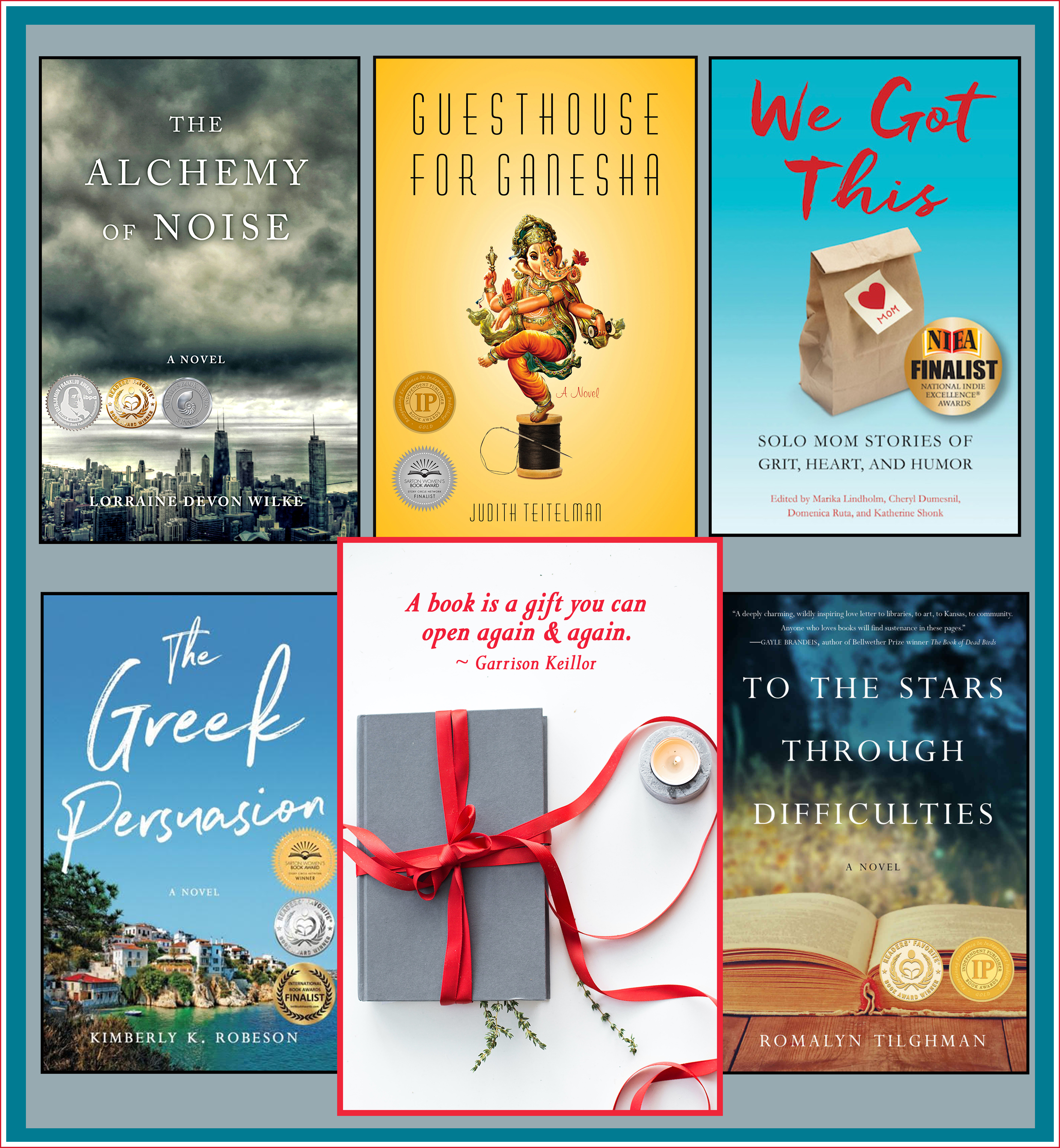
Beyond wanting to take this timely opportunity to wish you all a holiday that’s as jolly as social distancing, masks, backyard dinners, Zoom gatherings, and limited household pods will allow, I also want to introduce you to four authors, with whom I’m friends and colleagues via our shared publisher She Writes Press, whose award-winning books will make brilliant choices for your holiday gift giving.   

You might recall, way, way back before the scourge descended, that I wrote about how I’d be appearing with these authors at the famed Los Angeles Times Festival of Books, something we were all looking forward to. But, as COVID would have it, not only was the original April date scrapped, but the subsequent October date was as well, with future options currently undetermined.

We decided to take matters into our own hands. 

Given our respect for each other’s works, and wanting to stick with the group effort (even if, sadly, without the cool booth and fun cookie and bookmark giveaways!), we decided to do a December “Gift a Book” Event, mutually presenting all five books as gift-giving suggestions, inspired by a quote of Garrison Keillor’s:“A book is a gift you can open again and again.”

To that end, let me share info & links about each author and book for your easy access:

Romalyn Tilghman’s, To the Stars Through Difficulties, tells the story of a group of contemporary women who join forces to revive a library and arts center in a small town destroyed by a tornado, inspired by found journals recounting the original building of the Carnegie Library.
 
Kimberly Robeson, a Greek-American professor of world lit & creative writing at Los Angeles Valley College, and co-advisor of the college’s LGBTQ+ Club, brings her native mythology to her debut novel, The Greek Persuasion, a fascinating story of a woman’s international search for love & sexual identity.
 
Judith Teitelman, development consultant, educator & facilitator, describes her debut novel, Guesthouse for Ganesha, as “magical realism,” a tale of love, loss & spirit reclaimed with a tagline that asks: Left at the altar, spurned—what does that do to a young woman’s heart? And why would a Hindu God care? 

Dr. Marika Lindholm, a trained sociologist who founded ESME.com, a social movement of solo moms, is co-editor of We Got This, essays by 75 women sharing their resilience & setbacks, follies & triumphs, with the powerful message that no one—not even those mothering solo—is truly alone.

And, of course, my own book, my third novel, The Alchemy  of Noise, a sociopolitical love story that tackles issues of racial injustice, police profiling, and subsequent challenges faced by an interracial couple whose relationship asks the question, “Can love bridge the distance between two Americas?” 
We also got together with author/teacher, Bella Mahaya Carter, to talk a bit about each of our books; click below for that lively conversation! 

https://youtu.be/sDd_0I584Go

I hope you’ll explore each of these wonderful, eclectic titles, and pick up copies for your own and other’s reading pleasure… I guarantee you’ll enjoy them all!

And that’s it for this, our mutually endured “Annus Horribilis 2020,” (in a nod to Queen Elizabeth!). Merry Christmas, Happy Holidays; Smashing New Year, every and all loving, inclusive, diverse salutations with my hopes, affirmations, prayers, and wishes that 2021 brings a fresh start, positive change, renewed hope, and a return to full body hugs, visible faces, indoor dining, and joyful, unencumbered gatherings in our many squares around the world. Until then… all my best!  

Woman in Mask photo by Volodymyr Hryshchenko on Unsplash


Visit www.lorrainedevonwilke.com for details and links to LDW’s books, music, photography, and articles.

Confessions of a Reluctant Self-Promoter

It’s true. I have a confession to make: I hate self-promoting. I do. I really do.

In fact, I hate it more as I get older, and accrue more and more years of having done it for the sake of my books, plays, articles, photographs, screenplays, band gigs, etc., etc. As much as I understand the need, and can professionally frame it as “absolutely necessary to the success of (fill in the blank),” it never fails to make me feel like that needy little girl jumping up and down, waving arms to demand, “Pick ME!! Notice ME!!”

Maybe it’s being one of eleven kids. Despite my placement (third), and personality inclinations (funny and/or charming), I actually felt I had to jump up and down to be truly noticed. I mean, really noticed, in that one-on-one way children require.

Leave it to me, then, to pick a “look at me!” career and stick with it long enough to arrive at the point where artists can no longer be “just artists,” and the act of waving hands and jumping up and down is now requisite behavior!

That’s because we are now, in this not-so-new digital age, unequivocally tasked with promoting and marketing ourselves with the same verve and skill set of the “helper people” but without the protective shield of their professional connections, entree, business acumen, objective skills, and laser focus. Despite occasional successes and winning results, and since we’re in confession mode, let’s be honest: It’s exhausting, expensive, time-consuming, even sometimes painful. I miss my helper people.

Oh, I’ve had them throughout the life of my career, and, when I did, it was freeing, unburdening, and glorious. Then I got older, careers shifted, culture changed, the Internet democratized everything (good and less-good). Every medium of art and communication became saturated with every kind of art and artist, and those very helpful “helper people” got harder to find, engage, and sign on the dotted line. You either hired skilled publicists—wonderful when you could afford it; I could only briefly—or you become your own designated “helper-person.”

And I don’t wanna be—that’s my true confession. I too often feel like Irene Cara warbling, “Out Here On My Own,” and I don’t have the benefit of Fame! But I do the job to honor the work I’ve put tremendous effort and vigilance into making as good as it can possibly be. I’m proud of that work, and I really want you to find and enjoy it. Not because I need accolades or exclamations of “you’re such a good writer!”, but because these stories and their characters and themes mean a lot to me; they contain ideas, concepts, and existential musings I want you to read and ponder and share. The only way that happens is if you hear about it, find it, and obtain the work. The only way that happens is if I, despite my whining and recalcitrance, make you aware of it.

So I do. Reluctantly but earnestly do.

But finding the right balance is tough. Sometimes you get it wrong; you worry about people’s eyes rolling. Your small publisher can only offer so much, some in media don’t want to hear directly from the artist, and sometimes responses can be downright cantankerous. For example, this example:

Since all three of my novels are literary fiction that fall neatly into the “book club” genre, I started researching book clubs. I found several, sent out polite private messages and emails, and, when I found a viable one on Goodreads, went to their page, saw a drop-down menu with “suggest a book,” and wrote, again, a very polite introduction of my latest book with pertinent links, awards, and information. So far, so good.

My Three Books – 

I was then stunned when the book club leader tersely responded: “I removed your book suggestion from our site because we do not [emphasis hers] allow authors to self-promote their own books”… like I crashed their party & hogged the karaoke mic.

What struck me was the wrist-slapping tone of her note, with its presumption that I was a boorish amateur spamming their club, rather than a respected writer who truly thought her book might hit the sweet spot of their particular club’s book sense. Though I did not sent this particular response, I should have:

“Dear Book Club Leader: Please be aware that it’s hard out there for authors. Given the fluctuating status of our industry, many talented writers are on their own, trying to get good work into the marketplace as creatively & graciously as possible. Don’t assume they’re hacks. Don’t assume they’re spammers. Be open. Like any good gatekeeper, you don’t want to miss the gems because you’re too quick to slam the door. If an author suggests her book to your club, maybe check it out before you slap her wrist. It just might be your group’s perfect ‘next book.'”

Then, as I was figuratively trundling home to return my books to their shelves, I was introduced to NovelNetwork, an organization with the following mission statement: “NOVEL NETWORK is a global space dedicated to connecting authors with avid readers, an expanded professional network, and published peers. NOVEL NETWORK was created to help authors find more innovative ways to connect with readers and promote their books to wider audiences.

Yes! That. Perfect. Huzzah!

Imagine how delighted I was when, after submitting my materials, I was invited to join with all three of my novels en tow. I suddenly had “helper people”@ And look, all three of my novels are tucked into their recent holiday promotion below and I had not a thing to do with it… Merry freakin’ Christmas!

Before I wrap this divulgence, let me add this: While I might cringe at the demand to persistently blow my own horn, please know how much I appreciate those in my circle who never seem to tire of my promotions; who’ve taken the time to leave reviews because they know how important those are to writers; who continually help spread the word and encourage others to give my books a read. I cannot tell you how very much this reluctant self-promoter appreciates every bit of that… THANK YOU.

And Happy Holidays, whichever ones you celebrate and however you do. Just remember: if it’s an occasion that involves gift-giving, keep this equation in mind:

 Books+Love=Perfect Holiday Presents!

(Lookie there… I did it… shameless self promotion!)

NOTE: From NovelNetwork: “Good news for individuals who do not have a book club home – you can still join NovelNetwork – simply register as a book club member and list ‘NovelNetwork Book Chat Group’ as your book club affiliation. We’d love to welcome you! Visit NovelNetwork.com to activate your free membership!”

“Pick Me” – original photo by Brooke Cagle on Unsplash
“My Three Books” by LDW
NovelNetwork Christmas promotion provided by NovelNetwork
“Equation” by LDW


Visit www.lorrainedevonwilke.com for details and links to LDW’s books, music, photography, and articles.

Guest Post: The Alchemy of Noise deserves to be on your summer reading list!

As time goes on & the hoopla around a book’s launch dies down, it’s sometimes challenging to know where and what your book is doing out there in the world. So, when an unexpected review pops up, one that so artfully and accurately expresses exactly the message and narrative you were hoping to convey in your story, there is something deeply gratifying about that.

Thank you, Janny Ess, for your articulate, moving review. I am touched… thrilled that you enjoyed the book, and appreciative of your taking the time to write so beautifully about it.

Review is below:

* * * * * * * *

Oh, Happy Day… It’s Pub Day!

It was a day long in coming. Pub day.

I started this book over three years ago; walked down many and myriad roads in the quest for publication, often got confused and discouraged, but was always clear it was a book meant to find its place. That it found its place with She Writes Press  was a boon.

I am so pleased and proud of the end product, a book that fully represents my creative sensibilities in every way: narratively, artistically, production and promotion-wise. I’m honored by the people I work with, grateful for Brooke Warner, president of She Writes Press, and Crystal Patriarche (Booksparks); my project manager, Samantha Strom, and certainly the fabulous Tabitha Bailey, my senior publicist who has walked this walk with me on an almost daily basis and done so with such empathy and enthusiasm. Thank you, Tabitha… thanks to you all!

To those who’ve bought the book, will buy the book; will read the book, think about it, hopefully be moved and entertained by it… thank you. It was, after all, meant for you.

Today I’m going to take it all in; close my eyes, take a deep breath, let myself feel it, and revel in the celebration… it’s a very good day.

(See you in Seattle (4.10), San Diego (4/16), Los Angeles (4.18), San Francisco (4.25) or Chicago (5.3)!)


LDW w glasses

Lorraine’s third novel, The Alchemy of Noise, is available at Amazon and elsewhere.

Visit www.lorrainedevonwilke.com for details and links to LDW’s books, music, photography, and articles.