
How would ICE have treated my grandmother?
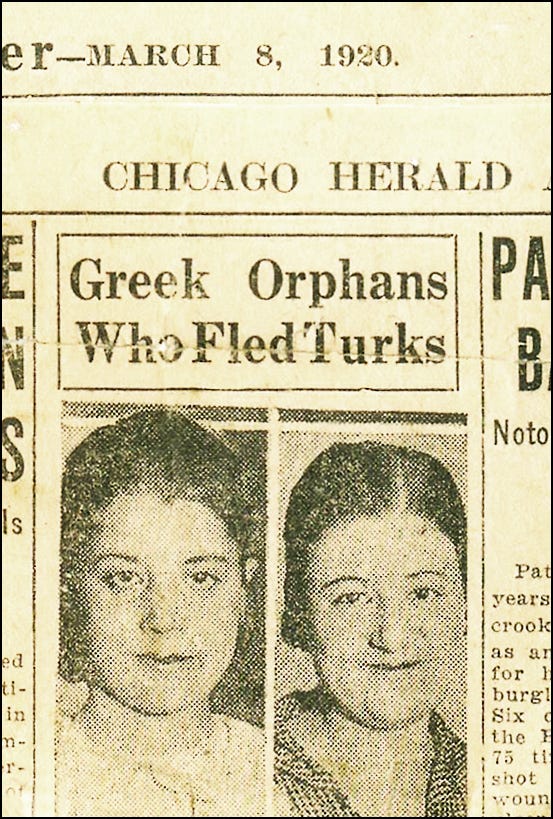
1919: Nineteen-year-old Deborah Derebey stood in a long line of immigrants waiting to be processed at Ellis Island, her younger half-sister, Sappho (known as Fofo), by her side. Nervous, hopeful, and exhausted from the long voyage from Turkey, they waited to be met by their aunt, Aphrodite Derebey, who’d sponsored their passage. Two Greek sisters, both orphans, making their way to a better life in the bountiful and welcoming arms of the United States of America…
I write this paragraph just minutes after watching yet another horrifying video of ICE agents lurking in the hallway of an immigration court, dog-piling on a young immigrant as he exited the courtroom. These masked thugs of the current White House occupant proceeded to violently arrest this man (with no criminal record) who was there, in that courtroom, to comply with the laws said Occupant claims everyone is violating.
Welcome to “Immigration, the MAGA Era.”
The reality that every single person in this country, bar the Native/First People, has descended from immigrants does not appear to diminish the raging sense of white entitlement so baked into the American Right. The compassionate intent of “Give me your tired, your poor, your huddled masses yearning to breathe free…” has little or no impact on minds hellbent on “making America great again” by regressing to some delusional version of “the golden days,” when whiteness reigned, immigrants were subservient, and everyone of color knew to keep “their place.”
Right now, as Trump dismisses the border of predominantly white Canada, the feverish “MASS DEPORTATION NOW!” crowd has laser-focused on the southern border. One might guess that jarring disconnect has something to do with the fact that between 2010 and 2022, the share of the population that is Hispanic/Latino grew the most, increasing 2.7 percentage points to 19.1%. The white (non-Hispanic) population had the largest decrease dropping 4.9 percentage points to 58.9%.
That statistic has gotta chill the cold, dark hearts of bigots and white supremacists.
As the granddaughter of immigrants from a country and culture often dismissed as politically and culturally problematic, I have often reflected on what my grandparents endured coming to this country. My sister, Mary Amandes, our family archivist, and I perused old pictures and discussed that journey, juxtaposing their experiences against the corrosive and toxic state of immigration as it’s currently being implemented. It struck us both that, if our family members had immigrated today, they could very well have been one of those tackled in a hallway, pulled from a job site, or dragged to the floor in handcuffs.
But Mary also made the salient point that, as toxic and repugnant as our current laws and policies are, history tells us this process, in a country literally built by and for immigrants, has long been fraught with discriminatory, contradictory, and biased policies and practices. The welcoming arms of America have been fickle, opening and closing based on changing leadership, as each administration imposed their own bigotries into laws that govern the activity. From Mary:
“The Homestead Act of 1862, offering 160 acres to men and women who met certain requirements, was critical to settling the west. Land was given to the railroads who then parceled it out to various groups of ‘select’ immigrants (no ‘shithole’ countries!) to settle 685 million acres of public land (all stolen from the native population). Total acreage of distributed land from the government was over 1 billion acres. Advertising was targeted to Northern European groups, especially Germans and Scandinavians, because existing farmers were having trouble finding farm laborers. Apparently the earlier waves of immigrants in the south were already too vested in their farms and too reliant on slave and tenant labor to move further west.
“Beyond the numbers, the concepts for this competitive advertising are the most interesting, especially contrasting with the present day attitudes. Immigrants were needed to form congressional districts, develop natural resources, raise land values, become consumers, merchants and tradespeople. These people had great value and were especially needed to share tax burdens.
“The most disheartening fact is that so many of these very prized, ‘select’ immigrants who came over and brought their ideas, talents, and work ethics, etc., ultimately turned into immigrant-hating, violent, racist thugs themselves, passing that toxic ideology down through family trees to our present-day divided America. Combine that with bigoted attitudes towards people of color and it’s amazing we function as well as we do.
“And yet people still want to come here.”
They do, don’t they? Though I have to wonder if now, in this toxic Trump era, that urge has been stunted.
Turning my thoughts to my grandmother, to whom my siblings and I were very close, I asked Mary to dig into her research to offer some perspective on what “Debbie Derebey” experienced in her own fraught journey as a teenager coming to this country in the early 20th century. Following is her report (mixed with some editing input of my own):
“The Derebey clan lived in an area of Turkey that had once been part of Greece. They were Protestants, which alienated them from the Orthodox Greeks, isolating them from the intense politics of the time. Both groups, however, were allowed to live peaceably and worship as desired until WWI. At the outbreak of that war, the Turks (the Ottoman Empire) chose to align themselves with the Germans. Imagine how this decision contributed to the festering of nationalism and tribalism driven by longstanding feuds!”
From the German-Ottoman Alliance: Some members of Ottoman leadership were eager to form an alliance at the start of WWI. They worried what might happen to their already weakened empire in the face of global war. The small, but powerful, war party saw Germany as a useful friend with money and a large military presence. They signed a secret alliance agreement with Germany on August 2, 1914.
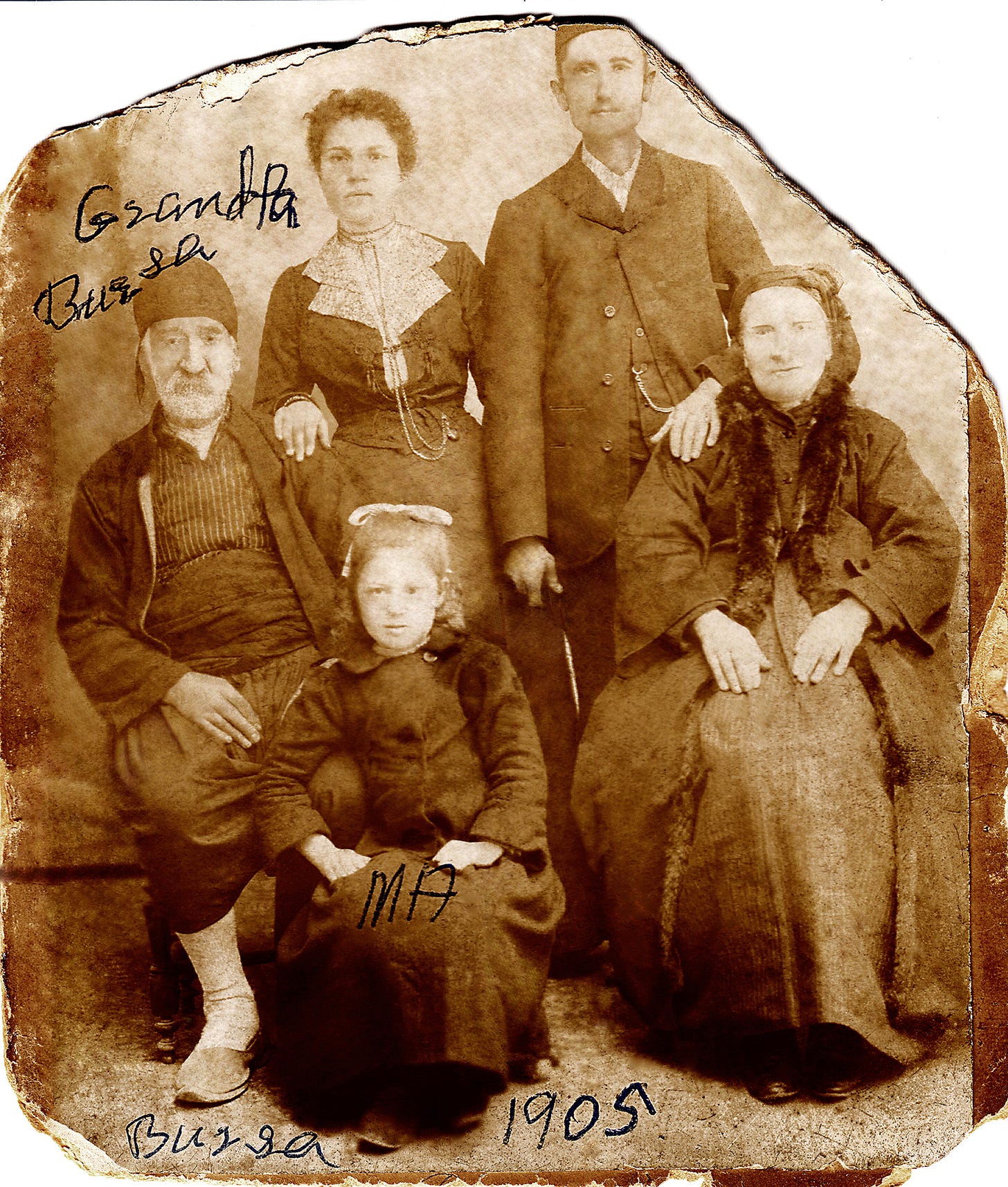
“Prior to that war, and when Debbie was still a young girl in the early 1900s, her Aunt Athena Derebey had escorted some of Debbie’s cousins out of Turkey to resettle them in Chicago. Another Aunt, Erasmia Derebey, was growing increasingly concerned about the roiling political climate, and wanted to get the whole family moved; three other Derebey siblings already in Chicago were perhaps keeping them apprised of the geopolitics at hand.
“Meanwhile, as Debbie grew older, she did housework to earn money, her family living with her maternal grandparents as the political atmosphere grew more fraught. Luckily, she was going to the American school and learning English, ultimately, if unknowingly, preparing herself for eventual migration. When the war finally broke out, the violence and chaos Greeks experienced was horrific. Just within the Derebey clan, twenty-seven members were killed in the political unrest.”
From the Hellenic Research Center: During and after World War I (approximately 1914-1922/23), historical sources show a significant number of Greeks in the Ottoman Empire, which later became Turkey, died due to systematic persecution and violence. This period is often called the Greek Genocide.
Estimates of the number of Ottoman Greeks who died during this period vary widely. Some estimates suggest that roughly 700,000 to 750,000 Greeks were killed. Others put the number closer to 1 million.
“This genocide, of course, heightened the family’s urgency to get the girls to safety. And just as the war was winding down, that urgency was heightened when the 1918 Pandemic, the ‘Spanish flu,’ hit. Having already lost her mother, Debbie was left completely orphaned when both her grandparents and her father became victims of the pandemic.
Her half-sister, Little Fofo, whose mother had also died years earlier, was by then working as a child laborer in a silkworm factory belonging to her father. When he, too, succumbed to the pandemic, leaving her an orphan as well, the Chicago family of siblings determined the time had come to rescue both girls.
“Interesting note: Somewhere in the family’s pre-emigration discussions, Debbie had developed an understanding that she would be getting a college education once she got to Chicago, clearly a ‘carrot’ of sorts. Being a young girl with a persistent nature and the desire to advance in her life, perhaps she was told that to keep her feeling positive about the journey.
“She did not go to school.”
Which makes me sad, frankly. My grandmother was very bright, an adventurous woman who traveled to all corners of the world on her own, even until the year of her death. She was inquisitive and fearless, and I can imagine, had she gotten that promised education, she would have been unstoppable.
But back to Mary and the immigration parallels between then and now:
“The 1917 Immigration Act (extended to 1924), particularly with its literacy rules detailed below, clearly applied to our grandmother—making her ability to read and speak English a boon. The Chicago family, working to get the girls over, was most likely aware of that and the many other provisions of THE IMMIGRATION ACT OF 1924 (THE JOHNSON-REED ACT):”
“In 1917, the U.S. Congress enacted the first widely restrictive immigration law. The uncertainty generated over national security during World War I made it possible for Congress to pass this legislation, and it included several important provisions that paved the way for the 1924 Act.
The 1917 Act implemented a literacy test that required immigrants over 16 years old to demonstrate basic reading comprehension in any language. It also increased the tax paid by new immigrants upon arrival and allowed immigration officials to exercise more discretion in making decisions over whom to exclude.
Finally, the Act excluded from entry anyone born in a geographically defined ‘Asiatic Barred Zone’ except for Japanese and Filipinos.
“The Asiatic Barred Zone? While this did not specifically apply to immigrants from Greece or Turkey, restrictions of the ethnic kind sound very familiar, don’t they?
“And how about some quotas as well?”
The literacy test alone was not enough to prevent most potential immigrants from entering, so members of Congress sought a new way to restrict immigration in the 1920s. Immigration expert and Republican Senator from Vermont, William P. Dillingham, introduced a measure to create immigration quotas, which he set at three percent of the total population of the foreign-born of each nationality in the United States as recorded in the 1910 census. This put the total number of visas available each year to new immigrants at 350,000. It did not, however, establish quotas of any kind for residents of the Western Hemisphere. President Wilson opposed the restrictive act, preferring a more liberal immigration policy, so he used the pocket veto to prevent its passage. In early 1921, the newly inaugurated President Warren Harding called Congress back to a special session to pass the law. In 1922, the act was renewed for another two years.
Once again, the opening and closing arms of America …
“There were many other elements of the law that restricted immigration, inclusive of national origin quotas, preserving racial and ethnic composition, nativist sentiment, and—and this says it all: ‘IN ALL OF ITS PARTS, THE MOST BASIC PURPOSE OF THE 1924 IMMIGRATION ACT WAS TO PRESERVE THE IDEAL OF U.S. HOMOGENEITY.’ How MAGA can you get?”
“So, Debbie comes to Chicago, a metropolis teeming with immigrants from everywhere on the planet, and a government looking to preserve U.S. ‘homogeneity.’ The dictionary defines homogeneity as ‘the quality or state of being all the same or all of the same kind.’ I would imagine there were all kinds of MAGA-style goons and pre-Nazis out there ready to enact this.
“I would actually like to know how the newspaper article about Debbie and Fofo being refugees came about [image at top]. I would have been concerned that this public exposure would have made them targets.
“Meanwhile, Debbie was given work housecleaning and being a governess. She was not happy about any of that and didn’t hide her feelings, which likely prompted the Derebey family to find her a husband to solve those myriad problems. That would have been our grandfather, Gus, a much older man. To me, both Gus and Debbie look resigned in their wedding photo.”
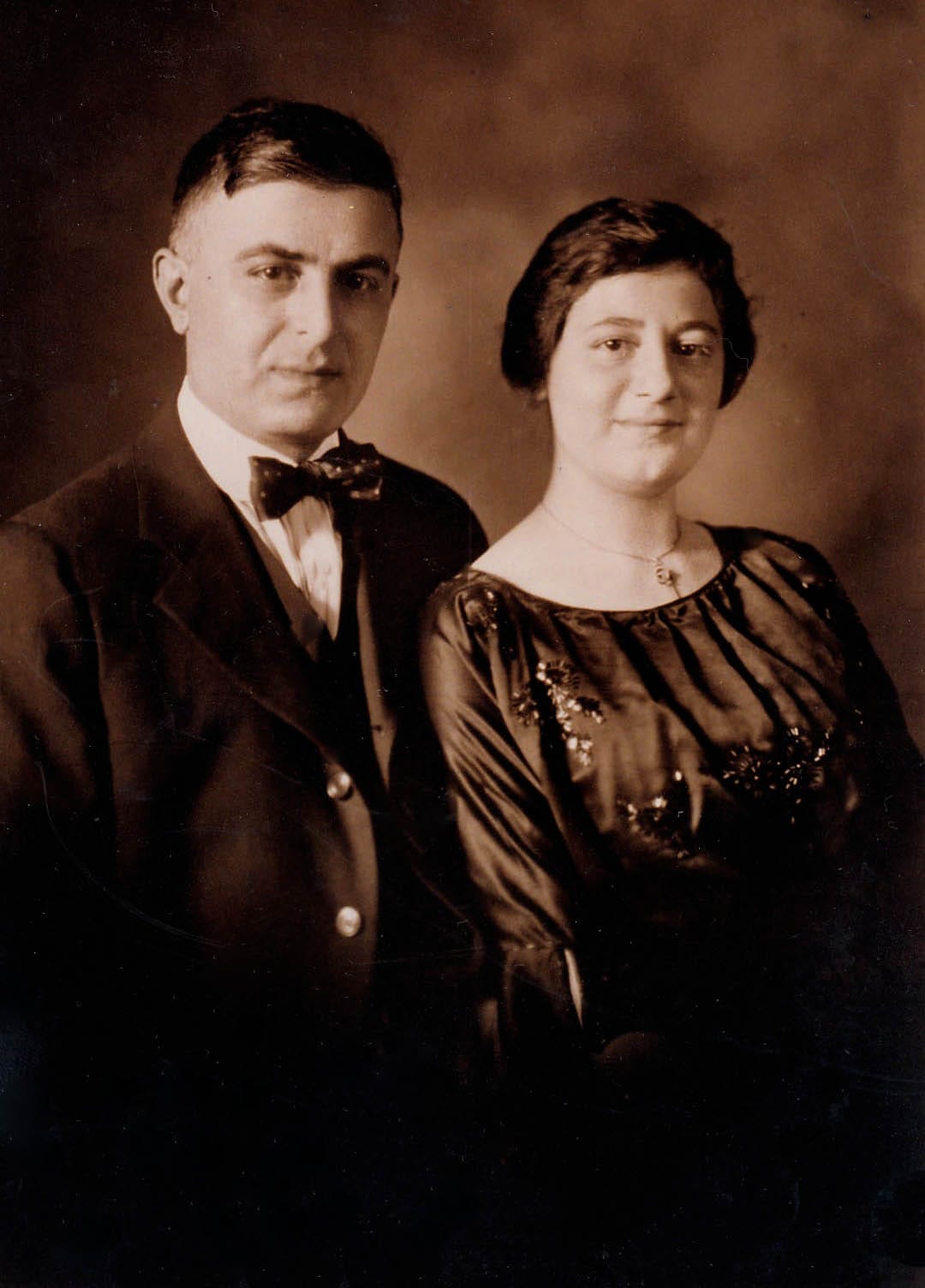
“Perhaps he’d already gotten the news that she didn’t have a large dowry after all. Perhaps the threat of deportation had been presented to her in no uncertain terms. Gus had become a citizen in 1915; she needed to be his wife in order to be naturalized and become a citizen herself. It was a marriage of need, of demand, and though they weren’t particularly suited to each other or happy together, they lived a good life, had two boys, our Uncle Henry and the man who became our father, Philip Amandes (or, as his Greek name would read: Theophilos Amanitides), and flourished in America.
“Fofo didn’t marry until 1940, but she was protected because she’d been claimed as the daughter of Aphrodite (the aunt who met them at Ellis Island) and her husband Peter in the 1930 census. She, like her older half-sister, was a strong, determined young woman. She became a citizen on her own prior to marriage. In between, she went to school, qualified for her beautician’s license, and launched her own business, tremendous accomplishments for any woman of the day, certainly a young Greek immigrant.
“Our grandparents, Debbie and Gus, set up a rental business with an apartment building and cottage, and she was named on the deed … another astonishing accomplishment for the time! She participated fully in the management of that enterprise, and took it on as a sole proprietor after Gus’ death, living there until her own death in 1979.” [Interestingly, that building was the first home of my two older sisters, a younger brother, and me.] She traveled the world, was beloved by family and friends globally, and tirelessly gave to those in need.
“The immigration laws that impacted all of them have been revised multiple times since 1924, with arcane details and restrictions that can be both daunting and, at times, prohibitive, yet people still want to come here! As for our Auntie Fofo and Grandma Debbie, I count them as two very successful immigrant stories to remember!”
I do too.
But I have to wonder: given my grandmother’s “illegal” status for a healthy chunk of time before her mandated marriage, if she, too, would have been rounded up by ICE, thrown to the floor, handcuffed, and spirited away to some hideous holding cell if her story happened in 2025. My grandfather came to America in 1907 but was unable to attain his citizenship until 1915 … after he served in the American army. Would ICE have assaulted him had they found him before those papers were in hand, despite his four years of loyal service in the military? I’d guess, in this MAGA era, they would have.

As I watch countless mothers, fathers, children, grandmothers, and grandfathers of other immigrant families experience exactly that fate, some quite brutally, my heart not only breaks, but my view of humanity falters. Cruelty seems to be the point, and the feint that it’s about “who’s here legally and who isn’t; who’s a criminal, who isn’t” appears to be just that: an attempt to distract from rampant racism and xenophobia.
Immigration throughout the ages has never been a neat, tidy progression of steps and sequences that meet every time marker and adhere to every deadline. For many (most?), it can be cumbersome, inefficient, and slow, leaving many in states of limbo, vulnerable to the Gestapo tactics of our current system. Each day, each egregious act, makes clearer that those of us who view people as people, regardless of country of origin, ethnicity, color, race, religion, orientation or immigration status, must continue to march, speak out, defend, protect, videotape, and VOTE … in defense of immigrants, and for good, sane, compassionate immigration policies.
Every single person being throw to the floor of some hallway, school yard, farm field, or immigration office by masked thugs is someone just like my grandmother. My aunt. My grandfather. A person, a human being, a beloved family member. Someone escaping danger, fleeing to protect family, or hoping, intending, determined to build a better life in this occasionally welcoming country.
We must keep it that way … for every Debbie, Fofo, and Gus.
Thank you, Mary Amandes, for your invaluable contribution to this story.





 | Rock+Paper+Music |
You must be logged in to post a comment.