Horn-Blowing and Other Necessary Evils of The DIY World

horn blowing

“But enough about me, let’s talk about you… what do YOU think of me?”
— 
Beaches, 1988

I was originally going to title this post: “I Don’t Want To Talk About My Books Anymore!” but figured it might come off as a little whiny. And really, it’s not that I don’t like talking about my books—I LOVE talking about my books—it’s that I get twitchy when I’m the only one doing the talking, flashes of those obnoxious parents endlessly jabbering about their “really cute kids” while everyone smiles tightly and averts their eyes (cannot be one of those!). I’d prefer to talk about my books because other people asked about them; someone else wanted to discuss plot and character, or how to order a dozen or two copies. I’d rather respond to a whole other person tooting that horn than pull out the trumpet myself.

It’s hard out there for a book-pimp.

See, all this self-promotion started when the entire world went DIY some years back, with everyone doing anything and everything for themselves. The trend was seen largely as a positive thing: a democratizing, equalizing, barrier-breaking thing for all those independent people out there with a dream. Writers could put up their own articles, artists and photographers could set up their own blogs to sell their art; businesses and private practitioners could hang shingles in the form of interactive websites, and authors, they self-published. It’s gotten so democratically DIY, I half expect women to start delivering their own babies with headphones and an online tutorial!

And it has been a boon in many ways. The DIY market has allowed countless creators of every industry and medium to move forward without the limitations of picky gatekeepers, elitist corporations, prohibitive budgets, and miserly invitation lists. But where it’s proven challenging is in the wrangling (i.e., affording) of ancillary team-members who typically help creators move, sell, and promote their products. The horn-tooters, trumpet blowers, PR flacks, publicity people. And while there is not one “self-anything” who doesn’t need those people doing those jobs, a big fat contingent can’t afford them.

A full-time publicist for any business typically costs thousands of dollars a month, sometimes many thousands. A big-ticket item. But smaller marketing and promotional campaigns can also run into many hundreds of dollars and must be cyclically and consistently rerun to be effective. Even artists lucky enough to be affiliated with “umbrella” companies that provide some marketing and promotional support will find they’re obligated to implement those efforts on their own time and their own dollar. In other words, no matter where you fall on the “self” spectrum, you’re pulling that horn out of the closet.

And doing my own trumpet-blowing has always made me a little queasy.

Maybe it’s because I grew up in a family of eleven children where one had to leap up and down and wave their arms to get any kind of non-generic, “oh, I see you” attention, but I find the “leaping” necessary to self-promotion (particularly in the glutted indie book market) to be oddly demeaning. Instead of your work drawing people to you while you stand there being quietly brilliant, you’re obligated to chase after them like a panting schoolgirl trying to snag the interest of the most popular guy (switch genders as applicable). Beyond that, it sometimes feels too self-focused, too attention-grabbing, too… I dunno… creatively narcissistic. I’d prefer that the work itself, or someone with excellent trumpet skills, speak for me.

But there’s no choice. As indie artists, we not only have to do the job, we have to be indefatigable about finding new and clever ways to get it done. There are thousands of businesses and websites out there tooting their horns in hopes we’ll hire them to help toot ours (sort of a DIY Circle of Life), but the costs can run anywhere from cheap (various “tweet your book” sites, featured pages, book-of-the days sorts of things) to downright expensive (Book Bub, Foreward and Kirkus reviews, online ads), and some, but very few, are free. Often you pay loads of money to set up sales in which you give your books away for free or very cheaply (always an odd oxymoron), and given the “effective marketing = persistent marketing” equation, even the most economical campaigns will add up.

So where do indie creators with limited budgets go? To social media, of course! It’s not only what’s left to them once they’ve tapped-out their budgets, it’s the information highway everyone uses, regardless of product. Which means social media is regularly BOMBARDED with streaming posts from all sorts of people touting the “latest with my fill in the blank (book, band, record, art, store, tour, company, etc.),” and, in some cases, that’s all they ever post. About their book. Their record. Their tour. Their whatever.

We get no other insight from them, no other angle on their personality or point of view; they don’t connect to or comment on other people’s posts, and far too often, their only contribution to the greater conversation is about that _________ they’ve created. Which makes their social interaction akin to turning a coffee shop into a billboard.

So my remedy, since we’ve got to do this horn-blowing thing whether we want to or not, is this: Get involved with other people, share about more than your own creation; “like” posts other people put up, jump in on a thread or two. Be human. Be interested. Be involved. So when you do talk about your whatever, we’re interested because we’re interested in you… and you’ve shown some interest in us. It’s an all-around happy social media thing, as it should be.

And until a scenario involving an enthusiastic horn blower comes my way, know I’ll be doing it for myself on social media too. Graciously, I hope. Forgive me if I ever seem redundant or one-note; if I ask too many times for you to reiterate your wonderful email response in a review at Amazon, or push too hard to get you out to a reading. I’m obligated to honor my work by wearing this hat, blowing this horn, but know I’m trying to be nuanced and selective about the notes. This thing is tricky, but I’ve heard practice makes perfect!

LDW w glasses


Visit www.lorrainedevonwilke.com for details and links to LDW’s books, music, photography, and articles.

Damn. I Was Supposed To Get Famous Before My Face Fell

LDW @ 20

I’m joking. My face was never supposed to fall. 🙂

I’m writing this today because, after a recent commenter accused me of being “too old” to grasp the finer points of whatever it was they were schooling me on, I got to thinking about the currency of age and aging as an insult. It is one strange sword.

Aging is a weird thing, though, no getting around that. Yes, it’s universal, it’s inevitable, and even your three-year-old is doing it, but the term seems only to apply to persons of a certain demographic…and is rarely offered as a compliment. A baby is “getting so big!” A toddler becomes “such a big girl!” A kid is “all grown up!”; a teen, well, let’s face it: a teen couldn’t be happier than when hearing, “you look so much older than your age!” Twenty-, thirty- and even forty-somethings are “coming into their own.”

The rest of us? We’re aging.

The Aging Demographic (or “AD”) is loosely comprised of those past their “prime” years, the years when most people look the best they’re ever likely to look, when sex drives every conversation (consciously or unconsciously), when everything seems possible, and when people admire you without the addendum of “for your age.” I knew I was in the demographic when a record producer commented (as he was rejecting me in lieu of a much younger singer), “you’re just not current anymore…though I bet you were hot in the 80s.” Really. He said that. To my face. My old, sagging, AD face.

Fuck ‘im… I was hot in the 80s!

But despite the raggedy edge of age’s cutting tool, I think I’ve surrendered to the process rather graciously, with humor, acceptance, and a certain appreciation for its cloak of invisibility (there is freedom in knowing hardly anyone’s looking at you anymore!). Then again, what are the options?

Being ungracious, for one thing. Fearing it, denying it, defying it in ways that reek of desperation: silly clothes from Forever 21, surgery from the “best of Beverly Hills,” inordinate obsession with all things trendy. Many of our demographic have undergone the microscope and knife, leaving us with peers whose gently aging faces now have jawlines so sharp they could cut paper, cheeks that give Alvin a run for his money, or, God save us all, those duck lips that turn even the finest face into something oddly inhuman. It seems we’ll soon have whole generations of aging men and women who resemble Katherine Helmond in Brazil and I don’t mean the country. This, apparently, is our culture’s misguided answer to the conundrum of aging.

But I get it, too. It’s tough to stay relevant in our overcrowded and viciously, vacuously viral world. It’s work, it’s effort, and it can be soul-crushing. As the old saying goes: “If you wanna dance, you gotta pay the piper,” and those who dance in the world of business, media, music, movies, TV, or even literature (if you can’t look hot you better write hot!) have been forewarned: payment is the currency of youth and beauty… even for those who are still young, particularly women. As controversial hip-hop artist, Iggy Azalea, all of twenty-five, explains:

“It’s hard to be a woman in 2015 with social media. There’s so much more emphasis on taking pictures of ourselves and the ‘likes’ or people commenting on them. There’s a lot more pressure to look beautiful. Some days I just want to look like s**t and feel okay with that.”

I hear ya, Iggy! When the front pages of even the most esteemed news sources lede with stories about who lost their baby weight the quickest, whose butt is breaking the Internet, or “can you believe these stars are in their 50s??” (when we all know they have seen Dr. Beverly Hills!), it’s clear we’ve lost our way on this topic.

But even everyday people are more pressured than ever to stay uber-competitive in jobs where management’s bleats about “fresh and cutting edge” are most often code for “watch your step…your old ass can be replaced any time.” I have friends in their fifties, sixties, and seventies who are smart, vibrant, and rife with expertise and know-how, but worry daily about when the “aging axe” will fall.

Ice floe, anyone?

But, on the flip side, there’s an interesting thing that happens once you get past the indignity of no longer being seen as “hot,” whether sexually, creatively, or commercially, perks to aging that no one tells you much about. There’s little emphasis on the fact that (forgive the cliché), much as it does with fine wine, artisanal cheese, or expert haircuts, time can season and perfect a thing, evolve it into its finest incarnation, its best version of itself. Things like a mind, a heart, a worldview, a sense of self… a person.

They don’t tell you how much calmer and less frantic you’ll feel, or mention the well-spring of patience you might discover within yourself. They forget to make clear just how philosophical and accepting you may become; how circumspect and objective about the minutia of life that tends to drive younger people crazy (that drove you crazy). Infrequently mentioned is how you’ll feel less apologetic, less beholden; more independent, and certainly more irreverent. You’ll care less about what other people think and more about what feels right to you, what resonates in your gut… even if your gut is bigger than it used to be!

You might even find yourself feeling sorry for those with the burden of youth: the pressures to be trendy and hip, the intensity of expectation for success and wealth; the confusions around how to be caring and compassionate in a culture built on snark, smartphones, and mindless “feuds” amongst privileged pop stars. I watch younger women work so damn hard to meet every beauty standard demanded of them — from managing body hair and high heels, to posting the appropriate number of selfies — and it all looks so exhausting. Clearly I’d have never made it as young person today…too damn culturally lazy!

As for young men, I observe many struggling to find the exact right balance between affecting cool and competence, romantic and non-committal, devil-may-care and well-employed, and I know how delicate that youthful branding exercise can be. It all matters when you’re young, self-obsessed, and certain all eyes are upon you. Which they often are.

Then you’re aging and nobody’s eyes are upon you. How freeing!!

Well, sorta. I mean, it is freeing in all the aforementioned ways, but occasionally I walk into a room where I would’ve caught glances in the past and notice how few look up these days. That’s OK, I say to myself, you’ve got other things to offer. Then I see the woman in the mirror and wonder, when did that happen to my neck and where did my jawline go? Or wince at candid shots that don’t involve the elegant lighting required for an aging face. I find I’m uninterested in posting TBT pictures, because, at this point, I prefer to focus less on what I was, and more on my ongoing journey of embracing and accepting what I am. That’s the journey we are all obligated to: the present… with its not-so-distant cousin, the future.

Sure, it would have been swell if my lifetime of creative effort had led to my fullest vision of success while I still held the flush of youthful exuberance; it would’ve been fun to take that ride while still eager and inexperienced. But should any of those big-picture goals be met in years to come, I hope to be gracious and graceful about openly sharing my AD self — lines, wrinkles, sags, and all — without apology, without self-consciousness, and with the newly-acquired exuberance of age and its many gifts.

Because damn if we ADers didn’t work hard to get where we are, a place replete with wisdom, experience, and, yes, our aging, fabulous selves. It’s a good mix, I’ve discovered, one that every lucky person, even Iggy Azalea and that bouncing three-year-old, will, hopefully, one day discover.

LDW w glasses


Visit www.lorrainedevonwilke.com for details and links to LDW’s books, music, photography, and articles.
UK Author & Blogger E.L. Lindley Reviews AFTER THE SUCKER PUNCH

ATSP_new billboard by Brenda Perlin

There is great honor, as an author, in seeing your work strike exactly the right chords, inspire exactly the desired response; even provoke exactly the intended conversations. We each understand that the experience of art and literature is a subjective exercise, but still… when it’s reflected back just as you imagined it in your head… well, that’s golden, isn’t it? 

UK author and blogger, E.L. Lindley, provided one of those shiny, golden moments for me today. She just posted her review of After The Sucker Punch, and I was as touched by her beautiful and articulate analysis of the book as I was her consideration in posting it beyond her blog and all over the social media world. THAT is truly above and beyond, and in a world where indie authors sometimes hear the resounding echo of their solo journey, that kind of support is truly and deeply felt. Thank you, E.L., I’m delighted you enjoyed the book! 

E.L. Lindley
E.L. Lindley

After The Sucker Punch is an aptly named novel because it packs a mighty punch and raises so many questions, I was left literally reeling by the end of it. Lorraine Devon Wilke commands our attention with a splendidly dramatic opening and never lets us off the hook until the very last page.

The novel is essentially the story of Tessa Curzio, who whilst attending her father’s funeral discovers that he kept diaries for fifty years and has used them to record less than complimentary observations about his family and friends. The trauma of the death of a parent combined with the diary findings serve to cast Tessa into a spiral of self-doubt and destruction. The diaries are described as a Pandora’s Box and indeed, once they’ve been opened, the lives of Tessa and her family will never be the same again. In addition to this, the effects of the Pandora’s Box seem to extend to the reader, leaving behind some very thorny philosophical questions.

LDW shrewdly uses the third person narrative to tell her story, which invites the reader to see the bigger picture. We don’t necessarily always agree with Tessa’s version of events, especially where her siblings are concerned. Tessa has a difficult relationship with her older sister Michaela but LDW offers us a glimpse of a woman trying to juggle her life as a wife, mother and teacher, whilst stepping up to her new role as the family designated carer for her newly widowed mother. Whilst Tessa may have little sympathy for Michaela, LDW ensures that the reader does.

Tessa’s relationship with her siblings is for me the heart and soul of the novel and anybody who has siblings will recognise the petty tensions and jealousies but deep visceral love that defines the bonds they share. Tessa to a large extent has removed herself from her family in order to survive and consequently much of the to-ing and fro-ing between them is via a hilarious series of telephone conversations.

LDW offers us the Curzio family and with it the question of whether parents are responsible for their adult children’s misery. Tessa grew up with an unstable mother who is prone to extreme mood swings and a distant, aloof father, who struggled with intimacy. Despite their chaotic childhood, Tessa and all five of her siblings have grown into accomplished, successful people. Ronnie, her younger brother has lost his way but still has the potential for a good life. However, they are mired in their childhood, looking for reasons as to why their parents are like they are. Tessa’s mother bemoans the fact that she feels like a “dartboard” as her children look to blame her for their difficult childhoods.

Tessa’s family dynamics reflect a period of time that will resonate with lots of us who grew up in the 60s the 70s. Children’s needs were not particularly taken into account and as Tessa points out there was “no concept of child abuse.” Her mother freely hits her children in anger and perhaps worse, they are subjected to the fear and anxiety of her constant mood swings. In some ways the fact that her mother has the capacity for great kindness, as when she reassures Tessa she isn’t sinful, makes her relationship with her children even more complex. In her role as a writer, Tessa covers a feature about fathers and daughters and finds herself comparing her own experiences with other more tangible forms of abuse. She comes to the conclusion that pain is subjective and so can’t be comparative – “it’s as deep as you feel it.”

There’s no denying that her father’s written words have a devastating effect on Tessa and cause her much soul searching. As she rails against his words, there is clearly the kernel of fear within her that they might be true. As she is forced to confront her fears, her life implodes around her. The only constant is her friendship with Kate and Ruby even though LDW allows just enough realism to creep into their relationships. Tessa can’t help but feel reassured by Ruby’s marital problems whilst suffused with jealousy at Kate’s seemingly perfect life.

At the crux of the novel is the idea of whether we should be judged by what we write. Leo Curzio’s diary habit is made more toxic by the fact that he wanted his family to read them. The diaries serve as a metaphorical hand grenade tossed into the bosom of his family with the potential to rip lives apart. Tessa’s aunt, who acts as the conscience of the novel, asserts that maybe we should be judged on our actions rather than by what we may write. To all intents and purposes Leo Curzio was a good man, who did his best to give his children the best start in life but, for some bizarre reason felt the need to vent his bitterness and resentment on paper. Which is the more valid Leo is the puzzle that Tessa is left to figure out.

In the end there are no startling revelations or absolute answers, just a sense of peace and the idea of trying to accept people as they are, warts and all. LDW has captured the spirit of family perfectly in that there is no perfect family. Her novel is funny, warm, tense, angry and ultimately shows us that life is to be lived and there’s no point in dwelling on the past.

To visit and stay updated with E.L.’s blog, click HERE. To visit her author page on Amazon, click HERE. 

ATSP photo art by Brenda Perlin.

LDW w glasses


Visit www.lorrainedevonwilke.com for details and links to LDW’s books, music, photography, and articles.

Beyond Genre and Gender Is Good Writing. By Good Authors. Meet Mark Barry

Mark Barry
Mark Barry

Writing is a an enigmatic art form, an alchemy of skill and talent that renders simple words into compelling prose, plot lines that take your breath away; jump-off-the-page dialogue, and characters we’d follow around any corner or shy from in the dark. Books are, quite simply, magic, and despite our cultural predilection to analyze the bejeezus out of anything and everything related to them — self vs. traditional, print vs. ebook; free vs. sensible prices; men vs. women; Amazon vs. everybody — when it really comes down to what we all want, it’s simple: GOOD BOOKS. And good books are, unarguably, written by GOOD WRITERS.

Of course, what makes a book “good” is clearly subjective (just set E.L. James fans on readers of Donna Tartt), but from this reader’s perspective, I don’t give a hoot about the race, creed, color, gender, genre, price point, publishing platform, or social media status of an author; all I want is the alchemy, the magic… the good book. Which is why I want to introduce you to a favorite new author of mine, a fellow who’s writing exactly those books: Mark Barry.

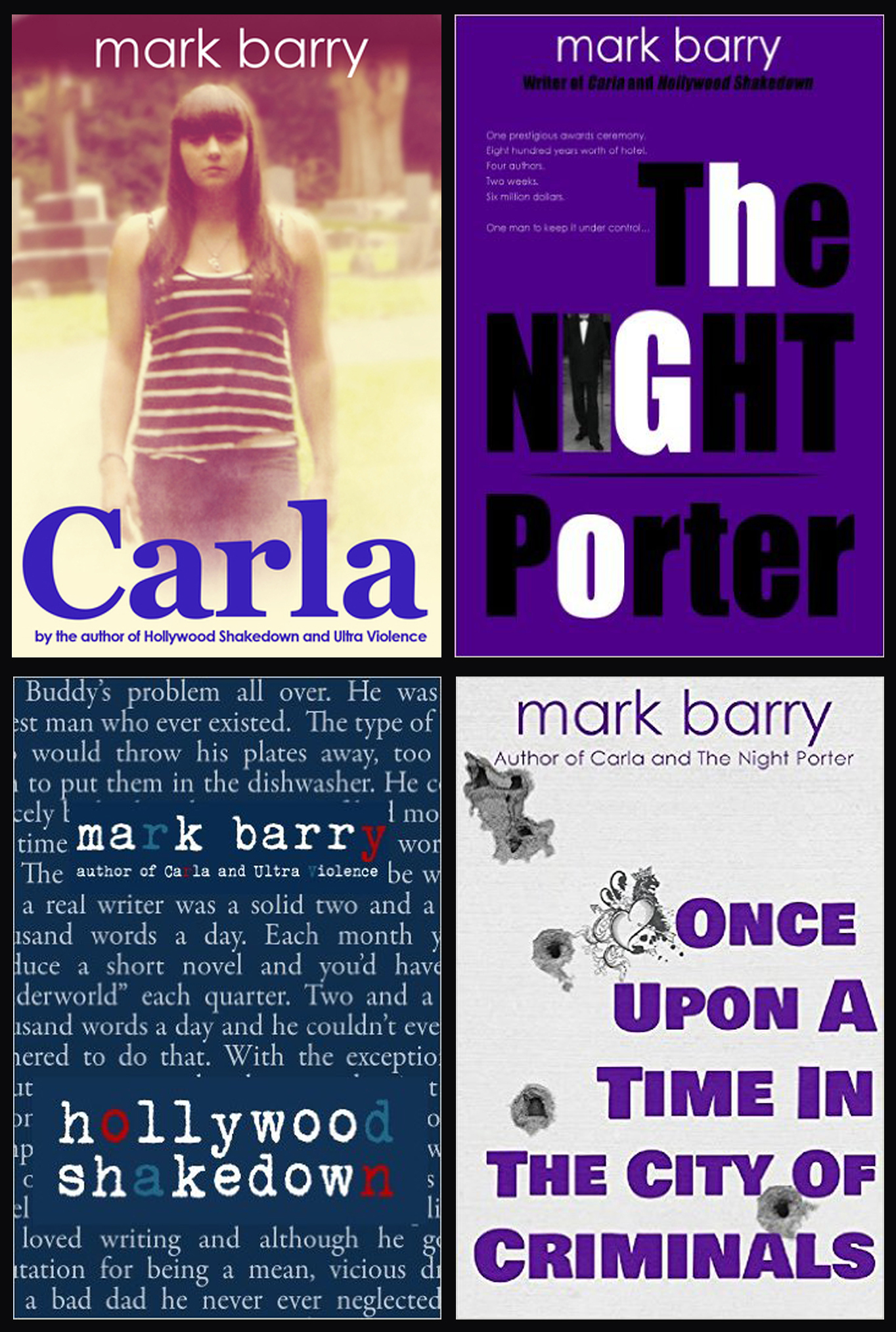
Certainly he’s not new, but I’ve just come upon his work in the last year. Writing fiction that stands out with its wit and originality, Barry, who’s based in Nottingham and Southwell in the UK, has built an impressive library of novels and short stories published through his company, Green Wizard Publishing, stories steeped in his cultural vernacular and sensibilities, biting and wickedly funny. Introduced by a fellow author who felt my own literary sensibilities aligned, I picked up my first of his books, Carla, to be pulled into an alternately tender and shocking story of love between a mentally-ill man and an innocent barmaid, swinging wildly from out-loud laughter to the gut-punch of pain, violence, and heartbreak. Rare to find such humor in so dark a tale… I was hooked.

Next came The Night Porter. A mad piece of fiction that employs Barry’s signature wit and irreverence, his attention to detail is so fine-tuned you’ll feel as though you know that part of England by the time you’re done. The narrative (begging to be made into a Wes Anderson film) covers the angst and antics of a rowdy group of writers gathered for an Academy Award-type event for indie books. With footnotes so rich as to be essential, Barry’s titular night porter finds his regimented life shaken to the core by the eclectic and confounding band of characters who demand his time, allegiance, and attention.

The most recent of Barry’s books I’ve read is Once Upon a Time in the City of Criminals, a bracing urban story that shares some of the aching tenderness of Carla, but goes deeper into the dark, following the trajectory of a tough, smalltime hoodlum who is hired to protect a young escort. With its sharp, brittle edges, its unvarnished glimpse into a violent subculture, it may be a rough read for some, but it’s replete with Barry’s crackling wit and signature mix of humor and pathos, and is, at its heart, a love story.

So now, with three books under my belt, and some correspondence articulating my kudos for his work, it seemed time for some one-on-one with the man himself, an invitation he so graciously accepted:

2015-07-20-1437412822-5795778-MarkBarrysbooks.jpg

So, Mark, what’s the most original, unique, hardcore thing about you as a writer?

Forty years ago, in the era I most venerate, I would have been quite common as a writer, with my admiration for crime books, pulp, gangster fiction, and such. But now, in the indie, PHP (Post Harry Potter) era, I am definitely unique and one-off, certainly in indie, which can be extremely conservative, concentrating on the commercial and the traditional.

I try new things. Three of my books do not use dialogue tags or speech marks. Ultra Violence, my football novel, is written in second person omniscient. The Night Porter makes use of footnotes. In Carla, the protagonist is a probationer from a mental asylum. No one else is doing this, to my knowledge, and sometimes it pisses people off. I’ve lost readers and, as a tactic, it doesn’t make for massive sales…but it does make for an interesting read!

Nothing disappoints me more than a book that’s identical to the last book I read and the one before that, which is an all-too-common experience for readers. Yes, there are people who like the familiar, but for me that’s beginning to wear thin. No two books of mine are the same.

What compelled you to write Carla, specifically? A real person? A real experience?

After walking into a pub one night, spotting this simply stunning young girl, and realising immediately that I was utterly (and quite rightly) invisible to her, it struck me that I had become old; that part of my life was all over. I remember feeling incredibly saddened by that, and the idea to write a novel about it followed shortly behind: I wanted to write about a mixed-age love affair. I thought about potential plots, came up with one, rejected another. For me, it wasn’t enough to have an everyday chap (like my very good self) as the older male – it simply wasn’t interesting enough and it had been done before.

I did have the experience of having been a psychologist back in the day, and, twenty years ago, I taught criminal psychology. That whole subject fascinates me, and so I had the idea of making the older male a mental patient – potentially (but not necessarily) dangerous – which, bearing in mind that Carla is written from his point of view, is interesting. Then it struck me: what if the girl (Carla) was, in fact, attracted to him and he wasn’t invisible at all?

It all came together from there, a story inspired by a very beautiful, but completely unattainable barmaid (and I never did find out her name, btw!).

The footnotes in The Night Porter, as mentioned above, are almost a character onto themselves. What inspired the decision to use that device, particularly in a novel?

One of my favourite authors is your countryman, David Foster Wallace, who unfortunately – and tragically – passed away late last decade. He was a prodigious user of footnotes which, for a fiction writer, is certainly an innovation. It’s usually in the domain of academia and non-fiction; you don’t often see them in fiction. DFW used footnotes for digressions, explanations, histories, lists, stories-within-stories, and internal monologues, thus keeping the body of the narrative clean, sharp and linear.

I was desperate to try this technique out and so, when the idea for The Night Porter came to me, it seemed the ideal opportunity. I also use footnotes in a wry way. Many indie authors will find their novels listed in one of the footnotes, particularly those who appeared on my interview blog, The Wizard’s Cauldron, and there are three pages of footnotes listing imaginary books from imaginary authors. I loved writing those.

TNP is a satire of publishing and indie at heart, and these footnotes are an ironic joke. Not entirely popular – and they are not available on the e-version (but the paperback is such a beautiful book, why bother with the e-version!). I would do it again and I have not ruled out a return to footnotes in subsequent books.

Violence and crime play a starring role in your work, certainly in your most recent novel, Once Upon a Time in the City of Criminals, yet you somehow always find the heart and humor within the darkness. Talk a bit about that signature mix.

In Criminals, I was keen to crack jokes and sprinkle the book with black humour. My friend, Georgia Rose, herself a mean writer, says that with Criminals, one minute she found herself laughing, the next, crying.

That’s pretty much what I aim for! I started out as a comedy writer (particularly with sketches about relationships) and my first audiences were predominantly female. And yes, while I enjoy a good punch-up in my fiction, I enjoy cracking jokes and, in particular, exploring the complex interactions between men and women, a lot lot more.

Frankly, I’ve been stunned by the ferocity of the violence in certain books — needed a shower after some, to be honest. I believe you have to throw something light into the mix to make it palatable.

If you could change one thing about the independent publishing world, what would it be?

One thing? Ummm. Nope – can’t do it! So let’s get radical: I’d limit the amount of books people can publish on Amazon in one calendar year. I’d completely ban novellas of less than 30,000 words, introduce some form of selection, and I would start a crowdfund to pay for five freelance sales reps to approach bookshops to persuade them to carry Independent paperbacks.

Bookshops: That’s the old/new frontier. The day I get my books in bookshops will be the day I’ve succeeded — it is simply too difficult now for me to continue using the Blog 101-recommended methods of Twitter, Facebook, and Book Bloggers, etc. The market is drenched with books, the review system is extremely dodgy, and everyone, talented or not, is fulfilling their I-Can-Write-Better-Than-That ideations. And fair play to them, but, in a lot of cases, they discover they cannot, yet still publish anyway.

In any case, evidence suggests readers are returning to the shops and that’s where writers need to be.

Lastly, you’re involved in a great literary organization, Brilliant Books; tell us a bit about that.

BB is something my friend, Phil Pidluznyj, and I started a year and a half ago. Funded by the British Big Lottery Fund, we take role models into schools – success stories from industry and commerce, sports and the arts – and get them to address and enthuse reluctant readers (of which there are many). Then, over eight weeks, we encourage the kids to write short stories and we publish the outcomes in an anthology that they keep forever. It’s been a roaring success so far – we even had the British Shadow Chancellor acting as a host. If you’d like to read a bit more about it, I’ve written a post about the group at Ali Levett’s A Woman’s Wisdom book blog.

So, there you have it: a snapshot of the prolific Mr. Barry: a good (excellent) author writing good (excellent) books. Visit his page, enjoy his work, and, frankly, don’t just take my word for it:

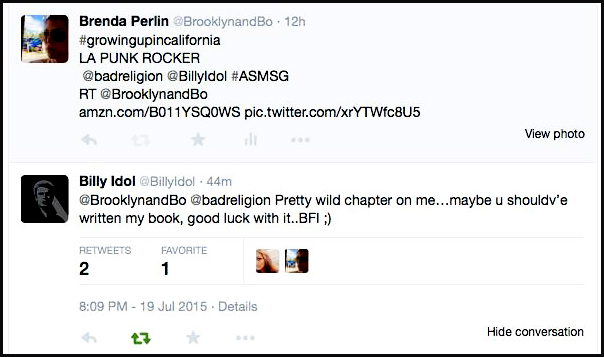
In the just-released LA Punk Rocker, an anthology produced by indie firecracker, Brenda Perlin, Barry contributed a short story on Billy Idol. With the book out only one day, the man himself Tweeted a “review” of Barry’s story:

2015-07-20-1437418052-3584550-LAPunkRocker_BillyIdol.jpg

Testimonials don’t get much better than that!

Photos by permission of Mark Barry.
Tweet image by permission of Brenda Perlin.

LDW w glasses


Visit www.lorrainedevonwilke.com for details and links to LDW’s books, music, photography, and articles.

Let’s Rethink ‘The Year of Women,’ Shall We?

women over books

Occasionally I sit outside certain issues, looking at how and why ideas emerged, if all parties involved explored the ramifications, and, if so, just how well thought out the process was.

A good example is the cause célèbre swirling around literary circles these days, the recent throw-down by author Kamila Shamsie in her piece titled, The year of women. Its thesis? An actual year in which only women will get published. Shamsie, after detailing statistical evidence of the clear and egregious gender bias in every category of the publishing world, articulates the challenge this way:

Now that the gender problem has been recognised, analysed, translated into charts and statistics, it is time for everyone in our literary culture to sign up to a campaign to redress the inequality for which all sectors of the culture bear responsibility. Last year readers, critics and at least one literary journal, the Critical Flame, signed up to a Year of Reading Women (YPW). Let’s take it a step further–let’s have a Year of Publishing Women. And 2018, the 100th anniversary of women getting the vote in the UK, seems both near enough and distant enough to be feasible.

So, 2018 will be the year in which, ostensibly, no male writers will be published. It’s believed (hoped) this will go a long way toward righting sexist wrongs. It’s also hoped that feminist-oriented males will go along with the program, with literary contest organizers, judges, and publishers, large and small, jumping on the bandwagon. Does anyone think this will actually happen? Well, so far, small press And Other Stories is on board, but we’ll see. 2018 is three years away and a lot can happen in that time. But still…

I found myself getting twitchy and all “devil’s advocatey” about the whole thing. Certainly I get the reason for such affirmative action — women are deeply under-represented in all areas of the arts, literature no exception — but what does it say that those taking on gender politics believe the way for women to rise is to literally remove men from the equation? Do we, as strong, female artists, really believe it’s necessary to excise men in order for fairness to reign? It seems many do. But I have a slight problem with that. Actually, several problems of varying degrees of slightness. Some maybe not so slight at all.

First of all, if you read Shamsie’s entire piece, you’ll see she makes note of the various gender-based proclivities women themselves fall victim to, ones that help perpetuate some of the very problems she’s railing against:

Of the 252 people who picked their books of the year, only 37% were women. In the past when the issue of women’s representation in literary pages has been brought up, it’s very often women editors who, while voicing their frustration, mention how much more likely men are than women to agree to review or judge or make lists of favourites. Suzi Feay, writing in 2011, stated: “You’d think it would be a pretty easy ask: a nomination for a (not the) book of the year. Yet in the first fortnight, not one female author approached said yes, while virtually all the men did. They had no trouble believing their views were worth having.

Or this:

I asked Ginny Hooker from the Guardian Review whether the comparative reticence of women writers was the reason the Books of the Year contributors were mostly men. She said: ” We always try to get a balance, and although I don’t have accurate records, my sense was always that more women said no to contributing than men did. But I suspect that if you looked at the number of people I’ve approached, it would probably be more than 50% men — something to do with who is in the public eye.” It’s a triple bind. More men than women get asked to judge, nominate, recommend–and of those who are asked, more men than women agree to do so, and those men are more likely to recommend yet more men.

So there’s that.

Women WritersThere’s also the fact that many “gatekeepers” in this industry — agents, publishers, publicists, marketers, etc. — are women, and they have much to do with which writers get agents, publishers, publicity; win contests, or, even, just get in the damn door. Personally, and from a strictly anecdotal perspective, I know countless female writers, many of whom are excellent writers, who cannot, for the life of them, get past the query letter stage with agents… and most of the agents rejecting them are women. As for publishers at the helm deciding which writers to push, which to give publicity, and which to send to various high-profile contests, may I ask: how many female publishers pushed their female writers with the same verve, and in the same numbers, as their male counterparts?

So there’s that.
Then there’s the fact that — again, anecdotally — a great many excellent male writers are just as frustrated and stymied in their efforts to advance their careers as female writers. I know several myself. They’re out there in the undulating white water of independent publishing, thrashing their arms in attempts to even be seen, much less reviewed and rewarded. Are we to make the literary marketplace just a little bit harder for them as a way to assuage gender imbalance, particularly when that imbalance is no fault of their own? Does that seem fair?

So there’s that.

Look, I’m a feminist, a strong voice for equality, parity, equal opportunity, and certainly equal pay. I’ve not been immune to sexism myself, nor am I unaware that it is deeply entrenched across many levels and layers of our global culture, often in ways that are far more egregious than literary exclusion. But each and every way in which women are marginalized, diminished, minimized, hurt, and dismissed is worth our loud, dissenting demand for change.

But I am also a humanist: the wife of a man, mother of a son, sister to five brothers, and friend to a great many wonderful men, many of whom are artists struggling to build careers and find footing in industries that are challenging for anyone, male or female. So, to suggest that a hardworking, talented male writer, by virtue of his gender alone, would not be able to get his book published in 2018, because that year has been deemed “a year of publishing women,” seems punitive. It seems unfair. It seems… sexist. Which inspires the question: is the only solution to gender bias reverse gender bias?

Women writers do need greater representation in the book world. We deserve greater representation. Women writing beautifully articulated, deeply moving and important books should be in the running for any literary prize, even those largely rewarded to men. They should be as reviewed, as featured; as respected and honored as men. But it’s not male writers preventing that from happening; it’s the gatekeepers, the key holders, the brandmakers, publicity wranglers, and star makers… male and female. It’s the people in power. And yes, some of those are male writers, the uber-famous, phenomenally successful male writers who wield great power in this industry. So we’ll put that rarefied group in with the rest of the power brokers. They are the ones with the power and obligation to right the wrongs of gender imbalance in publishing, not the average male writer.

So how about this? Instead of “a year of publishing women,” let’s have “a year of publishing parity.” TYOPP. Let’s throw down a challenge to demand parity in every aspect of publishing. Every aspect:

  • Agents will be obligated to sign as many female writers as male writers.
  • Publishers will be obligated to give deals to as many female writers as male writers.
  • Publishers (or anyone) submitting books to contests will, by virtue of the rules of TYOPP, submit as many by women as men.
  • Book reviewers will be required to review as many books by women as men.
  • Book sections of any media will be obligated to feature as many women writers as men.

And so on. Ah… wouldn’t it be lovely if that could actually happen?

Sophie Lewis of And Other Stories publishing, who, as mentioned above, is on board with the “year of women” plan, believes Kamila Shamsie’s challenge is an inspiring “provocation” …

We will have to start now, hunting for the women we want to publish, commissioning translations, and scheduling in the editing sessions. We will end up, we hope, publishing a few excellent women writers we might not otherwise have discovered. This will be a step in the right direction, and a source of pride for us.

But I must ask: why does any publisher need “a year of publishing women” to do that? Why aren’t they doing that already, every single day of the week, during any year, not just one called “a year of publishing women”? They should be. There are a lot of “excellent women writers” they haven’t discovered simply because they’re not looking hard enough, being inventive enough, or stepping outside industry norms enough.

Let’s rethink this, fellow women. We do deserve equal space at the table, but we don’t need male writers to be banished for us to succeed. What we need is for all those in positions of power to raise their consciousness, adjust their thinking, broaden their focus, and take more chances. Seek out more of those “excellent women writers.” Publish them, promote them, give them awards… just as they would the deserving men.

But let’s not wait until 2018. Let’s start “The Year of Publishing Parity” right now. Because every year should be a year for excellent writers, gender be damned.

Women & Book @ Vintage Women on Pinterest
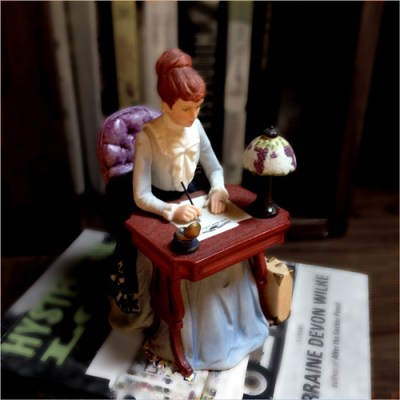
Vintage Female Writer image by LDW
Original article posted at The Huffington Post

LDW w glasses


Visit www.lorrainedevonwilke.com for details and links to LDW’s books, music, photography, and articles.

Flag Waving and Other American Pastimes

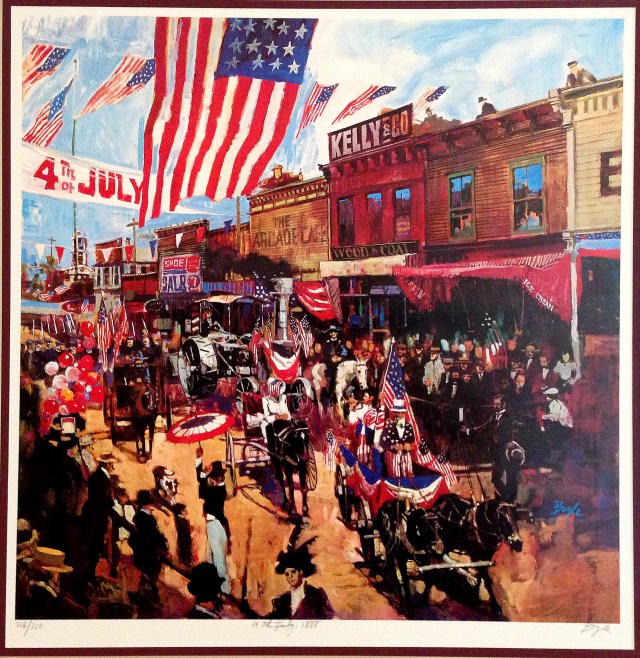
– 4th of July 1888_by Neil Boyle

We clearly hadn’t thought it out…

We were headed to a 4th of July parade with an enthusiastic youngster riding high on holiday excitement. It was a beautiful, sunny day, and we were all looking forward to the revelry of red, white, and blue. As said youngster took note of the countless American flags flapping in doorways, waving from passing cars, or clutched in the hands of other like-minded kids, his eyes lit up. It was the 4th of July and he had to have a flag.

Why we hadn’t anticipated that probability, or at least thought of it earlier, say, before every store within a 50-mile radius was all out, was inexplicable. I hate to say we’re bad parents, but come ON! Still, foresight be damned, it was Independence Day and that bubbling little patriot was getting’ a flag!

We must have hit every party, grocery, and CVS store in Claremont, CA, the town hosting the events of the day, and there was not a single star or strip to be found. And just as we were about to endure a full-blown “I don’t have a flaaaag!” meltdown, the friends we joined at the parade miraculously snagged an unclaimed (albeit small and plastic) flag, and fireworks of the not pretty, popping kind were preempted.

My point is: people love their flags. They love ’em. They love to hang them in doorways, march with them down streets; wave them as symbols of pride, alliance, and attachment. America has, in fact, been cranking out some version of the American flag since 1775 and, in looking over some of the earlier contenders, it’s good we didn’t settle too quickly on a design: this one here with the stripes and snake on which we were not to tread lacked, I think, artistic gravitas. But surely our current flag is a worthy choice, a stately symbol redolent of so much history and national passion.

Which brings to mind certain cultural events of late, brouhahas centered around the topic of flags. Interesting that, shortly before our most patriotic and all-American holiday, we’d be widely, and wildly, debating other flags that hold great meaning—good and bad—for our eclectic and often polarized citizenry.

I don’t think anyone could deny that the Confederate flag incites tremendous emotion, both from those who believe it’s a symbol of racism and national disdain, and others who insist, “it’s heritage and not hate,” as Rickey Medlocke of Lynyrd Skynyrd remarked recently. And while that sentiment may be true for some southerners, it’s getting harder to accept the assessment, particularly since the “flag of Dixie” has been held high by some of the most heinous characters in history, as recently as the tragedy in Charleston, S.C.

In fact, even Patterson Hood, founder of another proud southern band, The Drive-By Truckers, asserted this about the flag known as the “Stainless Banner”:

“I’m from Alabama,” says Patterson Hood, “I lived in the South my entire life. I have ancestors who fought in that ill-begotten war, but it’s way, way past time to move on … That [Civil] War was what, 150 years ago? It’s time to move on. It should have been a moot point years ago. The flag represents an act of war against the United States.

“The flag was put there to antagonize and intimidate,” he says, about its initial erection over the Capital. “During the Civil Rights era, Southern states started flying those flags and putting the logo on their state flags to remind black people what they thought their place was. It was just that simple…

“People say ‘The South will rise again,’ Hood says. “The South will never rise again as long as we keep our heads up our asses. I feel very strongly about it. I’m from Alabama. I lived in the South my entire life. I have ancestors who fought in that ill-begotten war, but it’s way, way past time to move on.”

Which makes sense to me. When some in this country talk about “taking back America,” demanding a “national language,” or bemoaning the “denigration” of the country by illegal immigration, how illogical is it, then, to defend a flag representative of so much pain and national antipathy? Particularly at a time when Americans of all stripes are (or should be) looking to bridge chasms, not create them.

There’s another flag that’s been waving around lately as well, one held high by those in our country fighting for equal rights for all: the Rainbow flag. Surely you’ve seen it. It’s the colorful symbol of gender and orientation diversity. No one near any kind of media these past weeks could have missed the wildly polar response to the Supreme Court’s ruling on constitutionally protected marriage equality. It was telling to watch the viral sharing of images showing the Confederate flag coming down as the Rainbow flag rose high. Wherever one stands on these issues, it can’t be denied that, yet again, it’s a flag that holds the symbology of so much passion and belief.

Which gets us back to the 4th of July: kids and flags; mom, dad, and apple pie; stalwart patriotism, and all things American. Each of these iconic concepts stirs warmth and nostalgia; optimism and hope, particularly as we look to strike a balance as individuals, stalwart in our beliefs, who also allow others to experience their own lives with dignity and respect. When I think of true American ideals, that’s where my mind goes.

Flag Waver_by Lorraine Devon Wilke

Our 4th of July will be spent with family in the bucolic surrounds of Ferndale (whose downtown looks very much like the iconic Neil Boyle illustration at top!). Our daughter, who hasn’t been able to get up here in recent years, is visiting with her two children. They’re excited to partake of of the many Humboldtian wonders, particularly highpoints we’ve identified in and around Ferndale (i.e., feeding grass to kindly horses and getting rides on a local fire engine). We’ll gather at our beloved home, raise a glass to family and community, raise eyes to the wonder of sparklers and fireworks, and hold hope that we can continue to raise awareness in the evolving country we all celebrate on this holiday.

I think the American flag has the spirit, the history, and the heart to be a proud standard for everyone moving toward that noble goal.

“Freedom to differ is not limited to things that do not matter much. That would be a mere shadow of freedom. The test of its substance is the right to differ as to things that touch the heart of the existing order. If there is any fixed star in our constitutional constellation, it is that no official, high or petty, can prescribe what shall be orthodox in politics, nationalism, religion or other matters of opinion.” — Supreme Court Justice Robert J. Jackson, 1943

* * * * * * * * * *

Original version published July 2, 2015 @ the Ferndale Enterprise

The illustration at the top, “4th of July, 1888” by Neil Boyle, is one of the many iconic and incredibly beautiful pieces of Boyle’s illustrating the book, Notes From Abe Brown’s Diary by Tom E. Knowlton. I was delighted to be gifted five limited prints from that collection by Boyle’s daughter, Kay Jackson, who has become a friend since we connected over an article of mine called Neil Boyle, Molly Malone’s and Pretty in Pink. I am honored to have both her friendship and her father’s prints, all of which now beautifully hang in our Ferndale home.

LDW w glasses


Visit www.lorrainedevonwilke.com for details and links to LDW’s books, music, photography, and articles.

Musicians Have Taylor Swift To Champion Fairness; Who Do Writers Have?

Taylor Swift, Fairness Warrior @ FB Timeline
Taylor Swift, Fairness Warrior; image @ FB Timeline

Even if you don’t pay attention to whatever elements of Taylor Swift’s life make the media on a given day, one would be hard-pressed to have missed the weekend’s brouhaha with Swift vs. Apple Music. Say what you will about the girl—her fluffy songs, her digitally-enhanced vocals, or her madcap rise to fame—she knows how to use a bully pulpit.

In a nutshell: after Apple Music announced their new streaming service on June 8th to much excitement and fanfare, it quickly became clear that the three-month trial period offered as enticement to joining artists came with some decidedly unappreciated fine print. It seems any music sold during those three months would NOT earn royalties for the artists, writers, and producers who signed up and whose music was being sold. Which meant those free three months, marketed as a “join-up gift,” were really a gift to Apple, allowing them to rake in whatever revenues were earned from those “trial” artists bereft of any payout to the artists themselves. Cold. Calculating. Greedy. And Ms. Swift would have none of it.

She not only withdrew her own latest (and wildly successful) album, 1989, from the steaming service, she took to her Tumblr page on June 21st with an open-letter to Apple. I’m going to put the whole thing here because I think her points (the most salient of which I’ve highlighted) are so important:

I write this to explain why I’ll be holding back my album, 1989, from the new streaming service, Apple Music. I feel this deserves an explanation because Apple has been and will continue to be one of my best partners in selling music and creating ways for me to connect with my fans. I respect the company and the truly ingenious minds that have created a legacy based on innovation and pushing the right boundaries.

I’m sure you are aware that Apple Music will be offering a free 3 month trial to anyone who signs up for the service. I’m not sure you know that Apple Music will not be paying writers, producers, or artists for those three months. I find it to be shocking, disappointing, and completely unlike this historically progressive and generous company.

This is not about me. Thankfully I am on my fifth album and can support myself, my band, crew, and entire management team by playing live shows. This is about the new artist or band that has just released their first single and will not be paid for its success. This is about the young songwriter who just got his or her first cut and thought that the royalties from that would get them out of debt. This is about the producer who works tirelessly to innovate and create, just like the innovators and creators at Apple are pioneering in their field…but will not get paid for a quarter of a year’s worth of plays on his or her songs.

These are not the complaints of a spoiled, petulant child. These are the echoed sentiments of every artist, writer and producer in my social circles who are afraid to speak up publicly because we admire and respect Apple so much. We simply do not respect this particular call.

I realize that Apple is working towards a goal of paid streaming. I think that is beautiful progress. We know how astronomically successful Apple has been and we know that this incredible company has the money to pay artists, writers and producers for the 3 month trial period… even if it is free for the fans trying it out.

Three months is a long time to go unpaid, and it is unfair to ask anyone to work for nothing. I say this with love, reverence, and admiration for everything else Apple has done. I hope that soon I can join them in the progression towards a streaming model that seems fair to those who create this music. I think this could be the platform that gets it right.

But I say to Apple with all due respect, it’s not too late to change this policy and change the minds of those in the music industry who will be deeply and gravely affected by this. We don’t ask you for free iPhones. Please don’t ask us to provide you with our music for no compensation.

Taylor

THANK YOU

All I could say was, “Brava, Ms. Swift!” Especially after it was announced, just hours after Swift’s note, that Apple Music not only heard her, they were, indeed, changing their policy. From The Huffington Post:

On Sunday evening, Apple responded to Taylor Swift’s rallying cry to fairly compensate artists. “We hear you @taylorswift13 and indie artists,” Apple’s Senior Vice President of Internet Software and Services Eddy Cue tweeted. Cue announced the tech giant will in fact pay artists for streaming services during the free trial period of Apple Music.

The power of protest. The power of standing up to behemoths of the industry to make clear that policies rooted in unfairness and lack of respect for the talent, hard work, and expended resources of artists, will not, and should not, stand. Kudos to Apple for getting the point and making the needed changes. Win/win all around. 

But what about writers? What about the novelists, non-fiction writers; essayists and article writers; in fact, any writer who’s creating work being posted, sold, or used by anyone else (i.e., book sale sites, news sites, resource sites, company websites, etc.)? This group of artists does not, at least not that I’m aware of, have a champion akin to Taylor Swift putting their own work on the line to protest for fairer industry practices. Instead, I see piece after piece cajoling writers to give their work away for free as “enmaeavatar_biggerticement” to new readers. I see content wranglers justifying non-payment in lieu of “online real estate,” calling it the “Huff Post formula” (forgetting that Huff Post actually has a level of exposure few other places do, and really, who need more “online real estate”??). I see sites like Amazon parsing subscription formulas to pay royalties based on how many pages of a book are actually read, as opposed to the purchase of the book itself (tell me, when were we ever allowed to pay for just the amount of a meal we ate at a restaurant??). All of these tactics, and others, are designed to benefit the purveyors of that content and the readers of that content, with little consideration for the creators of that content. Which is wrong. And pretty much the exact argument Swift was making to Apple. 

In fact, she made a similar point last year regarding Spotify, another music streaming service, reiterating her view of the “value of art” in an interview at Yahoo Music:

“I’m not willing to contribute my life’s work to an experiment that I don’t feel fairly compensates the writers, producers, artists, and creators of this music. And I just don’t agree with perpetuating the perception that music has no value and should be free.

I felt like I was saying to my fans, ‘If you create music someday, if you create a painting someday, someone can just walk into a museum, take it off the wall, rip off a corner off it, and it’s theirs now and they don’t have to pay for it.’  I didn’t like the perception that it was putting forth. And so I decided to change the way I was doing things.

Yes! Exactly! What’s with the perception that art has little or no value? That artists are somehow obligated to give their work away simply because it’s on the Internet and there’s that strange, persistent, unsupported “cultural think” that if it’s on the Internet it should be free? NO, IT SHOULDN’T! The Internet is like a store. A store where people put up the stuff they’re selling. It’s not a free box on the side of the road; it’s a place for commerce. As Taylor says, we don’t ask for free iPhones, so why free art? 

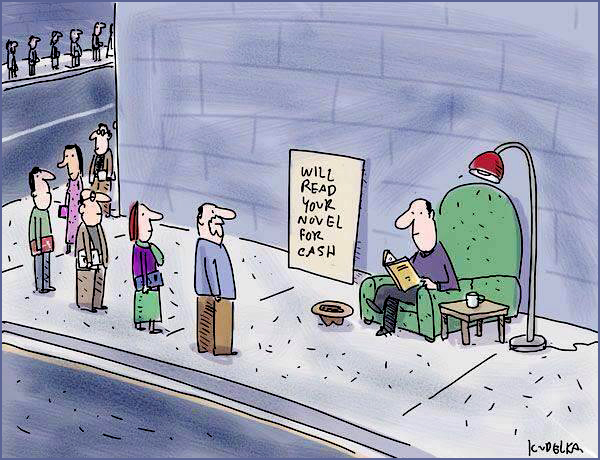
read your novel

But, sadly, we in the book/writing business don’t have a champion like Swift. The 2014 kerfuffle between Amazon and Hatchette was just a snit-fest between the Big 5 and big Amazon; it had nothing to do with fair compensation for indie writers. And, let’s face it, the proliferation of sites screaming “FREE & BARGAIN BOOKS!!” has exploded, creating a demographic of readers that simply expect books to either be free or so effing cheap the profit margin wouldn’t afford the author a latte while writing the next book they’ll be browbeaten to “donate” to the undiscerning public.

I can hear Taylor screaming in her jasmine-scented soundproofed vocal booth.

That's not how it works

Clearly, I’m no Taylor Swift. There are no legions of fans hanging on my every word; no one cares with whom I’m holding hands. I’m not tall, skinny, and loaded with a Brinks vault of awards. I have no power over any industry (though there was a time my catering captain skills were in demand!), and the only thing of mine Apple respects is a decent purchase history of phones and computers. But still… I’ve been around a long time, I’ve got artistic bona fides, and some have said (though I can’t remember who), I’ve got a good head on my shoulders. So if I had a bully pulpit, this is what I’d say:

Perpetuating the perception that independent books have little value and should be free or sold for ridiculously low prices is deleterious to the true merit, status, and negotiating power of independent authors. This is not about greed or the overvaluation of unknown writers; this is about the artistry and hard work that goes into creating good books. Excellent books. Books that, if agents and publishers were wrangling them in the traditional publishing world, would be bestsellers. Instead, those authors are struggling to find footing in a slippery marketplace that can’t seem to discern between mediocre and masterful, and values/devalues it as “all the same.” 

Which is folly. If an amateur wants to crank out an unpolished tome to put on Amazon for family/friend consumption, giving that book away for free or one or two bucks, so be it. But if a skilled, professional, highly qualified author puts years in, hires experts to produce, and publishes a masterful book (and I know many of those excellent authors and their excellent books), those books deserve to be sold at prices comparable to any other excellent book being traditionally published. Anything else creates a two-tiered system that designates one group as worthy, the other as not. Which is inherently unfair and vastly misguided, as what publishing category a book belongs to does not necessarily indicate its excellence.

This is about us indie writers and our industry taking a stand to determine that the perceived value of our art is commensurate with any other valued art, and, subsequently, demanding commensurate and fair payment for that art. Let “free” be a choice, not a mandate.

Okay, I’m done. I’m gonna go now and “Shake It Off”! 

Related articles you might find interesting:
I’m Not Interested In FREE Books 
Free Books: Marketing Genius or Devaluation of Writers?
Free Book Promotions: How Good ARE They For Writers?

LDW w glasses


Visit www.lorrainedevonwilke.com for details and links to LDW’s books, music, photography, and articles.

Lorraine Devon Wilke Reviewed! by Mark Barry of Green Wizard Publishing

The author_2sm

It’s not every day you have a deliciously brilliant author/indie publisher from the UK spend a little word count on your behalf, so when it happens, how remiss would you be if you didn’t share those precious words with your always interested audience?

Please take a moment to enjoy the very funny, astute, and really touching write-up Mr. Mark Barry wrote up about the state of fiction in general, and my fiction specifically.

And when you click over to read the full post, I urge you to take some time to click on Barry’s books posted on his site. The three I’ve read—Carla, The Night Porter, and Once Upon A Time In the City of Criminals—were each incredibly original stories, with fierce wit, enough edge to slice a finger, and utterly intriguing characters and plot lines. Which makes his kudos for my work all the more meaningful.

Thank you, sir; you are a reminder of what a wonderful circle of wagons the indie community can be!

• • • • • • • •

Lorraine Devon Wilke Reviewed!

by Mark Barry

Contemporary Fiction is the unwanted, bastard stepchild of Independent fiction.

Harsh? No. True. Don’t believe me? Come and join me at the shelter where, just outside the soup kitchen, you can find ten, fifteen, twenty Contemporary Fiction writers huddled around the brazier, polystyrene mug of powdered Minestrone warming fingerless mitts and coating trembling, arid lips.

Contemps just can’t catch a break.We starve for our art.

I’ll go further.

To sell in Indie, you need to be writing genre fiction.

Famous Nottingham author Nicola Valentine held court on this in a debate at the Nottingham Writer’s Studio a short while ago and many, many blogs and analysts on the scene allude to the eminence, the supremacy of genre. Here’s the top four (outside non-fiction and self help).

Vampire – preferably the stuff that sparkles.
Erotica – atm, LGBT erotica in particular.
Young Adult – pick something unreal and it’s likely to be written about: Wizards, Zombies and Gargoyles have been popular recently and of course,
Romance/chicklit – say no more.

(The really clever authors who are sitting on biblical piles of paper moolah the size of the Tower of Babel are those who write dirty vampire romances for teenagers. They’re rolling cigars made of crisp twenties and laughing all the way to the bank).

That’s genre.

Unreal. Invented. Other. Escapist.

In fact, genre fiction= escapist. The more fantastic, the more unreal and out there, the more it is likely to sell.

Contemporary fiction writers can usually be found hunting for food in skips outside conferences full of genre authors, which is a shame as generally contemporary fiction authors, as writers, knock genre writers into a cocked hat. These boys and girls can write.

And Lorraine Devon Wilke, who lives just up the road from Brenda Perlin, the “Faction” writer I featured last week, is a damned fine contemporary writer indeed.

She’s written two books. The first, After The Sucker Punch, I reviewed here: Review of After The Sucker Punch. 

I loved it. It was in the top three books I read last year and in the top thirty of my lifetime. It is that good…

CLICK TO CONTINUE READING….


Smashwords2Follow Lorraine Devon Wilke on Twitter, Facebook, Goodreads, Instagram, and Huffington Post. Her article archive can be found at Contently, her photos at Fine Art America, and details and links to her other work @ www.lorrainedevonwilke.com.

Her novels, AFTER THE SUCKER PUNCH and HYSTERICAL LOVE, are available in ebook and paperback at Amazon and Smashwords. Her short story, “She Tumbled Down,” (ebook) is available at Amazon. To view the After The Sucker Punch trailer, click HERE.

Be sure to stay current with her adventures in publishing here at her book blog at www.AfterTheSuckerPunch.com.

To Those Who Post Animal Videos On Social Media…Thank You!

Say Hello To My Little Friend
“Say hello to my little friend…”

I’m not being facetious; I mean it. Because I LOVE animal videos. They make me happy. They make me laugh. Sometimes they make my day. I’m not shallow, I’m not a crazy cat lady; I’m just an appreciator of our great animal kingdom. And science now proves I’m on the right track.

Since I no longer subscribe to the local paper (too many ads, too much wasted paper, and we travel too much), I typically start my workday with a cup of chai (lately my thing) and a scroll through various online new sources. And when I get to Facebook, I find myself smiling, grinning, even laughing out loud at the predictably present videos of animals doing those things animals do: being cute, tugging heartstrings, interacting nicely with various species, listening to or dancing to music, or just generally being incredibly entertaining.

It used to be standard operating procedure to poke fun at not only those who posted such pictures and videos, but those who enjoyed them, but there’s been a recent cultural shift, inspired by some actual stats that prove the value of such postings.

A Japanese research paper entitled “The Power of Kawaii: Viewing Cute Images Promotes a Careful Behavior and Narrows Attentional Focus,” posits that taking breaks to indulge in a little animal viewing can actually be helpful to one’s work flow:

Results show that participants performed tasks requiring focused attention more carefully after viewing cute images. This is interpreted as the result of a narrowed attentional focus induced by the cuteness-triggered positive emotion that is associated with approach motivation and the tendency toward systematic processing.

Animal videos have also helped raise awareness of the plight of poaching; promoted greater human-to-animal understanding; aided humans as a form of meditation, and even contribute to scientific understanding of animal behaviors:

“They’re not substitutes for good, hardcore research, but they’re very valuable for people who aren’t going to see certain things,” Marc Bekoff, a former professor of ecology and evolutionary biology at the University of Colorado, Boulder, told LiveScience this week. “From a pedagogical point of view, I wish I had had more access to YouTube videos. I would have probably used them in my classes.”

Others have even extrapolated that the pleasure derived from watching cute animal videos helps in bone growth (that seems a stretch, but, hey, who am I to argue?). Even Super Bowl 2015’s most successful commercial was a compilation of some of the best inter-species videos around (maybe my favorite commercial ever!).

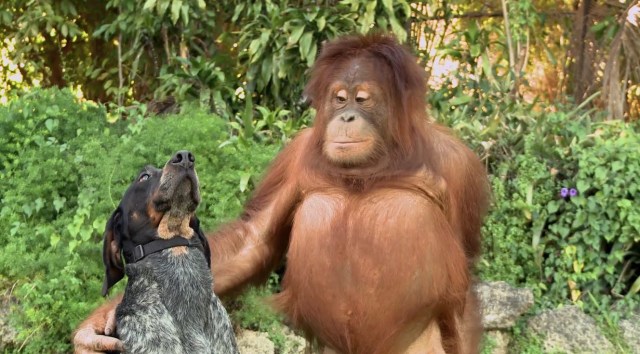
– "Friends forever" Android video screenshot
– “Friends forever” Android video screenshot

Personally, and with kudos to all those many benefits, I am simply entertained. I love breaking up my work to occasionally enjoy cockatoos with decidely different attitudes about Elvis (hilarious!!), a montage of cats who rule the roost, or an elephant finding delight in a big blue ribbon. Of course, baby goats are always delightful, but baby goats in pajamas will leave you speechless. And if you think only furry animals are worth a watch, get a kick of out this octopus determined to hold onto coconut shells he/she found!

These glimpses into the lives, emotions, activities, and predilections of our animal brethren can only help make clear just how alike we creatures are. They not only entertain us, they connect us; they let us know we’re all in this together, living, loving, and banging on pots.

So thanks, everyone, for making my days a little brighter. And now I’ll leave you with Husky Sings With Baby. Go build some bone! 🙂

LDW w glasses


Visit www.lorrainedevonwilke.com for details and links to LDW’s books, music, photography, and articles.
Art of the Book Cover: Pictures Tell the Story

Walking the Cambria Shore_sm
“Walking the Cambria Shore” — original photo used for back cover of AFTER THE SUCKER PUNCH

Someone asked me the other day what was the singlemost reason I chose to self-publish my books. Actually, I have two reasons, which, I suppose, makes this a “doublemost” situation.

First: while I would’ve loved (I mean, seriously loved) the help of an enthusiastic literary agent and the support and heft of a publisher with name value and cultural prestige, procuring those collaborators in our ever-changing industry has become an increasingly elusive event; it certainly was for me. I gave it my all over several years then decided I had no more all to give; since I truly believed what I was doing merited further advancement, and I’d gotten to the point where I just wanted to move forward, I leapt off the indie cliff.

Think I’m still in mid-fall!

Second: I wanted control over the work I put out. Frankly, if you’re not getting the perks of industry collaboration, there has to be some kind of trade-off; one of the most phenomenal trade-offs of “doing it yourself” is controlling exactly how your work comes to fruition. For the uninitiated, this is a big thing because, with traditional publishers, items like final edit, title, and book cover are typically taken out of the hands of the author. Certainly an unknown author. Which would be me. And since I was one of the brave souls striking out independently—for better or for worse—one of the “betterest” reasons was the ability to create and produce EXACTLY the books I wanted.

Bene Bene_sm
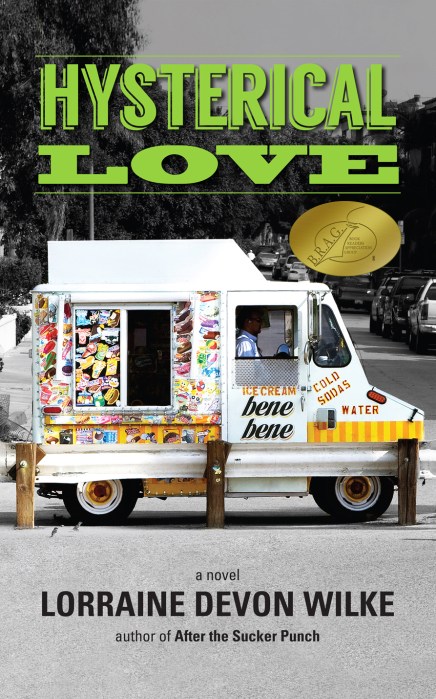
“Bene Bene” – original photo used for HYSTERICAL LOVE cover

Now, if you’re like me, a creative perfectionist who’s driven many a musician, producer, co-writer, actor, director, sound mixer, editor, or wildly opinionated drummer crazy with detailed, nuanced, and very specific standards and opinions, you’ll understand that the perk of creative control for someone like me is a boon. I’ve always believed that, if you’ve put in the time to truly learn your craft, gain your experience, hone your expertise, and bring to life a beautifully imagined story and set of characters, you deserve the power to render the final edit, pick the title, and decide on your cover art. Certainly working with professionals in the arena of editing is essential, input on titles is always illuminating, and a cover designer is a must-have, but ultimately it all comes down to YOU.

She Tumbled Down_v
“Street Memorial” — Original photo used for cover of “She Tumbled Down”

Which is lovely.

And a book cover, to my mind, is one of the most important elements of the final product. Why wouldn’t it be? Books truly are judged by their covers and too often the covers of self-published books are artistically lacking, poorly designed, and amateurishly rendered. Those covers then become litmus tests to the perusing and reading public, signaling to many that this writer may not have a firm grasp on professional market standards and, therefore, likely hasn’t delivered a professionally excellent book. I’m sure that’s not true in every case, but from all reports: most.

So given my bona fides as a photographer with a deep catalogue of images from which to choose—convenient, considering my preference for photographic cover art—my design process was both financially beneficial and extremely simple. Add in the fact that my cover designer is a brilliant graphic artist from Chicago, Grace Amandes, who just happens to be my sister, and it was a foregone conclusion that I’d get exactly the covers I wanted. And I did.

AfterTheSuckerPunch_front_cover

AFTER THE SUCKER PUNCH, with its story of a woman who discovers on the night of her father’s funeral that he thought she was a failure, needed a female face in the background, one that reflected the mood and emotional tone of the piece. After pulling an image from my gallery—as well as finding a back cover image that illustrated another story point that takes place in Cambria, CA— I handed the images to Grace, who ultimately came back with a cover I loved: 

With HYSTERICAL LOVE, a more whimsical story about a thirty-something guy struggling to find the meaning of true love and his father’s long-lost soul mate, a through-line involving an ice cream truck became the inspiration. There was no doubt I’d be using a favorite photograph taken in my neighborhood and processed with a “selective color” concept (see original above). Grace found the exact right font and color for the title, and it has become a cover that people literally smile over. I do too!

HL front cover_indieBRAG

For “She Tumbled Down,” a short story about a tragic hit-and-run, published only in e-book, I decided to design the cover myself, trusting that, since ebooks don’t require quite the specifications of a print cover, I could pull it off. Inspired by Grace’s work, I came up with another “selective color” version of an image also taken in my neighborhood (see original above). It makes the very poignant point.

She Tumbled Down

Working in both literary and photographic mediums, I’ve discovered my general thrust as an artist is, quite simply, storytelling. Whether visual, literal, or musical, the narrative I see and feel impels the work forward, and so it has been a natural marriage between words and images in bringing my books to happily imagined life…a result that makes all the challenges and occasional indignities of self-publishing all the more easy to forgive!

To view my photography galleries at Fine Art America click HERE.

LDW w glasses


Visit www.lorrainedevonwilke.com for details and links to LDW’s books, music, photography, and articles.