Flag Waving and Other American Pastimes

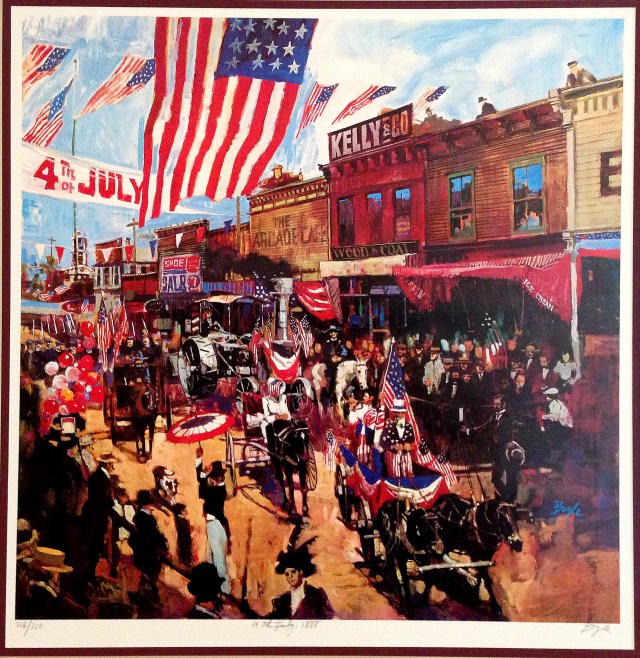
– 4th of July 1888_by Neil Boyle

We clearly hadn’t thought it out…

We were headed to a 4th of July parade with an enthusiastic youngster riding high on holiday excitement. It was a beautiful, sunny day, and we were all looking forward to the revelry of red, white, and blue. As said youngster took note of the countless American flags flapping in doorways, waving from passing cars, or clutched in the hands of other like-minded kids, his eyes lit up. It was the 4th of July and he had to have a flag.

Why we hadn’t anticipated that probability, or at least thought of it earlier, say, before every store within a 50-mile radius was all out, was inexplicable. I hate to say we’re bad parents, but come ON! Still, foresight be damned, it was Independence Day and that bubbling little patriot was getting’ a flag!

We must have hit every party, grocery, and CVS store in Claremont, CA, the town hosting the events of the day, and there was not a single star or strip to be found. And just as we were about to endure a full-blown “I don’t have a flaaaag!” meltdown, the friends we joined at the parade miraculously snagged an unclaimed (albeit small and plastic) flag, and fireworks of the not pretty, popping kind were preempted.

My point is: people love their flags. They love ’em. They love to hang them in doorways, march with them down streets; wave them as symbols of pride, alliance, and attachment. America has, in fact, been cranking out some version of the American flag since 1775 and, in looking over some of the earlier contenders, it’s good we didn’t settle too quickly on a design: this one here with the stripes and snake on which we were not to tread lacked, I think, artistic gravitas. But surely our current flag is a worthy choice, a stately symbol redolent of so much history and national passion.

Which brings to mind certain cultural events of late, brouhahas centered around the topic of flags. Interesting that, shortly before our most patriotic and all-American holiday, we’d be widely, and wildly, debating other flags that hold great meaning—good and bad—for our eclectic and often polarized citizenry.

I don’t think anyone could deny that the Confederate flag incites tremendous emotion, both from those who believe it’s a symbol of racism and national disdain, and others who insist, “it’s heritage and not hate,” as Rickey Medlocke of Lynyrd Skynyrd remarked recently. And while that sentiment may be true for some southerners, it’s getting harder to accept the assessment, particularly since the “flag of Dixie” has been held high by some of the most heinous characters in history, as recently as the tragedy in Charleston, S.C.

In fact, even Patterson Hood, founder of another proud southern band, The Drive-By Truckers, asserted this about the flag known as the “Stainless Banner”:

“I’m from Alabama,” says Patterson Hood, “I lived in the South my entire life. I have ancestors who fought in that ill-begotten war, but it’s way, way past time to move on … That [Civil] War was what, 150 years ago? It’s time to move on. It should have been a moot point years ago. The flag represents an act of war against the United States.

“The flag was put there to antagonize and intimidate,” he says, about its initial erection over the Capital. “During the Civil Rights era, Southern states started flying those flags and putting the logo on their state flags to remind black people what they thought their place was. It was just that simple…

“People say ‘The South will rise again,’ Hood says. “The South will never rise again as long as we keep our heads up our asses. I feel very strongly about it. I’m from Alabama. I lived in the South my entire life. I have ancestors who fought in that ill-begotten war, but it’s way, way past time to move on.”

Which makes sense to me. When some in this country talk about “taking back America,” demanding a “national language,” or bemoaning the “denigration” of the country by illegal immigration, how illogical is it, then, to defend a flag representative of so much pain and national antipathy? Particularly at a time when Americans of all stripes are (or should be) looking to bridge chasms, not create them.

There’s another flag that’s been waving around lately as well, one held high by those in our country fighting for equal rights for all: the Rainbow flag. Surely you’ve seen it. It’s the colorful symbol of gender and orientation diversity. No one near any kind of media these past weeks could have missed the wildly polar response to the Supreme Court’s ruling on constitutionally protected marriage equality. It was telling to watch the viral sharing of images showing the Confederate flag coming down as the Rainbow flag rose high. Wherever one stands on these issues, it can’t be denied that, yet again, it’s a flag that holds the symbology of so much passion and belief.

Which gets us back to the 4th of July: kids and flags; mom, dad, and apple pie; stalwart patriotism, and all things American. Each of these iconic concepts stirs warmth and nostalgia; optimism and hope, particularly as we look to strike a balance as individuals, stalwart in our beliefs, who also allow others to experience their own lives with dignity and respect. When I think of true American ideals, that’s where my mind goes.

Flag Waver_by Lorraine Devon Wilke

Our 4th of July will be spent with family in the bucolic surrounds of Ferndale (whose downtown looks very much like the iconic Neil Boyle illustration at top!). Our daughter, who hasn’t been able to get up here in recent years, is visiting with her two children. They’re excited to partake of of the many Humboldtian wonders, particularly highpoints we’ve identified in and around Ferndale (i.e., feeding grass to kindly horses and getting rides on a local fire engine). We’ll gather at our beloved home, raise a glass to family and community, raise eyes to the wonder of sparklers and fireworks, and hold hope that we can continue to raise awareness in the evolving country we all celebrate on this holiday.

I think the American flag has the spirit, the history, and the heart to be a proud standard for everyone moving toward that noble goal.

“Freedom to differ is not limited to things that do not matter much. That would be a mere shadow of freedom. The test of its substance is the right to differ as to things that touch the heart of the existing order. If there is any fixed star in our constitutional constellation, it is that no official, high or petty, can prescribe what shall be orthodox in politics, nationalism, religion or other matters of opinion.” — Supreme Court Justice Robert J. Jackson, 1943

* * * * * * * * * *

Original version published July 2, 2015 @ the Ferndale Enterprise

The illustration at the top, “4th of July, 1888” by Neil Boyle, is one of the many iconic and incredibly beautiful pieces of Boyle’s illustrating the book, Notes From Abe Brown’s Diary by Tom E. Knowlton. I was delighted to be gifted five limited prints from that collection by Boyle’s daughter, Kay Jackson, who has become a friend since we connected over an article of mine called Neil Boyle, Molly Malone’s and Pretty in Pink. I am honored to have both her friendship and her father’s prints, all of which now beautifully hang in our Ferndale home.

LDW w glasses


Visit www.lorrainedevonwilke.com for details and links to LDW’s books, music, photography, and articles.

Musicians Have Taylor Swift To Champion Fairness; Who Do Writers Have?

Taylor Swift, Fairness Warrior @ FB Timeline
Taylor Swift, Fairness Warrior; image @ FB Timeline

Even if you don’t pay attention to whatever elements of Taylor Swift’s life make the media on a given day, one would be hard-pressed to have missed the weekend’s brouhaha with Swift vs. Apple Music. Say what you will about the girl—her fluffy songs, her digitally-enhanced vocals, or her madcap rise to fame—she knows how to use a bully pulpit.

In a nutshell: after Apple Music announced their new streaming service on June 8th to much excitement and fanfare, it quickly became clear that the three-month trial period offered as enticement to joining artists came with some decidedly unappreciated fine print. It seems any music sold during those three months would NOT earn royalties for the artists, writers, and producers who signed up and whose music was being sold. Which meant those free three months, marketed as a “join-up gift,” were really a gift to Apple, allowing them to rake in whatever revenues were earned from those “trial” artists bereft of any payout to the artists themselves. Cold. Calculating. Greedy. And Ms. Swift would have none of it.

She not only withdrew her own latest (and wildly successful) album, 1989, from the steaming service, she took to her Tumblr page on June 21st with an open-letter to Apple. I’m going to put the whole thing here because I think her points (the most salient of which I’ve highlighted) are so important:

I write this to explain why I’ll be holding back my album, 1989, from the new streaming service, Apple Music. I feel this deserves an explanation because Apple has been and will continue to be one of my best partners in selling music and creating ways for me to connect with my fans. I respect the company and the truly ingenious minds that have created a legacy based on innovation and pushing the right boundaries.

I’m sure you are aware that Apple Music will be offering a free 3 month trial to anyone who signs up for the service. I’m not sure you know that Apple Music will not be paying writers, producers, or artists for those three months. I find it to be shocking, disappointing, and completely unlike this historically progressive and generous company.

This is not about me. Thankfully I am on my fifth album and can support myself, my band, crew, and entire management team by playing live shows. This is about the new artist or band that has just released their first single and will not be paid for its success. This is about the young songwriter who just got his or her first cut and thought that the royalties from that would get them out of debt. This is about the producer who works tirelessly to innovate and create, just like the innovators and creators at Apple are pioneering in their field…but will not get paid for a quarter of a year’s worth of plays on his or her songs.

These are not the complaints of a spoiled, petulant child. These are the echoed sentiments of every artist, writer and producer in my social circles who are afraid to speak up publicly because we admire and respect Apple so much. We simply do not respect this particular call.

I realize that Apple is working towards a goal of paid streaming. I think that is beautiful progress. We know how astronomically successful Apple has been and we know that this incredible company has the money to pay artists, writers and producers for the 3 month trial period… even if it is free for the fans trying it out.

Three months is a long time to go unpaid, and it is unfair to ask anyone to work for nothing. I say this with love, reverence, and admiration for everything else Apple has done. I hope that soon I can join them in the progression towards a streaming model that seems fair to those who create this music. I think this could be the platform that gets it right.

But I say to Apple with all due respect, it’s not too late to change this policy and change the minds of those in the music industry who will be deeply and gravely affected by this. We don’t ask you for free iPhones. Please don’t ask us to provide you with our music for no compensation.

Taylor

THANK YOU

All I could say was, “Brava, Ms. Swift!” Especially after it was announced, just hours after Swift’s note, that Apple Music not only heard her, they were, indeed, changing their policy. From The Huffington Post:

On Sunday evening, Apple responded to Taylor Swift’s rallying cry to fairly compensate artists. “We hear you @taylorswift13 and indie artists,” Apple’s Senior Vice President of Internet Software and Services Eddy Cue tweeted. Cue announced the tech giant will in fact pay artists for streaming services during the free trial period of Apple Music.

The power of protest. The power of standing up to behemoths of the industry to make clear that policies rooted in unfairness and lack of respect for the talent, hard work, and expended resources of artists, will not, and should not, stand. Kudos to Apple for getting the point and making the needed changes. Win/win all around. 

But what about writers? What about the novelists, non-fiction writers; essayists and article writers; in fact, any writer who’s creating work being posted, sold, or used by anyone else (i.e., book sale sites, news sites, resource sites, company websites, etc.)? This group of artists does not, at least not that I’m aware of, have a champion akin to Taylor Swift putting their own work on the line to protest for fairer industry practices. Instead, I see piece after piece cajoling writers to give their work away for free as “enmaeavatar_biggerticement” to new readers. I see content wranglers justifying non-payment in lieu of “online real estate,” calling it the “Huff Post formula” (forgetting that Huff Post actually has a level of exposure few other places do, and really, who need more “online real estate”??). I see sites like Amazon parsing subscription formulas to pay royalties based on how many pages of a book are actually read, as opposed to the purchase of the book itself (tell me, when were we ever allowed to pay for just the amount of a meal we ate at a restaurant??). All of these tactics, and others, are designed to benefit the purveyors of that content and the readers of that content, with little consideration for the creators of that content. Which is wrong. And pretty much the exact argument Swift was making to Apple. 

In fact, she made a similar point last year regarding Spotify, another music streaming service, reiterating her view of the “value of art” in an interview at Yahoo Music:

“I’m not willing to contribute my life’s work to an experiment that I don’t feel fairly compensates the writers, producers, artists, and creators of this music. And I just don’t agree with perpetuating the perception that music has no value and should be free.

I felt like I was saying to my fans, ‘If you create music someday, if you create a painting someday, someone can just walk into a museum, take it off the wall, rip off a corner off it, and it’s theirs now and they don’t have to pay for it.’  I didn’t like the perception that it was putting forth. And so I decided to change the way I was doing things.

Yes! Exactly! What’s with the perception that art has little or no value? That artists are somehow obligated to give their work away simply because it’s on the Internet and there’s that strange, persistent, unsupported “cultural think” that if it’s on the Internet it should be free? NO, IT SHOULDN’T! The Internet is like a store. A store where people put up the stuff they’re selling. It’s not a free box on the side of the road; it’s a place for commerce. As Taylor says, we don’t ask for free iPhones, so why free art? 

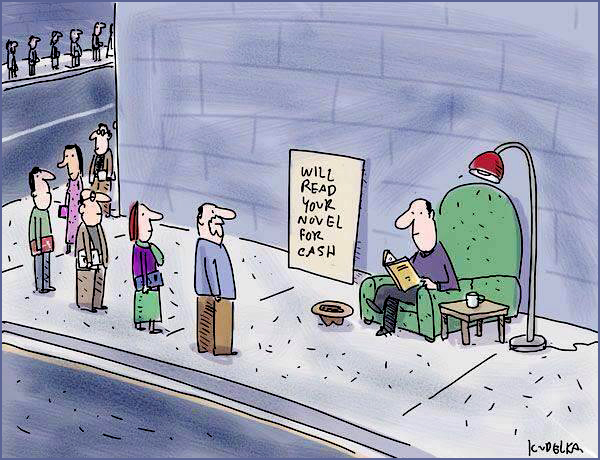
read your novel

But, sadly, we in the book/writing business don’t have a champion like Swift. The 2014 kerfuffle between Amazon and Hatchette was just a snit-fest between the Big 5 and big Amazon; it had nothing to do with fair compensation for indie writers. And, let’s face it, the proliferation of sites screaming “FREE & BARGAIN BOOKS!!” has exploded, creating a demographic of readers that simply expect books to either be free or so effing cheap the profit margin wouldn’t afford the author a latte while writing the next book they’ll be browbeaten to “donate” to the undiscerning public.

I can hear Taylor screaming in her jasmine-scented soundproofed vocal booth.

That's not how it works

Clearly, I’m no Taylor Swift. There are no legions of fans hanging on my every word; no one cares with whom I’m holding hands. I’m not tall, skinny, and loaded with a Brinks vault of awards. I have no power over any industry (though there was a time my catering captain skills were in demand!), and the only thing of mine Apple respects is a decent purchase history of phones and computers. But still… I’ve been around a long time, I’ve got artistic bona fides, and some have said (though I can’t remember who), I’ve got a good head on my shoulders. So if I had a bully pulpit, this is what I’d say:

Perpetuating the perception that independent books have little value and should be free or sold for ridiculously low prices is deleterious to the true merit, status, and negotiating power of independent authors. This is not about greed or the overvaluation of unknown writers; this is about the artistry and hard work that goes into creating good books. Excellent books. Books that, if agents and publishers were wrangling them in the traditional publishing world, would be bestsellers. Instead, those authors are struggling to find footing in a slippery marketplace that can’t seem to discern between mediocre and masterful, and values/devalues it as “all the same.” 

Which is folly. If an amateur wants to crank out an unpolished tome to put on Amazon for family/friend consumption, giving that book away for free or one or two bucks, so be it. But if a skilled, professional, highly qualified author puts years in, hires experts to produce, and publishes a masterful book (and I know many of those excellent authors and their excellent books), those books deserve to be sold at prices comparable to any other excellent book being traditionally published. Anything else creates a two-tiered system that designates one group as worthy, the other as not. Which is inherently unfair and vastly misguided, as what publishing category a book belongs to does not necessarily indicate its excellence.

This is about us indie writers and our industry taking a stand to determine that the perceived value of our art is commensurate with any other valued art, and, subsequently, demanding commensurate and fair payment for that art. Let “free” be a choice, not a mandate.

Okay, I’m done. I’m gonna go now and “Shake It Off”! 

Related articles you might find interesting:
I’m Not Interested In FREE Books 
Free Books: Marketing Genius or Devaluation of Writers?
Free Book Promotions: How Good ARE They For Writers?

LDW w glasses


Visit www.lorrainedevonwilke.com for details and links to LDW’s books, music, photography, and articles.

Lorraine Devon Wilke Reviewed! by Mark Barry of Green Wizard Publishing

The author_2sm

It’s not every day you have a deliciously brilliant author/indie publisher from the UK spend a little word count on your behalf, so when it happens, how remiss would you be if you didn’t share those precious words with your always interested audience?

Please take a moment to enjoy the very funny, astute, and really touching write-up Mr. Mark Barry wrote up about the state of fiction in general, and my fiction specifically.

And when you click over to read the full post, I urge you to take some time to click on Barry’s books posted on his site. The three I’ve read—Carla, The Night Porter, and Once Upon A Time In the City of Criminals—were each incredibly original stories, with fierce wit, enough edge to slice a finger, and utterly intriguing characters and plot lines. Which makes his kudos for my work all the more meaningful.

Thank you, sir; you are a reminder of what a wonderful circle of wagons the indie community can be!

• • • • • • • •

Lorraine Devon Wilke Reviewed!

by Mark Barry

Contemporary Fiction is the unwanted, bastard stepchild of Independent fiction.

Harsh? No. True. Don’t believe me? Come and join me at the shelter where, just outside the soup kitchen, you can find ten, fifteen, twenty Contemporary Fiction writers huddled around the brazier, polystyrene mug of powdered Minestrone warming fingerless mitts and coating trembling, arid lips.

Contemps just can’t catch a break.We starve for our art.

I’ll go further.

To sell in Indie, you need to be writing genre fiction.

Famous Nottingham author Nicola Valentine held court on this in a debate at the Nottingham Writer’s Studio a short while ago and many, many blogs and analysts on the scene allude to the eminence, the supremacy of genre. Here’s the top four (outside non-fiction and self help).

Vampire – preferably the stuff that sparkles.
Erotica – atm, LGBT erotica in particular.
Young Adult – pick something unreal and it’s likely to be written about: Wizards, Zombies and Gargoyles have been popular recently and of course,
Romance/chicklit – say no more.

(The really clever authors who are sitting on biblical piles of paper moolah the size of the Tower of Babel are those who write dirty vampire romances for teenagers. They’re rolling cigars made of crisp twenties and laughing all the way to the bank).

That’s genre.

Unreal. Invented. Other. Escapist.

In fact, genre fiction= escapist. The more fantastic, the more unreal and out there, the more it is likely to sell.

Contemporary fiction writers can usually be found hunting for food in skips outside conferences full of genre authors, which is a shame as generally contemporary fiction authors, as writers, knock genre writers into a cocked hat. These boys and girls can write.

And Lorraine Devon Wilke, who lives just up the road from Brenda Perlin, the “Faction” writer I featured last week, is a damned fine contemporary writer indeed.

She’s written two books. The first, After The Sucker Punch, I reviewed here: Review of After The Sucker Punch

I loved it. It was in the top three books I read last year and in the top thirty of my lifetime. It is that good…

CLICK TO CONTINUE READING….


Smashwords2Follow Lorraine Devon Wilke on Twitter, Facebook, Goodreads, Instagram, and Huffington Post. Her article archive can be found at Contently, her photos at Fine Art America, and details and links to her other work @ www.lorrainedevonwilke.com.

Her novels, AFTER THE SUCKER PUNCH and HYSTERICAL LOVE, are available in ebook and paperback at Amazon and Smashwords. Her short story, “She Tumbled Down,” (ebook) is available at Amazon. To view the After The Sucker Punch trailer, click HERE.

Be sure to stay current with her adventures in publishing here at her book blog at www.AfterTheSuckerPunch.com.

To Those Who Post Animal Videos On Social Media…Thank You!

Say Hello To My Little Friend
“Say hello to my little friend…”

I’m not being facetious; I mean it. Because I LOVE animal videos. They make me happy. They make me laugh. Sometimes they make my day. I’m not shallow, I’m not a crazy cat lady; I’m just an appreciator of our great animal kingdom. And science now proves I’m on the right track.

Since I no longer subscribe to the local paper (too many ads, too much wasted paper, and we travel too much), I typically start my workday with a cup of chai (lately my thing) and a scroll through various online new sources. And when I get to Facebook, I find myself smiling, grinning, even laughing out loud at the predictably present videos of animals doing those things animals do: being cute, tugging heartstrings, interacting nicely with various species, listening to or dancing to music, or just generally being incredibly entertaining.

It used to be standard operating procedure to poke fun at not only those who posted such pictures and videos, but those who enjoyed them, but there’s been a recent cultural shift, inspired by some actual stats that prove the value of such postings.

A Japanese research paper entitled “The Power of Kawaii: Viewing Cute Images Promotes a Careful Behavior and Narrows Attentional Focus,” posits that taking breaks to indulge in a little animal viewing can actually be helpful to one’s work flow:

Results show that participants performed tasks requiring focused attention more carefully after viewing cute images. This is interpreted as the result of a narrowed attentional focus induced by the cuteness-triggered positive emotion that is associated with approach motivation and the tendency toward systematic processing.

Animal videos have also helped raise awareness of the plight of poaching; promoted greater human-to-animal understanding; aided humans as a form of meditation, and even contribute to scientific understanding of animal behaviors:

“They’re not substitutes for good, hardcore research, but they’re very valuable for people who aren’t going to see certain things,” Marc Bekoff, a former professor of ecology and evolutionary biology at the University of Colorado, Boulder, told LiveScience this week. “From a pedagogical point of view, I wish I had had more access to YouTube videos. I would have probably used them in my classes.”

Others have even extrapolated that the pleasure derived from watching cute animal videos helps in bone growth (that seems a stretch, but, hey, who am I to argue?). Even Super Bowl 2015’s most successful commercial was a compilation of some of the best inter-species videos around (maybe my favorite commercial ever!).

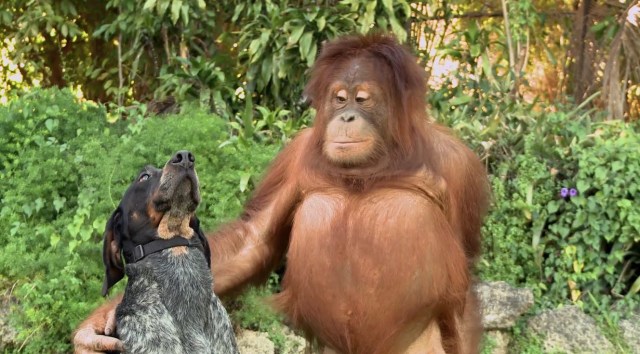
– "Friends forever" Android video screenshot
– “Friends forever” Android video screenshot

Personally, and with kudos to all those many benefits, I am simply entertained. I love breaking up my work to occasionally enjoy cockatoos with decidely different attitudes about Elvis (hilarious!!), a montage of cats who rule the roost, or an elephant finding delight in a big blue ribbon. Of course, baby goats are always delightful, but baby goats in pajamas will leave you speechless. And if you think only furry animals are worth a watch, get a kick of out this octopus determined to hold onto coconut shells he/she found!

These glimpses into the lives, emotions, activities, and predilections of our animal brethren can only help make clear just how alike we creatures are. They not only entertain us, they connect us; they let us know we’re all in this together, living, loving, and banging on pots.

So thanks, everyone, for making my days a little brighter. And now I’ll leave you with Husky Sings With Baby. Go build some bone! 🙂

LDW w glasses


Visit www.lorrainedevonwilke.com for details and links to LDW’s books, music, photography, and articles.

Art of the Book Cover: Pictures Tell the Story

Walking the Cambria Shore_sm
“Walking the Cambria Shore” — original photo used for back cover of AFTER THE SUCKER PUNCH

Someone asked me the other day what was the singlemost reason I chose to self-publish my books. Actually, I have two reasons, which, I suppose, makes this a “doublemost” situation.

First: while I would’ve loved (I mean, seriously loved) the help of an enthusiastic literary agent and the support and heft of a publisher with name value and cultural prestige, procuring those collaborators in our ever-changing industry has become an increasingly elusive event; it certainly was for me. I gave it my all over several years then decided I had no more all to give; since I truly believed what I was doing merited further advancement, and I’d gotten to the point where I just wanted to move forward, I leapt off the indie cliff.

Think I’m still in mid-fall!

Second: I wanted control over the work I put out. Frankly, if you’re not getting the perks of industry collaboration, there has to be some kind of trade-off; one of the most phenomenal trade-offs of “doing it yourself” is controlling exactly how your work comes to fruition. For the uninitiated, this is a big thing because, with traditional publishers, items like final edit, title, and book cover are typically taken out of the hands of the author. Certainly an unknown author. Which would be me. And since I was one of the brave souls striking out independently—for better or for worse—one of the “betterest” reasons was the ability to create and produce EXACTLY the books I wanted.

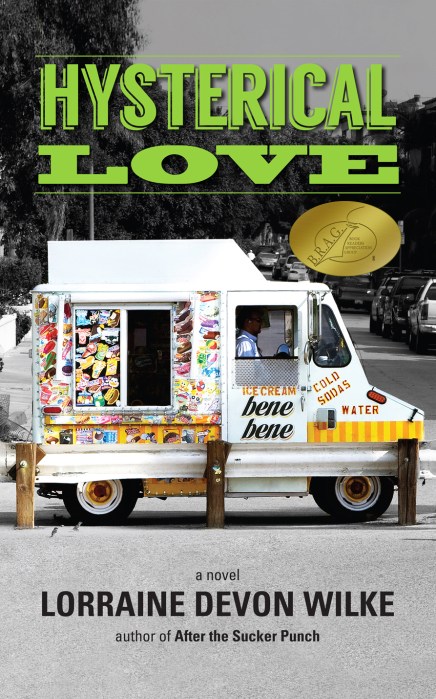
Bene Bene_sm
“Bene Bene” – original photo used for HYSTERICAL LOVE cover

Now, if you’re like me, a creative perfectionist who’s driven many a musician, producer, co-writer, actor, director, sound mixer, editor, or wildly opinionated drummer crazy with detailed, nuanced, and very specific standards and opinions, you’ll understand that the perk of creative control for someone like me is a boon. I’ve always believed that, if you’ve put in the time to truly learn your craft, gain your experience, hone your expertise, and bring to life a beautifully imagined story and set of characters, you deserve the power to render the final edit, pick the title, and decide on your cover art. Certainly working with professionals in the arena of editing is essential, input on titles is always illuminating, and a cover designer is a must-have, but ultimately it all comes down to YOU.

She Tumbled Down_v
“Street Memorial” — Original photo used for cover of “She Tumbled Down”

Which is lovely.

And a book cover, to my mind, is one of the most important elements of the final product. Why wouldn’t it be? Books truly are judged by their covers and too often the covers of self-published books are artistically lacking, poorly designed, and amateurishly rendered. Those covers then become litmus tests to the perusing and reading public, signaling to many that this writer may not have a firm grasp on professional market standards and, therefore, likely hasn’t delivered a professionally excellent book. I’m sure that’s not true in every case, but from all reports: most.

So given my bona fides as a photographer with a deep catalogue of images from which to choose—convenient, considering my preference for photographic cover art—my design process was both financially beneficial and extremely simple. Add in the fact that my cover designer is a brilliant graphic artist from Chicago, Grace Amandes, who just happens to be my sister, and it was a foregone conclusion that I’d get exactly the covers I wanted. And I did.

AfterTheSuckerPunch_front_cover

AFTER THE SUCKER PUNCHwith its story of a woman who discovers on the night of her father’s funeral that he thought she was a failure, needed a female face in the background, one that reflected the mood and emotional tone of the piece. After pulling an image from my gallery—as well as finding a back cover image that illustrated another story point that takes place in Cambria, CA— I handed the images to Grace, who ultimately came back with a cover I loved: 

With HYSTERICAL LOVE, a more whimsical story about a thirty-something guy struggling to find the meaning of true love and his father’s long-lost soul mate, a through-line involving an ice cream truck became the inspiration. There was no doubt I’d be using a favorite photograph taken in my neighborhood and processed with a “selective color” concept (see original above). Grace found the exact right font and color for the title, and it has become a cover that people literally smile over. I do too!

HL front cover_indieBRAG

For “She Tumbled Down,” a short story about a tragic hit-and-run, published only in e-book, I decided to design the cover myself, trusting that, since ebooks don’t require quite the specifications of a print cover, I could pull it off. Inspired by Grace’s work, I came up with another “selective color” version of an image also taken in my neighborhood (see original above). It makes the very poignant point.

She Tumbled Down

Working in both literary and photographic mediums, I’ve discovered my general thrust as an artist is, quite simply, storytelling. Whether visual, literal, or musical, the narrative I see and feel impels the work forward, and so it has been a natural marriage between words and images in bringing my books to happily imagined life…a result that makes all the challenges and occasional indignities of self-publishing all the more easy to forgive!

To view my photography galleries at Fine Art America click HERE.

LDW w glasses


Visit www.lorrainedevonwilke.com for details and links to LDW’s books, music, photography, and articles.

GATSBY BOOKS: Supporting Indie Bookstores That (Truly) Support Indie Authors

Gatsby Books_blog

Oh, sometimes I feel like a curmudgeon, carrying on about cranky bloggers with semantical issues, cultural trends devaluing the value of art, or bookstores that take out their Amazon-pique on innocent, hardworking authors, but today I want to celebrate something worth celebrating: GATSBY BOOKS, a bookstore that clears the air of smoke and semantics to be exactly what it claims to be: an independent bookstore that not only serves its community, but serves the authors who come in to share their work.

Does that distinction seem strange? Were you thinking: doesn’t every indie bookstore support indie authors? Isn’t that an integral part of their mission statement? Isn’t that why so many people shout “save your independent bookstore!!”, friends urge friends to shop local and little, and mega-millonaire authors like James Patterson pledge hard, cold cash to help save this beleaguered business model from extinction?

You’d think so. Up till several months ago that’s exactly what I thought, but that was before my naive little indie-author self became aware of what appears to be standard operating procedure in much of the indie book world: if an author shows up with print copies made by CreateSpace (an Amazon-affiliated company), they are not invited to share their books at said store… even if the book is excellent… even if the author supplies the books… even if the store never has to even think about that company whose name shall not be uttered… even if all their dealings and interactions will only be with the self-publishing, self-peddling, just-trying-to-get-my-work-out-and-reach-an-audience independent author. Nope. Turns out, if there is any connection whatsoever to the hated behemoth, that author’s book is to be shunned in a political effort to be punitive to Amazon.

(Oh, to be important enough that excluding my books really did send a “f**k you” to the big A! 🙂 )

That these stores stock their shelves with thousands of books by traditionally published authors who also sell on Amazon appears to be a moot point. That indie authors are the exact kind of proactive, independent artists these stores should eagerly support is dismissed. That the mean-spirited and myopic attitude of exclusion will ultimately be more damaging to the store than the indie author certainly merits analysis. But right now, none of that matters. We’re not invited. 

I wrote about this sorry phenomenon in an earlier piece titled, Caught Between a Bookstore and That Amazon Place, and since then I’ve had two more “independent” bookstores refuse my work simply because the print copies were made by CreateSpace. They actually stated that as the reason. They didn’t even look at my book. 

Gatsby Books owner, Sean Moore. Photo by Ashleigh Oldland.

Then there’s Gatsby Books. A bookstore of a different color. I was introduced to owner, Sean Moore, by my book publicists, JKS Communications, and after Sean invited me to come in and do a reading/signing event with my new novel, HYSTERICAL LOVE, I drove down to Long Beach, CA, to meet him and get a feel for the store. As you’d expect, it’s a wildly eclectic place with loads of books, flyers and notices on every wall, a cozy area for readings and other events, and, yes, somewhere there’s a cat (featured in the company logo). Sean is a warm, accessible guy, and as we went over the details of the reading, I mentioned to him how refreshing it was to come upon an indie bookstore that didn’t stigmatize self-published authors whose books were printed by CreateSpace. His reply went something like this:

“Look, I don’t like Amazon either, no independent bookstore does, but this isn’t about them; this is about bringing good books into the store for my customers.”

Bravo to you, Sean! Even when I mentioned—’cause I know how challenging it can be to get people out on a Thursday night for an unknown indie author reading a few excerpts from her self-published novel—I couldn’t guarantee how many people would show up, this very cool guy replied:

“If I can sell even five books and introduce new people to the store, I’m good.”

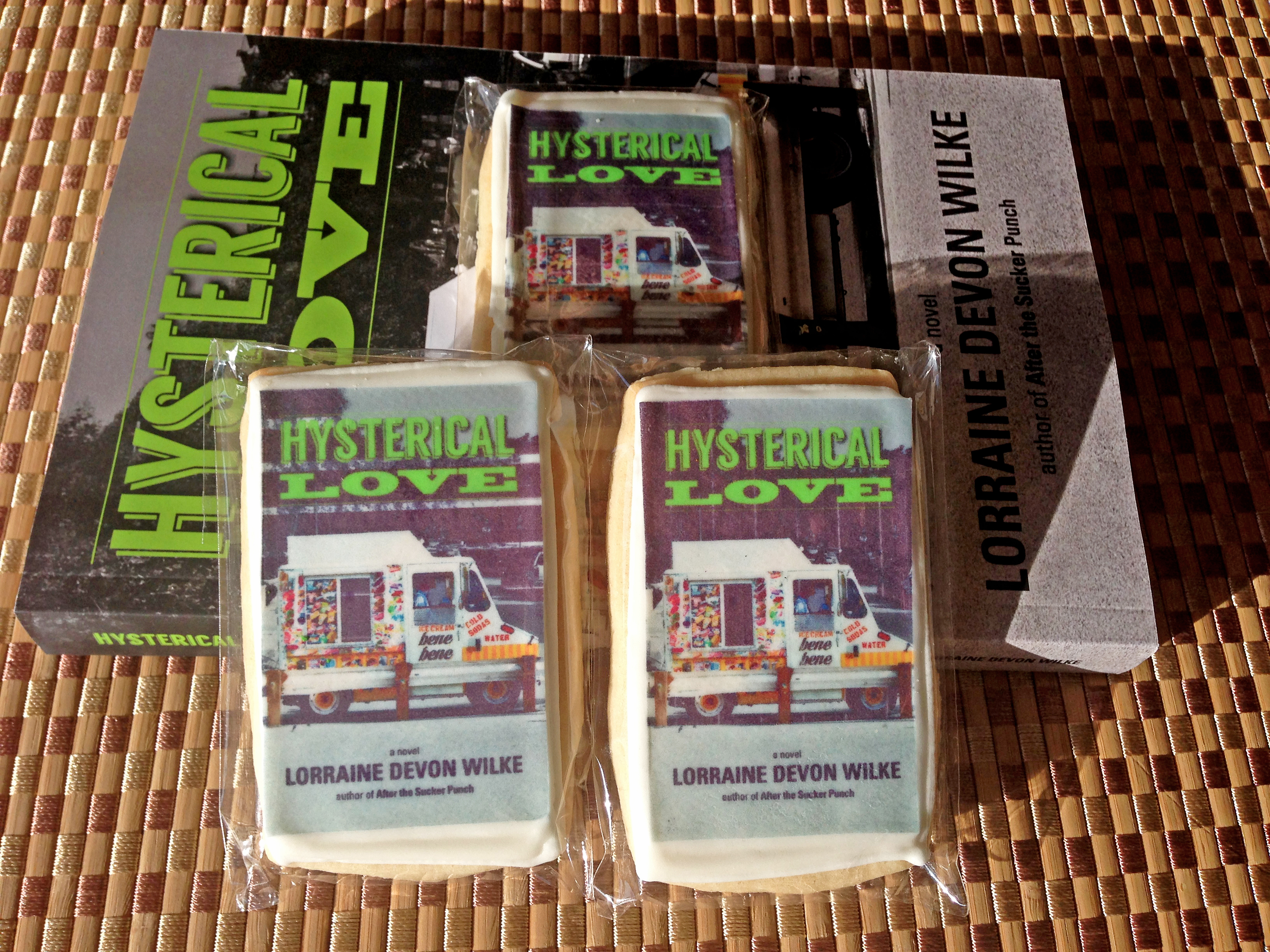
Indeed. Then he said he’d have some wine to go along with my famous book cookies. Seriously, what a guy!

HL cookies

So while other indie bookstore owners are slamming their doors to authors who just might be the next bestseller, who just might bring in passionate new customers, who just might help that store raise its profile by their own marketing efforts, Sean Moore is being both a mensch and a smart businessman. The industry is evolving and will keep evolving—likely in continuing huge and clumsy increments—until the balance between technology, digital delivery, new price models, and changing culture settle into something more predictable (assuming that can actually happen!). The entrepreneurs and creative thinkers who will ultimately survive that plate-shifting will be those who—instead of looking backward, mis-targeting their enemies, and thinking small—are willing to look at the bigger picture, embrace emerging artists in whatever form they come, and understand the inevitability of a changing marketplace. Sean Moore is one of those and I not only applaud his forward-thinking, I’m very much looking forward to sharing my new book with customers who come to his store on Thursday night!

So come on down/up on May 28th to join me… us (we’re featuring a special guest reader, actor and writer extraordinaire, Eddie King). It’ll be a fun night of literary entertainment AND we’ll get to show some support to a bookstore that gets it right.

Let’s see if we can sell at least five books!  🙂

• • • • • •

GATSBY BOOKS Presents a Book Reading/Signing Event for HYSTERICAL LOVE by Lorraine Devon Wilke
Thursday, May 28, 2015, 7:00 pm
5535 E. Spring Street, Long Beach, CA 90808
(562) 208-5862

Books will be available for purchase and signing by the author.

• • • • • •

For more details (or to RSVP) you can leave a comment or click HERE for the Facebook Event page.

And for an interesting interview with Gatsby Books owner, Sean Moore, click HERE.

NOTE: Certainly other independent bookstores are as welcoming as Gatsby Books. I’ve got copies of my previous novel, After The Sucker Punch, on shelves at Skylight Books; other bookstores accept quality self-published work with a fee. If you know of other independent bookstores who will stock the work of indie authors, even those who use Create Space to print their books, please let me know in comments. Let’s get the word out about these bigger thinkers! 

LDW w glasses


Visit www.lorrainedevonwilke.com for details and links to LDW’s books, music, photography, and articles.

Writer or Author? What To Call Whom and Other Industry Silliness

writer author copy

A writing colleague of mine sent me an interesting article recently; wanted my opinion on a piece written by a book blogger with a rather fierce agenda about who gets to call themselves an “author” these days. The piqued pontificator asserted that there are fundamental distinctions to be made between “author” and “writer,” nuances he deemed essential to preventing confusion in the literal and virtual book-buying marketplace.

And here I thought readers just wanted to know which were the good books!

This inexplicably grumpy guy (who shall remain nameless and linkless in a nod to collegial decorum), purports to have his finger on the pulse of the book industry’s beating heart, and takes personal umbrage at our loosey-goosey tendency to let just anyone use the term “author.” Since it’s a matter of great importance to him, and, unfortunately, many others in this rapidly evolving marketplace, I decided to give his thesis a whirl:

According to our parsing pundit, the title of “author” applies only within this very limited parameter: a writer who makes a living with the books they write. Their full-time living. No side-jobs. No article writing, copyediting, babysitting; mowing of the neighbor’s lawn, or even the occasional catering gig. If there is any under-the-table commerce unrelated to the business of the book, well then, they are not an author. They are just a writer.

Why that assignation—writer— is considered lesser, I do not know; but, apparently, it is.

Obviously this semantical corralling would include most self-published authors—I mean, writers—because, except for the select few who’ve managed to self-publish their way to enviable fame and fortune, the rest are busy selling real estate, proofing web copy, or teaching grade schoolers while pursuing their passion on the side…and until they hit their literary jackpot. Our bitching blogger believes distinctions are to be made for these folks.

But even if you agree with him, I have to ask: why should the distinction matter…to anyone? And yet it does. To that particular blogger and others I’ve encountered along the way. So much so that self-publishers who dare refer themselves as “authors” are likened, in some ways, to paralegals posing as attorneys, interns marching hospitals in doctor whites, or security guards puffed up like the NYPD Blue. In other words: pretenders, imposters, frauds.

Really? The distinctions between writer and author are SO carved in stone as to allow the Word Police to pejoratively deny one group use of the more vaunted descriptive of author?  Well, how ’bout we leave it to the dictionary? 

Author: noun; 1. a person who writes a novel, poem, essay, etc.; the composer of a literary work; 2. the literary production or productions of a writer; 3. the maker of anything; creator; originator. Verb: to write; be the author of:

That seems clear. Shall we continue?

Writer: Noun: 1. a person engaged in writing books, articles, stories, etc., especially as an occupation or profession; an author or journalist. [emphasis added]

Yep, as interchangeable as driver and motorist, teacher and educator; trapeze artist and aerialist. More importantly, did you note the first, most important definition of “writer”? According to the dictionary, it’s the writer who’s identified as the professional, not the author!

Holy bloviating blogger, that drops the whole theory on its head!

But while I poke fun at the condescension of said cynic and his ilk, the sad fact remains that they are emblematic of many who marginalize independent, self-published authors as dilettantes and amateurs, relegating them (sometimes literally) to card tables in the back room rather than up on the dais with the “real authors.” Fair? No. But the nose-snubbing endures.

It likely began with the vanity press, that notorious business model that gave amateur writers the opportunity to publish their work for a fee. The narcissism of the option was presumed: anyone who would pay to have their own book made, a book they obviously couldn’t get published through professional means, must surely be a vainglorious sort.

Forget that they might have just wanted a few copies to leave the family.

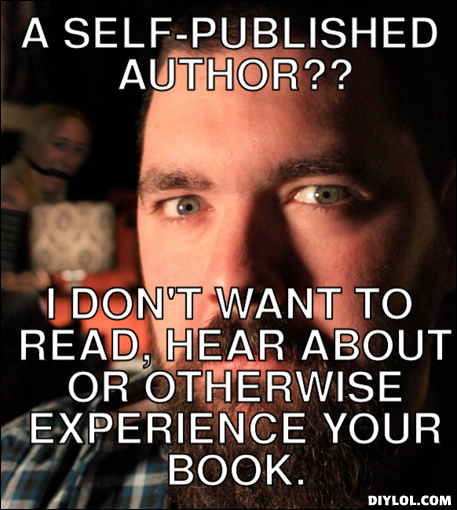
Self-pub meme

But moving past vanity presses came the even more paradigm-shifting digital revolution, which first hit the music industry like a hurricane, forcing analogue studios into Pro Tools machines, and traditional record companies upside-down-you-turn-me. No one was sure how to adjust (it’s still a conundrum…see Taylor Swift and Spotify; see Apple and Spotify, see Spotify and Pandora…), but adjustments were and continue to be made. And artists who’d previously been kept outside the gates were suddenly making and selling their own, affordably recorded, music, while payment formulas, arcane to begin with, went up in smoke. No one knows how anyone’s making a living these days, but there’s lots of great music and many excellent (heretofore ignored) singers, songwriters, bands, and musicians who are finally able to get their work out there. That, alone, is worth a great deal to a great many.

Are they, then—those scratching out a living however they can while playing gigs, hawking CDs, and keeping hope alive on the Internet—allowed to call themselves musicians, recording artists, bands, and so on? Of course! Because they actually are all those things. How they get their art produced and delivered, or how much money they’re able to accrue in the process, has zero bearing on their talent, skill, or the value and artistry of their work.

Or what they’re called.

Is it all good work? No. But it never was all good work, even when record companies were stationed like trolls at the gate. But much of it is astonishing music that would have never seen the light of day under the old regime. And now it’s the audience, the marketplace, that not only has access to many more artists by virtue of this democratization, but will be the arbiter of just how the supply and demand piece plays out.

That same paradigm shift is happening in book publishing.

Since sites like Amazon, Smashwords, Kobo, iBooks, IngramSparks and others have created platforms for independent authors to upload, publish, and sell their work, similar fears, criticisms, and condescensions have percolated. But just as those who naysay indie musicians tend to be backward travelers, so, too, are the curmudgeons who’d generalize, dismiss, and denigrate independent authors across the boards.

Because the talent, skill, and artistry of authors is not based on whether or not they fit the narrow demands of publishers scrambling to stay relevant (or solvent); nor is it based on whether the sum total of dollars they’re able to earn is enough to cover their bills. No; the talent, skill and artistry of authors is based on…drum roll…the talent, skill, and artistry of each individual author. Period.

Is every book by a self-published author a good one? No, of course not. That’s been established. But many are as profound, as resonating, as any good book sitting on the shelf at Barnes & Noble. And, conversely, all one has to do is ferret through a book bin at CVS, peruse the racks at an airport, or consider some of the most viral of bestsellers put out by traditional publishers to find examples of the kind of drek that makes our blogger’s teeth grind.

It’s past time for the media, the publishing industry, book stores, and cultural taste-makers to move beyond elitist, myopic attitudes about the clearly indefatigable self-publishing world. As that demographic evolves, the authors within it will raise their own bar to demand the highest standards from its members: constructive peer pressure designed to make sure the steps are taken, the funds invested, and the necessary work done to deliver the most excellent books possible. And what will happen then is that more and more of those authors will break through the barriers to slowly but surely make more money, get more attention, and find their way onto bestseller lists, award tables, Kindles, and bed stands of discerning readers.

Because they are authors, just as the dictionary confirms: “writers creating original, literary works.” Which is exactly what self-published and independent authors have been doing all along.

Image courtesy of Wellcome Images @ Wikimedia Commons

LDW w glasses


Visit www.lorrainedevonwilke.com for details and links to LDW’s books, music, photography, and articles.

There’s Really Isn’t Much As Lovely As a Tree

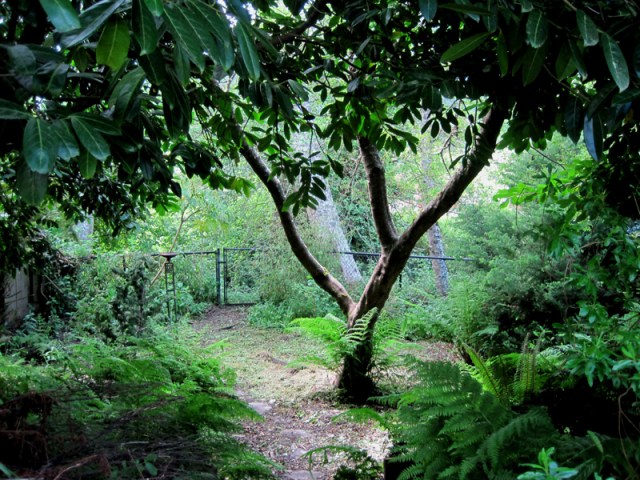
The green curtain, Ferndale
– The green curtain, Ferndale

The prognosis was in. It wasn’t good. General health decline and evidence of weakening structure. There’s nothing anyone can do. The third alder’s comin’ down.

All I can say is, dammit, there goes the forest

Well, our forest, the little one we’ve got wrapped around our yard in Ferndale, CA, that mélange of trees, bushes, ferns, bamboo, and more stinging nettle than anyone should have to wrangle. It’s a hodge-podge I’ve grown to love and I’m not pleased about its seemingly inexorable thinning.

It started a while ago. A towering alder that bordered our back fence (the one you see in the background of the photo above) suddenly crashed down, rupturing the green curtain that comprised our view. My husband reminded me that we’d been told from the get-go that this particular tree was not long for life and my tree-grief should be modified accordingly.

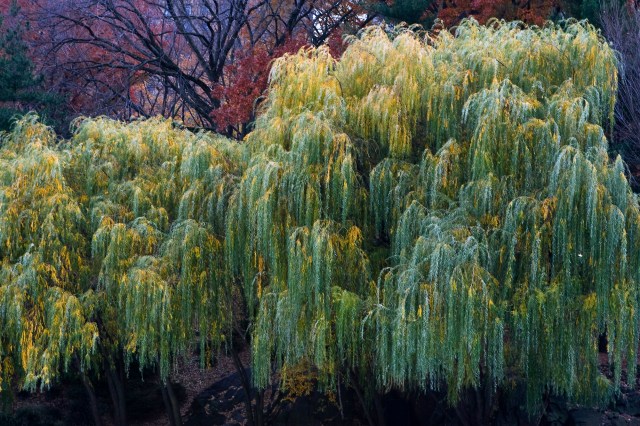
So I moved on; planted a couple of willows; wrapped potato vines around the split-rail; put in another round of drought-resistant whatevers in the front patch, and hoped for the best. The potato vines didn’t make it, but I’m encouraged that the willows are still straggling along (though considering my ideal is the willows of Central Park, odds are good I’m being a bit delusional!).

– Willows of Central Park

Then, like a thunderbolt from Artemis, Dionysus, or whichever tree deity handles alders, the second one tumbled not long after the first, and this one had not come with a terminal diagnosis. No telltale pockmarks, no tilting weaknesses; its leaves seemed plentiful; there was nothing to portend its cruel and unceremonious demise. Now, instead of two auspicious alders bookmarking our backyard, there are wide open spaces and lots more sky.

I love sky. I love wide open spaces. I loved my trees more.

What is it with alders? Their life expectancy is 60-100 years, so I can only assume ours were in the winter of their lives. Old. Clearly not as old as the grand conifers that abound, but old enough for both to die within a relatively short period of time. Maybe they’re like swans, mating for life, and it was a soul mate thing.

I checked an article by David D. Mortimer of the Simi Valley Acorn titled, Ask the Arborist—Death of the Alders, and here’s what he had to say:

“Why are so many alders dying? Could it be bugs? Some nefarious disease? Global warming? Hardly. How about this: They are just being alder trees, doing what alder trees do. That is pretty much the story. Alder trees have a comparatively short lifespan, especially when they’re not in their native habitat. They’re definitely not a drought-tolerant tree.”

Maybe it is the drought. Or maybe they were just old (and God knows I have respect for that state of being!).

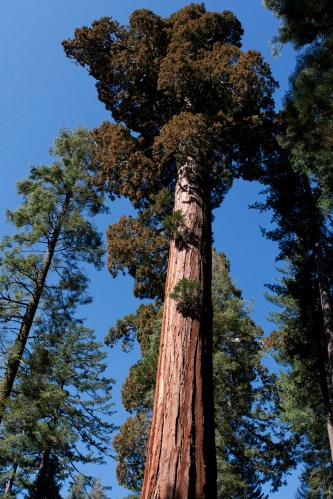
– Big Yosemite Tree
– Big Yosemite Tree

I’ll admit: I’m a bit of a tree-hugger. I wept openly decades ago (scaring my then-toddler son) when a misguided gardener hacked the life out of a majestic conifer outside our picture window. I practically caused internecine crisis years back when I stomped off a friend’s property after they described the house that’d be going up after the old-growth cedar came down… the one I’d just been hugging (yes, literally hugging). So it’s a thing with me, that’s seems clear.

Obviously in forested territory like Humboldt County tree-love has to find balance with the essential and job-providing lumber industry. And let’s face it, who doesn’t love a wood house, gorgeous hardwood floors, the warmth of beams and rugged fence work. Balance is the key, and I figure as long as everyone involved is a responsible steward—thinning, replanting, selective harvesting in lieu of full scale annihilation—one can hardly raise a ruckus. But given the essential role trees play in the holistic health of our planet—balancing carbon dioxide, providing habitat, preventing erosion, and so on—protective and proactive attitudes and actions are always a wise investment.

In fact, I recently stumbled on a GoodNewsNetwork.com story about an ex-NASA engineer who plans to use drones to plant one billion trees a year. Really.

Drones will fly two or three meters above the ground and fire out pods containing pre-germinated seeds that are covered in a nutritious hydrogel. The company’s CEO, who might be called ‘Johnny Apple Drone’, thinks it should be possible to plant up to 36,000 trees a day, and at around 15% of the cost of traditional methods. And they aren’t just looking to create plantations of trees, but full ecosystems.

“Together with tree seeds, we hope to seed in other species including micro-organisms and fungi to improve the soil quality and ensure long-term sustainability of our efforts.”

I’d say that’s not only dedication, but a far better use of drones than blowing up things!

All this matters to me because, on a global scale, I want to see the integral value of all trees honored and protected worldwide. On a local scale, I’m mourning the loss of that third alder on our property. (See, my scope is both macro and micro!) Though, actually, it’s not on our property; it’s on city property, a stately specimen that not only contributes to our personal forest, but is precariously perched so that if/when it goes, its sheer size will bring the fall trajectory not only onto our property, but our roof. Not good, clearly.

We’re told the tree may have some time left, so it’s possible just topping it will deliver us from danger and give us all a few more years. I hope so. I want the tree around a bit longer. I also want my roof.

– Peg's backyard
– Peg’s backyard

But I have discovered a brilliant assuagement for tree loss, particularly those that have fallen worldwide for one reason or another. There’s a site called StandForTrees.org, where contributing just $10 “keeps one tonne of CO2 from entering the atmosphere by supporting local and indigenous communities protecting forest in developing countries.” That’s right; you get to pick your forest. I love the idea. So far I’ve bought three tonnes and I plan to buy more. If you love trees, or you just want to take part in helping the planet, you don’t have to be a tree-hugger; you just have to buy a tonne. Or two or three. I urge you to visit the site and learn more about it; it’s a very innovative business model. And it’s saving trees.

So as I mourn the imminent thinning of my forest, I’ll take solace in managing my metric tonnes and getting out there to see what else can be salvaged in the yard. The magnolia is looking good and it’s certainly time for those willows to start flourishing…

Adapted from article originally published @ The Ferndale Enterprise on May 7, 2015.

Peg’s Tree, Willows of Central Park, Big Yosemite Tree, & The Green Curtain photos by LDW

LDW w glasses


Visit www.lorrainedevonwilke.com for details and links to LDW’s books, music, photography, and articles.

Mother’s Day Celebrates Life, It’s Not An Act of Exclusion

As I was doing research for a piece at HuffPost, I Don’t Care If You Don’t Want Children…Really, I became increasingly dismayed by the bitterness and resentment bubbling under the surface of our current parent vs. non-parent wars. As some in my circle remarked upon reading my article: “Who knew?”

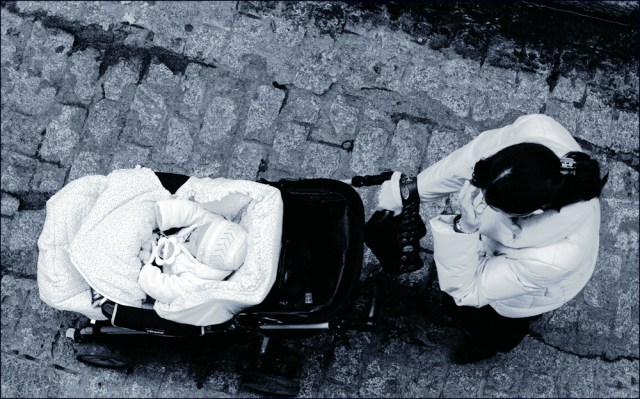
– Passing Down Below

Indeed, who knew that the procreation imperative, imprinted in humans since the beginning of man, had unleashed such competitive envy, defensiveness, judgment, and self-pity? But it seems it has. Reams have been—and continue to be—written on the topic (my mentioned article has links to several), to the point that even the sweet tradition of Mother’s Day has been put under the gun by cultural flamethrowers:

“I did not raise my son, Sam, to celebrate Mother’s Day. I didn’t want him to feel some obligation to buy me pricey lunches or flowers, some annual display of gratitude that you have to grit your teeth and endure.”

* * *

“Mother’s Day celebrates a huge lie about the value of women: that mothers are superior beings, that they have done more with their lives and chosen a more difficult path. Ha!”

* * *

“I hate the way the holiday makes all non-mothers, and the daughters of dead mothers, and the mothers of dead or severely damaged children, feel the deepest kind of grief and failure.”

Think those lines were uttered by one of the curmudgeons at Fox News? A churlish blogger with generalized anger issues? Some embittered naysayer who rains on the parade of any holiday celebration? You’d be wrong. They were all part of very gifted writer, Anne Lamott’s, takedown on the matter of Mother’s Day, a surprisingly caustic rant that seemed out-of-character for the usually wise and compassionate author. Not only is Ms. Lamott put off by the singling out of mothers on this special day, she goes so far as to assert that 98% of parents not only feel themselves superior, that same percent believes non-parents simply cannot know the level of love they know. To which I sigh, “Really?? I have not met those parents. Apparently the people I know are in the other, more rarified, 2%.”

COME ON, PEOPLE!!

happy coupleThe fact is, yes: while everyone has been a non-parent at some point in their life, no one who has not had children can know what it feels like to have children. Fact; not judgment. Just as I cannot know what it feels like to climb Mt. Everest, go hand-gliding, or bungie jump off a bridge. People can tell me the attendant exhilaration is like no other, and I believe them; but I wouldn’t know. That they’ve had that experience does not make them superior; it just means they’ve had an experience I have not.

Maybe it’s a lame analogy, but the same applies to parenting. Whatever that experience is for anyone, it doesn’t make them superior. But let me also add: no one I know feels superior simply because they’re a parent. They may feel superior about other things, God knows, but the mere fact and act of procreating is not something I see anyone hoist as a measure of personal value or worth. It’s just part of who they are and how they’re living their life. Like being a teacher, a doctor, lawyer, or landscape artist.

If those who are childless-by-choice, who have lost, or who cannot have children, feel minimized and/or dismissed by the parents in their circle, either they’re hanging out with the wrong people (who likely act superior and callous about a great many other things as well), or they need to look inward to see why their pain and heartache, or their choice, compels them to judge others so negatively. It’s one thing to step away from a Mother’s Day celebration because it’s difficult to be reminded of what you can’t have, don’t have, lost, didn’t want, or had an unpleasant version of; it’s another to denigrate the holiday and people celebrating it.

I don’t usually get involved in social media hot-topics these day, but frankly, as a mother, a woman, and an optimistic human who believes we each have the power to manage our joys and sorrows, I was stunned by both Lamott’s thesis and the vitriol of some of those commenting. The language of this seemingly metastasizing conflict is counter-productive and presumptuous enough that, ultimately, I felt a need to respond on the thread:

I usually agree with your wonderful posts, Anne Lamott, but find this one sad and oddly cynical. Celebrating mothers is not, in any way, a dismissal of the myriad roles men and women play in making this world go around. Nor is it about “pricey lunches or flowers, some annual display of gratitude that you have to grit your teeth and endure.” That WOULD be a sad thing, and if that’s what the holiday means to you, I can understand why you never celebrate it with your son!

I cannot help but hear a certain victim tone in your assertion that by celebrating one set of people, “superiority” is being asserted over another, the non-parent people in our midst. Not only is that not true, there is narcissism and bitterness in the belief that makes me sad…that somehow you feel the universe doesn’t provide enough joy for us all, so much so that you begrudge the celebration all together. In fact, the day is NOT another faux-separation of women-who’ve-had-kids vs. women-who-haven’t, a construct that seems rampant these days. ANY woman who has been a mentor, a leader; a caregiver, a teacher, or a nurturer is honored on this one little day. Not at the exclusion of anyone else. We’ve got days to celebrate fathers, our God-figures, the birth of the nation—hell, even secretaries; we can surely spare one day for the mother/nurturers in our midst.

Nor do most of us approach the day with a presumption of “guilt” being the driving force behind our children’s cards, our family’s emails of love; our colleagues’ and friends’ hoots of “happy day!” For many of us, Mother’s Day is simply a day to give a nod to the women in our lives who’ve provided nurturance and compassion, whoever they may be and regardless of their parental status. It can be done with a simple hug, a card, a text, a phone call, a warm smile, an “I love you”; maybe a homemade breakfast, a walk on the beach, or shared space on the couch watching a movie. No money has to be spent; no endurance required.

But to say “Mother’s Day celebrates a huge lie about the value of women: that mothers are superior beings, that they have done more with their lives and chosen a more difficult path” is such a sadly negative and ungenerous perception. I don’t know where you get that “98% of people think….” negatively about non-parents, but Anne, none of the parents I know believe celebrating mother/nurturers makes any such statement! Dear Lord, we cannot live our lives so afraid of offending someone or making someone feel left out that we eschew honest, joyful celebration. Even the women who are not mothers were born of mothers, have strong female role models, etc… how about turning the day into a celebration of them!?

Maybe you feel your stance on this is democratizing, but I’d ask that you look at the edge in your philosophy and consider that you might have made some presumptions about those us who’ve had children that simply don’t ring true.

For now, I’m going to go leave for a walk on the beach with my family, to celebrate me, our children, our mothers, our mentors, and our nurturing friends (some of whom are not parents!). And it will be a great day. I hope somehow you have one too.

That pretty much says it all. For me, anyway.

family-reunion-09

Look, life is short, obstacles are many, and most of us are focused on living meaningful lives infused with as much joy and happiness as possible. When a holiday presents an opportunity to celebrate the essence of love and compassion as symbolized by the life-giving role of “mother”—a title and role that can be applied to any person who nurtures and mentors—the wiser person acknowledges that intent, and either joins in, or steps aside to allow others to join in. The person less wise and considerate makes it about them, about less, about what they don’t have that others might; what they don’t wish to celebrate that others do.

Let’s not do that. Let’s rise above, let’s exude generosity of spirit; let’s allow that each one of us is having our experience and one does not negate the other.

So to my friends and family celebrating: Happy Mother’s Day… said with all my authentic, guilt-free, non-superior, all-inclusive, openhearted love, and good-will!

All photos by or by permission of me.

LDW w glasses


Visit www.lorrainedevonwilke.com for details and links to LDW’s books, music, photography, and articles.

Hysterical Love: The Perfect Vacation Read With Ice Cream

Getting a positive review that conveys the reviewer’s enjoyment of your book is always a great experience. Getting a positive review written by someone who speaks with such an articulate voice, with depth of perspective that goes beyond the usual, is truly worth mentioning. Thank you, Barb Taub, for “getting” it and so beautifully writing about it!

barbtaub's avatarBarb Taub

IMG_20150415_141507_hdr_kindlephoto-178064415I read Hysterical Love at one go, sitting on a park bench on a sunny afternoon at the Tuileries Garden in Paris while my daughter toured the Louvre. She came out before I was quite done, so I sent her for ice creams. Toffee, of course. She came back with salt caramel. Close enough.


The Story

 
HL_front_cover_hi_resDan McDowell, a thirty-three-year-old portrait photographer happily set to marry his beloved Jane, is stunned when a slip of the tongue about an “ex-girlfriend overlap” of years earlier throws their pending marriage into doubt and him onto the street. Or at least into the second bedroom of their next-door neighbor, Bob, where Dan is sure it won’t be long. It’s long.
 
His sister, Lucy, further confuses matters with her “soul mate theory” and its suggestion that Jane might not be his… soul mate, that is. But the tipping point comes when his…

View original post 1,575 more words