Sharing An Editor’s Perspective On the Quality Debate: Meet Jamie Chavez

Jamie Chavez
Jamie Chavez’s Blog Banner

As one who is hellbent on making sure my points, my theses, are all thoroughly clear and understood, I find that when evidence suggests I’ve not succeeded, I occasionally go overboard with “clarifications,” addendums, updated material, etc., in a quest to correct the problem. What I discover is, more often than not, there really is no problem, just the dissent of those who do not share my opinion (sometimes with horribly bad manners!). So when a tweeting follower sent me an article that supported a controversial theme I covered recently, I paid attention.

When I published Dear Self-Published Author: Do NOT Write Four Books a Year, a strongly worded (I’ll admit 🙂 ) opinion piece about the “quality vs. quantity” debate that inspired prodigious pushback from angry writers, I considered that I’d taken, perhaps, too broad a brushstroke about who ought to publish in volume (those who vigilantly take the time and care to put out excellent work regardless of how often) vs. those who shouldn’t (anyone who doesn’t). But no amount of clarification would mollify the angry mobs who found my theory heinous, so I left it where I could and got on with my life.

photo_jamie
Jamie Chavez

Then this article was sent my way, That’s Not Writing–It’s Typing, and I felt the writer, developmental editor/writer, Jamie Chavez, not only echoed some version of my thesis, but very possibly did a better job of articulating the issues. Have a read:

A good friend of mine proofs for a small firm that publishes category romances. Her social media commentary about it is hilarious (and most of it unprintable in a family blog like this one, though recently I learned the word throbbing, among others, is currently out of fashion in the romance novel biz).

It’s a time-honored, legitimate publishing endeavor, the writing of romances—and whether they are PG or sexy or hard-core, there’s a huge fan base of smart, savvy romance readers out there. Don’t believe me? Check out the Smart Bitches Trashy Books website, which has been doing a booming review business for ten years now.

If you’re a writer, then, this is a huge market you might want to tap, n’est-ce pas?

Oui. As Entertainment Weekly notes, “Romance novels were once the book world’s dirty little secret. No more. Thanks in part to e-readers and Fifty Shades of Grey, they’re now the hottest fiction genre going.” Even Jane Friedman, to whose blog I subscribe, wrote a piece about a highly successful self-published author, Bella Andre, and what other writers could learn from her path to success.

Who is this Bella Andre? I wondered. EW says,

In 2010 Bella Andre was dropped by Random House after her firefighter romance series failed to generate sales. She’d spent the previous seven years shuffling between publishers, and now it seemed that her career was over. … Some friends and romance readers encouraged the writer to self-publish. So in July 2010 she uploaded the fittingly titled Love Me—a sequel that her then publisher, Simon & Schuster, had never wanted to put out. She sent personal notes to every fan who’d ever contacted her during her career, urging them to seek out the new book on Amazon. “I probably made $8,000 that month, which was bigger than the advance of $5,000 I’d been offered by Plume, and I retained all the rights,” she says. Five months later she self-published another sequel, and within weeks she became the first self-published author to hit the top 25 on Barnes & Noble’s Nook best-seller list, selling 1,000 books a day.

I didn’t know that when I read Friedman’s piece, though. So I looked up this woman’s best-selling books. They must be good, I thought. And I bought one, in spite of the dreadful cover. (That should have been my first clue.)

Continue reading full article….

Excellent piece. Excellent points. Thank you, Jamie, for your wise, experienced, and useful contribution to the debate.  

LDW w glasses


Visit www.lorrainedevonwilke.com for details and links to LDW’s books, music, photography, and articles.

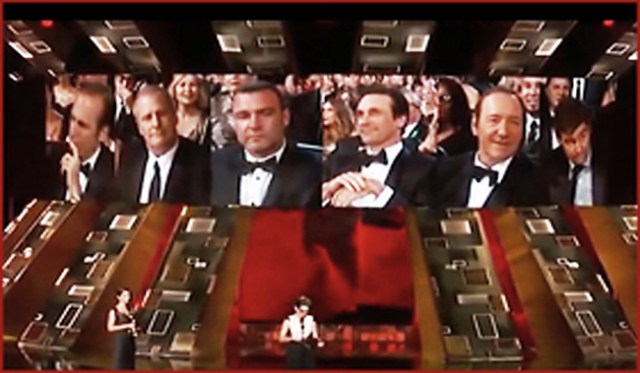
I Did It Again: I Watched the Emmys… And I Still Hate Award Shows

Waiting-to-win_articleNot because I don’t think people deserve to win awards. Awards are lovely. I’ve won a few myself and they’re a wonderful acknowledgement of work well done, of community and/or peer approval; a fabulous reminder that people are actually paying attention to what exactly it is you do. But still…

I swore a while back that I was going to retire my tiara and not watch award shows anymore, and I meant it. But it was a slow night Sunday, I was feeling too lazy to work, and I was invested enough in a couple of shows and performers that I worked up a little curiosity. But not even minutes into the whole thing I was reminded of what remains the same for me: my resistance to the sheer cruelty of this entertainment tradition. 

When I sit and watch that moment, the one before the announcement is made, when the five (or whatever) amazingly talented people are all, still, of equal importance, waiting breathlessly to hear if they got the prize, their faces set in what is, no doubt, a considered non-expression that belies the anxiety they’re feeling, I get a little queasy, I can’t help but think to myself: why on earth are these accomplished, talented people who have all done stellar work being put in a position where they’re essentially pitted against each other like beauty contestants? All so just one of them gets to feel that “special acknowledgement” while the rest walk away as non-winners. Why do we do that to our most talented performers? Why?? 

I dunno. It seems crazy to me. I mean, I was delighted to see the wonderful Olive Kitteridge win a slew of awards, including one for Frances McDormand, whom I adore, but when I think about how stunning Maggie Gyllennhaal was in An Honorable Woman, I wonder why she has to feel passed over in any way, shape, or form, when she, too, did amazing, kudo-worthy work. Is it lesser work? NO!! Not even close. It’s just the work that did not get picked by a subjective bevy of voters who chose a “best.”

It would be one thing if there were actually some tangible, quantifiable criteria to winning these things—whoever hits the most targets with a bow & arrow, or whoever jumps the highest on the trampoline game show on Trampolinea.com, or which one correctly answers the most trivia questions asked by Al Roker—then, maybe, the winner would be clear-cut and undeniable. As it is, once you’ve got five equally extraordinary actors and performances nominated, it’s about any number of arbitrary things: popularity, public relations success, who’s trending, which person has been nominated more and not won; which show is going off the air and deserves a nod; which person brings the highest level of good will or political approval, etc. That’s all it can be, because there’s no way you can look at the work Ben Mendelsohn did in Bloodline, or Alan Cummings in The Good Wife, and say either was not as worthy as Peter Dinklage’s wonderful work in Game of Thrones. Nor are Tatiana Maslany or Claire Danes any less worthy than Viola Davis.

As thrilled as I am for those who won, as deserving as they each are, I can’t help but feel a pang of empathy for those who did not, as they are all, surely, as deserving of the win as the ones who actually won. Or something like that. 

But we love our awards shows and they will go on and on, with pomp and circumstance, winners and not winners (we don’t say “losers”), oddsmakers and party planners, a tradition built around arbitrary choices about who’s “the best.” And while many will watch with anticipation, surrounded by good friends, prodigious snacks, and the occasional cocktail, cheering whoever makes the cut with authentic enthusiasm, we all know that everyone up there is completely and equally deserving, equally appreciated, for giving us incredible performances while working at the top of their game. Cue the applause. For all

Related article: Why I’ve Retired The Tiara And Won’t Watch Award Shows Anymore

LDW w glasses


Visit www.lorrainedevonwilke.com for details and links to LDW’s books, music, photography, and articles.

Death By EL James… a take from Tara Sparling

0d231378936ee6ac6f567c2d2e94d051
Tara Sparling

And now for a complete change of pace: some Fifty Shades of Grey silliness from one of my favorite bloggers. Enjoy the many interpretive imaginings of this iconic tome, pulled from the depths of Sparling’s stylistic playbook….

And be sure to go check out the rest of her blog at Tara Sparling Writes. She’s easily one of the funniest, most observant commenters about the writing scene around. 

  * * * * * * * * * 

Tara Sparling's avatarTara Sparling writes

When I threatened to kill a bunny by reading it EL James’ Grey until it ran headlong and arse-ways into traffic, some thought me callous. Some thought me justified, because the furry little gits give them nightmares. Someone else coined the phrase “Death by EL James”, which immediately sounded to me like a great story title.

So without further ado, here are not one, but five – count ’em! – five different versions, in five different genres, of Death By EL James. (I have yet to take action on the bunny – it all depends on whether you’ll vote for me in the 2015 Irish Blog Awards here and here before September 21st. Just sayin’)

Death By EL James

1. Literal

Oh, my! she thought, as he came with the knife. Was he going to stab her? She’d never been stabbed before. But she was sure it would be delicious. It was a very large and magnificent knife. She was sure none of the…

View original post 608 more words

Step Away From The (Misguided) Advice and Do NOT Write Four Books A Year

Book

No matter what experts tell you, no matter what trends, conventional wisdom, social media chatter, or your friends in the Facebook writers group insist upon, do NOT write four books a year. I mean it. Don’t.

Unless they’re four gorgeously written, painstakingly molded, amazingly rendered, and undeniably memorable books. If you can pull off four of those a year, more power to ya. But most can’t. I’d go so far as to say no one can, the qualifier being good books.

Beyond the fact that the marketplace is glutted with an overwhelming number of books already (many of dubious quality), writing good books simply takes time, lots of it. There’s no getting around that time. It involves learned skills, unhurried  imagination, fastidious drafting, diligent editing, even the time to step away, then step back, to go over it all again. And, unless you’re a hack (and we know there are plenty of those out there), isn’t the whole point of this exercise to write good books? 

Our most highly esteemed, widely applauded, prodigiously awarded, read, and revered authors know this to be true. Donna Tartt, last year’ s Pulitzer Prize winner for The Goldfinch, took eleven years to deliver that masterpiece. This year’s winner, Anthony Doerr, had only written four books in his entire career before he penned All The Light We Cannot See, wisely taking years to craft his stunning tale. The cultishly-beloved Harper Lee had only To Kill A Mockingbird in her catalogue before this year’s controversial release of Go Set A Watchman (which some are convinced was not of her doing). Even others amongst our best, who do put out work on a more regular basis, do so with focus appropriately attuned to the quality of the book, not the depth of their catalogue or the flash-speed with which they crank out product. 

photo-1462642109801-4ac2971a3a51

But, you say, I’m not interested in writing Pulitzer Prize winners, I don’t need to be on The New York Times bestseller list; I just wanna see my name up at Amazon and sell a few books to family and friends, and, hey, if I go viral, all the better! They say write to the market, so I gotta write to the market. I mean, look at E.L. James…she’s hardly Chaucer and look what’s happened to her!! 

Point taken. Which actually brings us to the point: what is your point?

What’s your point as a creative, an artist; an author? A purveyor of the written word? Why are you here, what is your purpose, your goal as a writer? What do you hope to achieve? Is it fame and fortune at any cost, quality be damned? Or is it about finely crafted work? It’s important to know, to decide, because those principles will guide and mandate every decision you make from there on out.  

I bring all this up because I experienced a snap the other day, one triggered by an article from Self-Published Author by Bowker called,Discovery: Another Buzzword We’re Wrestling to Understand.” In it, the writer lists many of the familiar instructions toward procuring success as an indie writer — social media, book reviews, networking, etc. — but her very first suggestion to self-published authors looking to get “discovered” was this:

 Publish. A Lot: For those of you who have spent 10 years writing your last book I have news for you. You have ten days to write your next one. Okay, I’m sort of kidding with the ten days but, candidly, the most successful authors are pushing out tons of content: meaning books, not blog posts. In most categories, readers are hungry for new reads, new books, and willing to discover new authors. You’ll have a better time getting found if you continually push new books out there. How many should you do? At a recent writers conference some authors said they publish four books a year. Yes, that’s right, four.  [Emphasis mine]

Wow.

So her first piece of advice to self-publishing authors wasn’t to put more focus on fine-tuning one’s craft, it wasn’t about taking time to mull and ponder what stories, what narratives, most inspire you to put “pen to paper”; it wasn’t even a suggestion to be relentless about working with professional content/copy editors and cover designers to create the best possible version of your work. No, it was the insanely insane advice to pump out at least four books a year. 

And people wonder why there are stigmas attached to self-publishing.

First of all, in looking at her point of reference, it depends on what you define as a “successful author.” I have a distinct feeling this may be where the disparities lie. Perhaps my own definition is a different one. 

When I self-published my first book, After The Sucker Punch, in April of 2014, I had, by then, put years into it, doing all those many things I itemized above. Because I not only wanted to publish a novel, I wanted that novel to be a work of art, a book of depth and merit, one that would not only tell a compelling story but would meet standards of publishing that authors of the highest regard are held to. I wanted it to be a book that would favorably compare with anything put out by a traditional publisher. My choice to self-publish was a result of not having engaged a publisher by the time my book was done and I was ready to market it. It was not based on the notion of joining the “second tier club” where one is unbound from the stricter, more demanding standards of traditional publishing. 

“Second tier club”? Yes. As insulting as that sounds, particularly in relation to self-publishing, there is no question that there are two tiers operating in the culture of the book industry. Take a moment to think about it, if you find that off-putting and you will see the evidence:

Based on what advice is given to self-published writers, some of which I shared above; based on the”free/bargain” pricing paradigms of most book sellers hawking those writers; based on the corner (quality)-cutting measures required to pump out endless product to meet the purportedly endless demand of those sites and their bargain-hunting readers, “second tier club” is no misnomer.

Where the best of traditional publishers set their sites not only on commercial viability but award-quality work, nurturing authors with enduring skills and profound stories to tell, in a climate that is selective (perhaps too selective) and based on the notion that that level of quality and commercial appeal is a rare and valued commodity, self-published authors are advised to, “Crank out loads of books; if you have to write little teeny short ones to get your catalogue pumped up, do that! Don’t worry about covers; your readers don’t give a hoot about artwork. It’s all about genre, easy reads, and low, low prices! And speaking of low prices, don’t even think about selling your books for more than a dollar or two, because readers who do bother with self-published books are too accustomed to bargain-basement prices to spend any more than that. This is the 99¢ Bargain Circus Book Store, where we push quantity over quality every day of the week!! CRANK OUT THAT PRODUCT!!”

I’ll bet good money Donna Tartt, Anthony Doerr, and other quality writers aren’t getting that same message from their publishers. First tier, baby.  

Look, if your point and purpose as a writer is largely related to the numbers—of books sold, of Amazon ranking, of reviews garnered, of Twitter followers and Facebook “likes”—then, certainly; follow the advice of the article quoted about. I know many self-published writers who are, and though I have no idea how well that’s working for them, it’s certainly the prevailing trend. 

But if your point and purpose as a writer is to take someone’s breath away, capture a riveting story, translate an idea—whether fantasy, love story, science fiction, human interaction, tragedy, thriller, family saga, memoir, non-fiction—in way that raises hairs or gets someone shouting “YES!”; if you’re compelled to tell that story so beautifully, so irreverently, with such power and prose as to make a reader stop to read a line over just to have the opportunity to roll those words around one more time, then don’t listen to that advice.

Instead, do the opposite: take your time, work your craft; look for the best possible ways to tell your story and allow yourself time to change your mind, sometimes often, until you know it’s right. Allow your editors time to help you mold your narrative into peak condition. Give your formatters and copy editors time to comb through your manuscript, again and again, to make sure everything is perfect. Work carefully with your cover artist to create the most gorgeous, most professional book cover you can. TAKE YOUR TIME.  

photo-1469460684636-7c3d8da2241e

Then take lots more to research marketing options; ask questions, weigh contradicting information, and come up with the best possible strategy for your book. Do what you choose with professionalism and without the misguided and frantic push to the “top of the list,” a pervasive attitude so rife with desperation and panic. You’re not in a race, with anyone. You are a professional author working your book your way. Be an artist, don’t be a carnival barker. Be a wordsmith, not a bean-counter. Be patient, not hysterical. Transact commerce wisely, but don’t lose your creative soul in the process. 

I know I’m bucking the trend here, and certainly there are quality issues and dubious motivations floating around both tiers. It’s also certain that, if you follow my lead, you will not be able to write four books a year, at least not four full-length books. You will write, perhaps, one. But if you do it right, taking time and taking care, you will have written one excellent book. One you’ll be proud of years from now. One your friends and family will keep on their book shelves. One readers across the globe will talk about on social media. One that tells the world, I am a writer and this book is my legacy. Then you’ll go write another of those…and so on.

The rest of it—sales, rankings, reviews, viralness, likes, tweets, awards, kudos, peer admiration… all that? If you do it right, if/when any of those things come, they will be warranted and well-deserved. You can celebrate them authentically, because you did not sell your creative soul to get them. You actually made the far, far better deal.

UPDATE: An addendum to this piece can be found at OK, So How About This Instead: Write As Many Books As YOU Choose…

Book photo by Gaelle Marcel
Fountain pen & book by Aaron Burden
Book stacks by Simson Petrol
Man writing by Evan Clark

LDW w glasses


Visit www.lorrainedevonwilke.com for details and links to LDW’s books, music, photography, and articles.

Loving A Little Love From Kirkus, indieBRAG, et al.

photoart by Brenda Perlin
OK, remember my
last post, about the “necessary evils of self-promotion”? Well, here we go, right here… sit back and enjoy a little “sonata for horn ensemble”…

When I was prepping for the launch of my latest book, Hysterical Love, I approached it with more forethought than was applied to my first book, After The Sucker Punch. Despite that book doing remarkably well (and still doing remarkably well) via my own little independent author efforts, this go-around I opted to work with a wonderful publicist, Julie Schoerke at JKSCommunications. She and her team were very helpful in sorting out and working on the most effective options available to me, given my indie status.

Because it does get confusing. For every blog, site, “expert” that tells you to do this or that, another slew will say something akin to the opposite. Additionally, (and I’ve written much on this) the unfathomable glut of indie books, along with the subsequent media nose-sniffing and stereotyping, have conspired to make it difficult for any indie author to leap through the burning hoops requisite for success. But still; we are writers writing books and once you’ve written a book you love, you’re obligated to get it out there and market it into vibrant life, come hell or high water. 

But back to the publicist: amongst the many words of wisdom she imparted during our time together, and after I asked her specifically about industrial-strength review sites like Kirkus and Foreward, she expressed an opinion I was not expecting: go for it, she said. She felt those two, of all the like-options, were valid, bona fide; often very tough, but worth the pursuit in that they have great reach and tremendous influence on what books people pay attention to. So I pursued Kirkus, fingers crossed that I wouldn’t get eviscerated. 

But I did wonder about that purported toughness, because I couldn’t help but notice there are few (if any) negative reviews posted, for example, at Kirkus. Then I discovered that every reviewed author has the option to not publish the review they receive if it’s a negative one… which explains the disproportionately jolly outcome of what’s up there! But what a charitable option, I thought. Who wants a gutting review from one of the biggest book/media resources in the world bouncing all over the internet for the rest of time if there’s an option to opt out? I felt at least assured of having some control over whatever Kirkus outcome came out.

And what came out was a lovely, largely positive review that I’d be happy to share with even my mother! I was delighted, because whatever one thinks of such “shallow pursuits” as reviews (something an acerbic blogger snarked to me once), having positive perspective of your book bandied about is much better than the opposite. Here’s the takeaway quote:

“Wilke is a skilled writer, able to plausibly inhabit Dan’s young male perspective… A well-written, engaging, sometimes-frustrating tale of reaching adulthood a little late.”   

I don’t know about the “frustrating” part (they also took exception with my protagonist’s behavior with a bit more verve than I might’ve, but others have also found him such, so likely I’m biased!). And though I didn’t garner one of their “stars” or “prizes,” I was grateful to get what I got. Yippidy do dah day! May floods of Kirkusian readers come rollin’ my way!  

The other “love” Hysterical Love garnered this week was the very lovely B.R.A.G. Medallion from indieBRAG.com. This acknowledgment is awarded by book clubs and readers affiliated with the site, and it really is quite an honor (my debut novel, After The Sucker Punch, is also a Medallion honoree). The site’s president. Geri Clouston, as well as its most public and passionate voice, Stephanie Moore Hopkins, are incredibly supportive and generous with their “honorees,” and the nod from them and their organization is always a welcomed gift… thank you!

To cap off this utterly self-serving but authentically felt trumpet solo, I’ll end with the other two accolades recently received: a wonderful review from Literary Fiction Book Reviews:

Hysterical Love is a deftly told tale about not only the search for love in the 21st century, but about seeking a greater understanding of the intricacies of the human heart, about love in all its various forms and disguises: puppy love, lost love, emerging love, enduring love, and of course, hysterical love.” (Read more…) 

And another from the sweetly enthusiastic Tracy Slowiak at Readers’ Favorite Book Reviews:

“Oh my, oh my! I just finished reading Hysterical Love, the newest novel by Lorraine Devon Wilke, and I must say, I simply adored it! …I loved this book! Loved, loved, loved it. Wilke’s writing style is witty, pointed and funny, even hilarious at times.” (Read more…)

So yes, a good run.

But here’s the thing: none of this matters if you, the readers, aren’t inspired to get out (or get to your computers) to buy and read said book(s)! What ultimately matters most to me is that reviews and awards spark a, “that sounds good… I have to get a copy” kind of response. Because (and I’m not just saying this!), getting my books into your hands to read and enjoy is the whole gig. THE WHOLE GIG. I’m just here doing my part to make sure you know how wise you’d be to pursue that goal. 🙂

And now I’m done. Thank you for listening and go have a great day. (Damn, my lips hurt!)

Photoart by Brenda Perlin

LDW w glasses


Visit www.lorrainedevonwilke.com for details and links to LDW’s books, music, photography, and articles.

Horn-Blowing and Other Necessary Evils of The DIY World

horn blowing

“But enough about me, let’s talk about you… what do YOU think of me?”
— 
Beaches, 1988

I was originally going to title this post: “I Don’t Want To Talk About My Books Anymore!” but figured it might come off as a little whiny. And really, it’s not that I don’t like talking about my books—I LOVE talking about my books—it’s that I get twitchy when I’m the only one doing the talking, flashes of those obnoxious parents endlessly jabbering about their “really cute kids” while everyone smiles tightly and averts their eyes (cannot be one of those!). I’d prefer to talk about my books because other people asked about them; someone else wanted to discuss plot and character, or how to order a dozen or two copies. I’d rather respond to a whole other person tooting that horn than pull out the trumpet myself.

It’s hard out there for a book-pimp.

See, all this self-promotion started when the entire world went DIY some years back, with everyone doing anything and everything for themselves. The trend was seen largely as a positive thing: a democratizing, equalizing, barrier-breaking thing for all those independent people out there with a dream. Writers could put up their own articles, artists and photographers could set up their own blogs to sell their art; businesses and private practitioners could hang shingles in the form of interactive websites, and authors, they self-published. It’s gotten so democratically DIY, I half expect women to start delivering their own babies with headphones and an online tutorial!

And it has been a boon in many ways. The DIY market has allowed countless creators of every industry and medium to move forward without the limitations of picky gatekeepers, elitist corporations, prohibitive budgets, and miserly invitation lists. But where it’s proven challenging is in the wrangling (i.e., affording) of ancillary team-members who typically help creators move, sell, and promote their products. The horn-tooters, trumpet blowers, PR flacks, publicity people. And while there is not one “self-anything” who doesn’t need those people doing those jobs, a big fat contingent can’t afford them.

A full-time publicist for any business typically costs thousands of dollars a month, sometimes many thousands. A big-ticket item. But smaller marketing and promotional campaigns can also run into many hundreds of dollars and must be cyclically and consistently rerun to be effective. Even artists lucky enough to be affiliated with “umbrella” companies that provide some marketing and promotional support will find they’re obligated to implement those efforts on their own time and their own dollar. In other words, no matter where you fall on the “self” spectrum, you’re pulling that horn out of the closet.

And doing my own trumpet-blowing has always made me a little queasy.

Maybe it’s because I grew up in a family of eleven children where one had to leap up and down and wave their arms to get any kind of non-generic, “oh, I see you” attention, but I find the “leaping” necessary to self-promotion (particularly in the glutted indie book market) to be oddly demeaning. Instead of your work drawing people to you while you stand there being quietly brilliant, you’re obligated to chase after them like a panting schoolgirl trying to snag the interest of the most popular guy (switch genders as applicable). Beyond that, it sometimes feels too self-focused, too attention-grabbing, too… I dunno… creatively narcissistic. I’d prefer that the work itself, or someone with excellent trumpet skills, speak for me.

But there’s no choice. As indie artists, we not only have to do the job, we have to be indefatigable about finding new and clever ways to get it done. There are thousands of businesses and websites out there tooting their horns in hopes we’ll hire them to help toot ours (sort of a DIY Circle of Life), but the costs can run anywhere from cheap (various “tweet your book” sites, featured pages, book-of-the days sorts of things) to downright expensive (Book Bub, Foreward and Kirkus reviews, online ads), and some, but very few, are free. Often you pay loads of money to set up sales in which you give your books away for free or very cheaply (always an odd oxymoron), and given the “effective marketing = persistent marketing” equation, even the most economical campaigns will add up.

So where do indie creators with limited budgets go? To social media, of course! It’s not only what’s left to them once they’ve tapped-out their budgets, it’s the information highway everyone uses, regardless of product. Which means social media is regularly BOMBARDED with streaming posts from all sorts of people touting the “latest with my fill in the blank (book, band, record, art, store, tour, company, etc.),” and, in some cases, that’s all they ever post. About their book. Their record. Their tour. Their whatever.

We get no other insight from them, no other angle on their personality or point of view; they don’t connect to or comment on other people’s posts, and far too often, their only contribution to the greater conversation is about that _________ they’ve created. Which makes their social interaction akin to turning a coffee shop into a billboard.

So my remedy, since we’ve got to do this horn-blowing thing whether we want to or not, is this: Get involved with other people, share about more than your own creation; “like” posts other people put up, jump in on a thread or two. Be human. Be interested. Be involved. So when you do talk about your whatever, we’re interested because we’re interested in you… and you’ve shown some interest in us. It’s an all-around happy social media thing, as it should be.

And until a scenario involving an enthusiastic horn blower comes my way, know I’ll be doing it for myself on social media too. Graciously, I hope. Forgive me if I ever seem redundant or one-note; if I ask too many times for you to reiterate your wonderful email response in a review at Amazon, or push too hard to get you out to a reading. I’m obligated to honor my work by wearing this hat, blowing this horn, but know I’m trying to be nuanced and selective about the notes. This thing is tricky, but I’ve heard practice makes perfect!

LDW w glasses


Visit www.lorrainedevonwilke.com for details and links to LDW’s books, music, photography, and articles.

Damn. I Was Supposed To Get Famous Before My Face Fell

LDW @ 20

I’m joking. My face was never supposed to fall. 🙂

I’m writing this today because, after a recent commenter accused me of being “too old” to grasp the finer points of whatever it was they were schooling me on, I got to thinking about the currency of age and aging as an insult. It is one strange sword.

Aging is a weird thing, though, no getting around that. Yes, it’s universal, it’s inevitable, and even your three-year-old is doing it, but the term seems only to apply to persons of a certain demographic…and is rarely offered as a compliment. A baby is “getting so big!” A toddler becomes “such a big girl!” A kid is “all grown up!”; a teen, well, let’s face it: a teen couldn’t be happier than when hearing, “you look so much older than your age!” Twenty-, thirty- and even forty-somethings are “coming into their own.”

The rest of us? We’re aging.

The Aging Demographic (or “AD”) is loosely comprised of those past their “prime” years, the years when most people look the best they’re ever likely to look, when sex drives every conversation (consciously or unconsciously), when everything seems possible, and when people admire you without the addendum of “for your age.” I knew I was in the demographic when a record producer commented (as he was rejecting me in lieu of a much younger singer), “you’re just not current anymore…though I bet you were hot in the 80s.” Really. He said that. To my face. My old, sagging, AD face.

Fuck ‘im… I was hot in the 80s!

But despite the raggedy edge of age’s cutting tool, I think I’ve surrendered to the process rather graciously, with humor, acceptance, and a certain appreciation for its cloak of invisibility (there is freedom in knowing hardly anyone’s looking at you anymore!). Then again, what are the options?

Being ungracious, for one thing. Fearing it, denying it, defying it in ways that reek of desperation: silly clothes from Forever 21, surgery from the “best of Beverly Hills,” inordinate obsession with all things trendy. Many of our demographic have undergone the microscope and knife, leaving us with peers whose gently aging faces now have jawlines so sharp they could cut paper, cheeks that give Alvin a run for his money, or, God save us all, those duck lips that turn even the finest face into something oddly inhuman. It seems we’ll soon have whole generations of aging men and women who resemble Katherine Helmond in Brazil and I don’t mean the country. This, apparently, is our culture’s misguided answer to the conundrum of aging.

But I get it, too. It’s tough to stay relevant in our overcrowded and viciously, vacuously viral world. It’s work, it’s effort, and it can be soul-crushing. As the old saying goes: “If you wanna dance, you gotta pay the piper,” and those who dance in the world of business, media, music, movies, TV, or even literature (if you can’t look hot you better write hot!) have been forewarned: payment is the currency of youth and beauty… even for those who are still young, particularly women. As controversial hip-hop artist, Iggy Azalea, all of twenty-five, explains:

“It’s hard to be a woman in 2015 with social media. There’s so much more emphasis on taking pictures of ourselves and the ‘likes’ or people commenting on them. There’s a lot more pressure to look beautiful. Some days I just want to look like s**t and feel okay with that.”

I hear ya, Iggy! When the front pages of even the most esteemed news sources lede with stories about who lost their baby weight the quickest, whose butt is breaking the Internet, or “can you believe these stars are in their 50s??” (when we all know they have seen Dr. Beverly Hills!), it’s clear we’ve lost our way on this topic.

But even everyday people are more pressured than ever to stay uber-competitive in jobs where management’s bleats about “fresh and cutting edge” are most often code for “watch your step…your old ass can be replaced any time.” I have friends in their fifties, sixties, and seventies who are smart, vibrant, and rife with expertise and know-how, but worry daily about when the “aging axe” will fall.

Ice floe, anyone?

But, on the flip side, there’s an interesting thing that happens once you get past the indignity of no longer being seen as “hot,” whether sexually, creatively, or commercially, perks to aging that no one tells you much about. There’s little emphasis on the fact that (forgive the cliché), much as it does with fine wine, artisanal cheese, or expert haircuts, time can season and perfect a thing, evolve it into its finest incarnation, its best version of itself. Things like a mind, a heart, a worldview, a sense of self… a person.

They don’t tell you how much calmer and less frantic you’ll feel, or mention the well-spring of patience you might discover within yourself. They forget to make clear just how philosophical and accepting you may become; how circumspect and objective about the minutia of life that tends to drive younger people crazy (that drove you crazy). Infrequently mentioned is how you’ll feel less apologetic, less beholden; more independent, and certainly more irreverent. You’ll care less about what other people think and more about what feels right to you, what resonates in your gut… even if your gut is bigger than it used to be!

You might even find yourself feeling sorry for those with the burden of youth: the pressures to be trendy and hip, the intensity of expectation for success and wealth; the confusions around how to be caring and compassionate in a culture built on snark, smartphones, and mindless “feuds” amongst privileged pop stars. I watch younger women work so damn hard to meet every beauty standard demanded of them — from managing body hair and high heels, to posting the appropriate number of selfies — and it all looks so exhausting. Clearly I’d have never made it as young person today…too damn culturally lazy!

As for young men, I observe many struggling to find the exact right balance between affecting cool and competence, romantic and non-committal, devil-may-care and well-employed, and I know how delicate that youthful branding exercise can be. It all matters when you’re young, self-obsessed, and certain all eyes are upon you. Which they often are.

Then you’re aging and nobody’s eyes are upon you. How freeing!!

Well, sorta. I mean, it is freeing in all the aforementioned ways, but occasionally I walk into a room where I would’ve caught glances in the past and notice how few look up these days. That’s OK, I say to myself, you’ve got other things to offer. Then I see the woman in the mirror and wonder, when did that happen to my neck and where did my jawline go? Or wince at candid shots that don’t involve the elegant lighting required for an aging face. I find I’m uninterested in posting TBT pictures, because, at this point, I prefer to focus less on what I was, and more on my ongoing journey of embracing and accepting what I am. That’s the journey we are all obligated to: the present… with its not-so-distant cousin, the future.

Sure, it would have been swell if my lifetime of creative effort had led to my fullest vision of success while I still held the flush of youthful exuberance; it would’ve been fun to take that ride while still eager and inexperienced. But should any of those big-picture goals be met in years to come, I hope to be gracious and graceful about openly sharing my AD self — lines, wrinkles, sags, and all — without apology, without self-consciousness, and with the newly-acquired exuberance of age and its many gifts.

Because damn if we ADers didn’t work hard to get where we are, a place replete with wisdom, experience, and, yes, our aging, fabulous selves. It’s a good mix, I’ve discovered, one that every lucky person, even Iggy Azalea and that bouncing three-year-old, will, hopefully, one day discover.

LDW w glasses


Visit www.lorrainedevonwilke.com for details and links to LDW’s books, music, photography, and articles.
UK Author & Blogger E.L. Lindley Reviews AFTER THE SUCKER PUNCH

ATSP_new billboard by Brenda Perlin

There is great honor, as an author, in seeing your work strike exactly the right chords, inspire exactly the desired response; even provoke exactly the intended conversations. We each understand that the experience of art and literature is a subjective exercise, but still… when it’s reflected back just as you imagined it in your head… well, that’s golden, isn’t it? 

UK author and blogger, E.L. Lindley, provided one of those shiny, golden moments for me today. She just posted her review of After The Sucker Punch, and I was as touched by her beautiful and articulate analysis of the book as I was her consideration in posting it beyond her blog and all over the social media world. THAT is truly above and beyond, and in a world where indie authors sometimes hear the resounding echo of their solo journey, that kind of support is truly and deeply felt. Thank you, E.L., I’m delighted you enjoyed the book! 

E.L. Lindley
E.L. Lindley

After The Sucker Punch is an aptly named novel because it packs a mighty punch and raises so many questions, I was left literally reeling by the end of it. Lorraine Devon Wilke commands our attention with a splendidly dramatic opening and never lets us off the hook until the very last page.

The novel is essentially the story of Tessa Curzio, who whilst attending her father’s funeral discovers that he kept diaries for fifty years and has used them to record less than complimentary observations about his family and friends. The trauma of the death of a parent combined with the diary findings serve to cast Tessa into a spiral of self-doubt and destruction. The diaries are described as a Pandora’s Box and indeed, once they’ve been opened, the lives of Tessa and her family will never be the same again. In addition to this, the effects of the Pandora’s Box seem to extend to the reader, leaving behind some very thorny philosophical questions.

LDW shrewdly uses the third person narrative to tell her story, which invites the reader to see the bigger picture. We don’t necessarily always agree with Tessa’s version of events, especially where her siblings are concerned. Tessa has a difficult relationship with her older sister Michaela but LDW offers us a glimpse of a woman trying to juggle her life as a wife, mother and teacher, whilst stepping up to her new role as the family designated carer for her newly widowed mother. Whilst Tessa may have little sympathy for Michaela, LDW ensures that the reader does.

Tessa’s relationship with her siblings is for me the heart and soul of the novel and anybody who has siblings will recognise the petty tensions and jealousies but deep visceral love that defines the bonds they share. Tessa to a large extent has removed herself from her family in order to survive and consequently much of the to-ing and fro-ing between them is via a hilarious series of telephone conversations.

LDW offers us the Curzio family and with it the question of whether parents are responsible for their adult children’s misery. Tessa grew up with an unstable mother who is prone to extreme mood swings and a distant, aloof father, who struggled with intimacy. Despite their chaotic childhood, Tessa and all five of her siblings have grown into accomplished, successful people. Ronnie, her younger brother has lost his way but still has the potential for a good life. However, they are mired in their childhood, looking for reasons as to why their parents are like they are. Tessa’s mother bemoans the fact that she feels like a “dartboard” as her children look to blame her for their difficult childhoods.

Tessa’s family dynamics reflect a period of time that will resonate with lots of us who grew up in the 60s the 70s. Children’s needs were not particularly taken into account and as Tessa points out there was “no concept of child abuse.” Her mother freely hits her children in anger and perhaps worse, they are subjected to the fear and anxiety of her constant mood swings. In some ways the fact that her mother has the capacity for great kindness, as when she reassures Tessa she isn’t sinful, makes her relationship with her children even more complex. In her role as a writer, Tessa covers a feature about fathers and daughters and finds herself comparing her own experiences with other more tangible forms of abuse. She comes to the conclusion that pain is subjective and so can’t be comparative – “it’s as deep as you feel it.”

There’s no denying that her father’s written words have a devastating effect on Tessa and cause her much soul searching. As she rails against his words, there is clearly the kernel of fear within her that they might be true. As she is forced to confront her fears, her life implodes around her. The only constant is her friendship with Kate and Ruby even though LDW allows just enough realism to creep into their relationships. Tessa can’t help but feel reassured by Ruby’s marital problems whilst suffused with jealousy at Kate’s seemingly perfect life.

At the crux of the novel is the idea of whether we should be judged by what we write. Leo Curzio’s diary habit is made more toxic by the fact that he wanted his family to read them. The diaries serve as a metaphorical hand grenade tossed into the bosom of his family with the potential to rip lives apart. Tessa’s aunt, who acts as the conscience of the novel, asserts that maybe we should be judged on our actions rather than by what we may write. To all intents and purposes Leo Curzio was a good man, who did his best to give his children the best start in life but, for some bizarre reason felt the need to vent his bitterness and resentment on paper. Which is the more valid Leo is the puzzle that Tessa is left to figure out.

In the end there are no startling revelations or absolute answers, just a sense of peace and the idea of trying to accept people as they are, warts and all. LDW has captured the spirit of family perfectly in that there is no perfect family. Her novel is funny, warm, tense, angry and ultimately shows us that life is to be lived and there’s no point in dwelling on the past.

To visit and stay updated with E.L.’s blog, click HERE. To visit her author page on Amazon, click HERE

ATSP photo art by Brenda Perlin.

LDW w glasses


Visit www.lorrainedevonwilke.com for details and links to LDW’s books, music, photography, and articles.

Beyond Genre and Gender Is Good Writing. By Good Authors. Meet Mark Barry

Mark Barry
Mark Barry

Writing is a an enigmatic art form, an alchemy of skill and talent that renders simple words into compelling prose, plot lines that take your breath away; jump-off-the-page dialogue, and characters we’d follow around any corner or shy from in the dark. Books are, quite simply, magic, and despite our cultural predilection to analyze the bejeezus out of anything and everything related to them — self vs. traditional, print vs. ebook; free vs. sensible prices; men vs. women; Amazon vs. everybody — when it really comes down to what we all want, it’s simple: GOOD BOOKS. And good books are, unarguably, written by GOOD WRITERS.

Of course, what makes a book “good” is clearly subjective (just set E.L. James fans on readers of Donna Tartt), but from this reader’s perspective, I don’t give a hoot about the race, creed, color, gender, genre, price point, publishing platform, or social media status of an author; all I want is the alchemy, the magic… the good book. Which is why I want to introduce you to a favorite new author of mine, a fellow who’s writing exactly those books: Mark Barry.

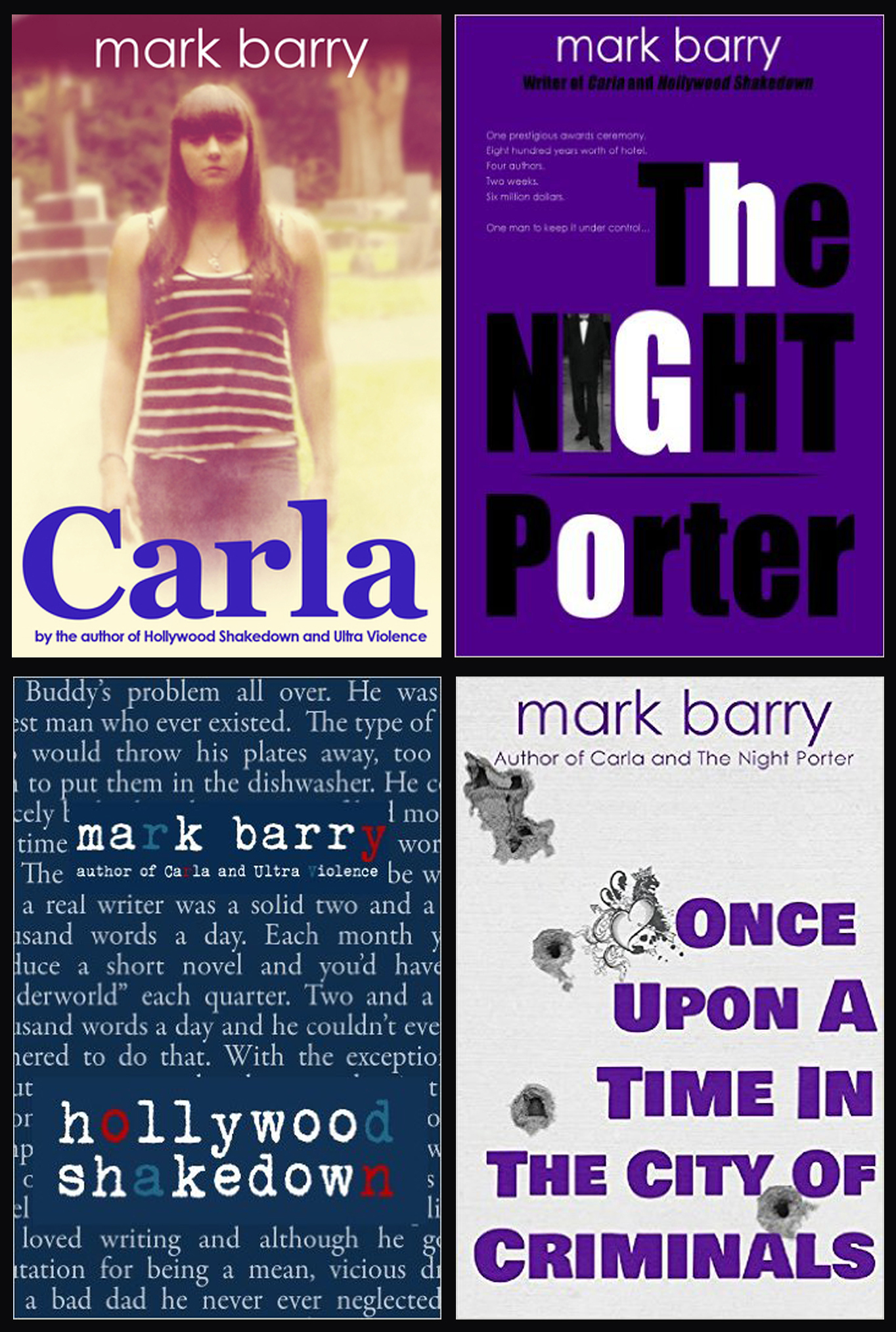
Certainly he’s not new, but I’ve just come upon his work in the last year. Writing fiction that stands out with its wit and originality, Barry, who’s based in Nottingham and Southwell in the UK, has built an impressive library of novels and short stories published through his company, Green Wizard Publishing, stories steeped in his cultural vernacular and sensibilities, biting and wickedly funny. Introduced by a fellow author who felt my own literary sensibilities aligned, I picked up my first of his books, Carla, to be pulled into an alternately tender and shocking story of love between a mentally-ill man and an innocent barmaid, swinging wildly from out-loud laughter to the gut-punch of pain, violence, and heartbreak. Rare to find such humor in so dark a tale… I was hooked.

Next came The Night Porter. A mad piece of fiction that employs Barry’s signature wit and irreverence, his attention to detail is so fine-tuned you’ll feel as though you know that part of England by the time you’re done. The narrative (begging to be made into a Wes Anderson film) covers the angst and antics of a rowdy group of writers gathered for an Academy Award-type event for indie books. With footnotes so rich as to be essential, Barry’s titular night porter finds his regimented life shaken to the core by the eclectic and confounding band of characters who demand his time, allegiance, and attention.

The most recent of Barry’s books I’ve read is Once Upon a Time in the City of Criminals, a bracing urban story that shares some of the aching tenderness of Carla, but goes deeper into the dark, following the trajectory of a tough, smalltime hoodlum who is hired to protect a young escort. With its sharp, brittle edges, its unvarnished glimpse into a violent subculture, it may be a rough read for some, but it’s replete with Barry’s crackling wit and signature mix of humor and pathos, and is, at its heart, a love story.

So now, with three books under my belt, and some correspondence articulating my kudos for his work, it seemed time for some one-on-one with the man himself, an invitation he so graciously accepted:

2015-07-20-1437412822-5795778-MarkBarrysbooks.jpg

So, Mark, what’s the most original, unique, hardcore thing about you as a writer?

Forty years ago, in the era I most venerate, I would have been quite common as a writer, with my admiration for crime books, pulp, gangster fiction, and such. But now, in the indie, PHP (Post Harry Potter) era, I am definitely unique and one-off, certainly in indie, which can be extremely conservative, concentrating on the commercial and the traditional.

I try new things. Three of my books do not use dialogue tags or speech marksUltra Violence, my football novel, is written in second person omniscient. The Night Porter makes use of footnotes. In Carla, the protagonist is a probationer from a mental asylum. No one else is doing this, to my knowledge, and sometimes it pisses people off. I’ve lost readers and, as a tactic, it doesn’t make for massive sales…but it does make for an interesting read!

Nothing disappoints me more than a book that’s identical to the last book I read and the one before that, which is an all-too-common experience for readers. Yes, there are people who like the familiar, but for me that’s beginning to wear thin. No two books of mine are the same.

What compelled you to write Carla, specifically? A real person? A real experience?

After walking into a pub one night, spotting this simply stunning young girl, and realising immediately that I was utterly (and quite rightly) invisible to her, it struck me that I had become old; that part of my life was all over. I remember feeling incredibly saddened by that, and the idea to write a novel about it followed shortly behind: I wanted to write about a mixed-age love affair. I thought about potential plots, came up with one, rejected another. For me, it wasn’t enough to have an everyday chap (like my very good self) as the older male – it simply wasn’t interesting enough and it had been done before.

I did have the experience of having been a psychologist back in the day, and, twenty years ago, I taught criminal psychology. That whole subject fascinates me, and so I had the idea of making the older male a mental patient – potentially (but not necessarily) dangerous – which, bearing in mind that Carla is written from his point of view, is interesting. Then it struck me: what if the girl (Carla) was, in fact, attracted to him and he wasn’t invisible at all?

It all came together from there, a story inspired by a very beautiful, but completely unattainable barmaid (and I never did find out her name, btw!).

The footnotes in The Night Porter, as mentioned above, are almost a character onto themselves. What inspired the decision to use that device, particularly in a novel?

One of my favourite authors is your countryman, David Foster Wallace, who unfortunately – and tragically – passed away late last decade. He was a prodigious user of footnotes which, for a fiction writer, is certainly an innovation. It’s usually in the domain of academia and non-fiction; you don’t often see them in fiction. DFW used footnotes for digressions, explanations, histories, lists, stories-within-stories, and internal monologues, thus keeping the body of the narrative clean, sharp and linear.

I was desperate to try this technique out and so, when the idea for The Night Porter came to me, it seemed the ideal opportunity. I also use footnotes in a wry way. Many indie authors will find their novels listed in one of the footnotes, particularly those who appeared on my interview blog, The Wizard’s Cauldron, and there are three pages of footnotes listing imaginary books from imaginary authors. I loved writing those.

TNP is a satire of publishing and indie at heart, and these footnotes are an ironic joke. Not entirely popular – and they are not available on the e-version (but the paperback is such a beautiful book, why bother with the e-version!). I would do it again and I have not ruled out a return to footnotes in subsequent books.

Violence and crime play a starring role in your work, certainly in your most recent novel, Once Upon a Time in the City of Criminals, yet you somehow always find the heart and humor within the darkness. Talk a bit about that signature mix.

In Criminals, I was keen to crack jokes and sprinkle the book with black humour. My friend, Georgia Rose, herself a mean writer, says that with Criminals, one minute she found herself laughing, the next, crying.

That’s pretty much what I aim for! I started out as a comedy writer (particularly with sketches about relationships) and my first audiences were predominantly female. And yes, while I enjoy a good punch-up in my fiction, I enjoy cracking jokes and, in particular, exploring the complex interactions between men and women, a lot lot more.

Frankly, I’ve been stunned by the ferocity of the violence in certain books — needed a shower after some, to be honest. I believe you have to throw something light into the mix to make it palatable.

If you could change one thing about the independent publishing world, what would it be?

One thing? Ummm. Nope – can’t do it! So let’s get radical: I’d limit the amount of books people can publish on Amazon in one calendar year. I’d completely ban novellas of less than 30,000 words, introduce some form of selection, and I would start a crowdfund to pay for five freelance sales reps to approach bookshops to persuade them to carry Independent paperbacks.

Bookshops: That’s the old/new frontier. The day I get my books in bookshops will be the day I’ve succeeded — it is simply too difficult now for me to continue using the Blog 101-recommended methods of Twitter, Facebook, and Book Bloggers, etc. The market is drenched with books, the review system is extremely dodgy, and everyone, talented or not, is fulfilling their I-Can-Write-Better-Than-That ideations. And fair play to them, but, in a lot of cases, they discover they cannot, yet still publish anyway.

In any case, evidence suggests readers are returning to the shops and that’s where writers need to be.

Lastly, you’re involved in a great literary organization, Brilliant Books; tell us a bit about that.

BB is something my friend, Phil Pidluznyj, and I started a year and a half ago. Funded by the British Big Lottery Fund, we take role models into schools – success stories from industry and commerce, sports and the arts – and get them to address and enthuse reluctant readers (of which there are many). Then, over eight weeks, we encourage the kids to write short stories and we publish the outcomes in an anthology that they keep forever. It’s been a roaring success so far – we even had the British Shadow Chancellor acting as a host. If you’d like to read a bit more about it, I’ve written a post about the group at Ali Levett’s A Woman’s Wisdom book blog.

So, there you have it: a snapshot of the prolific Mr. Barry: a good (excellent) author writing good (excellent) books. Visit his page, enjoy his work, and, frankly, don’t just take my word for it:

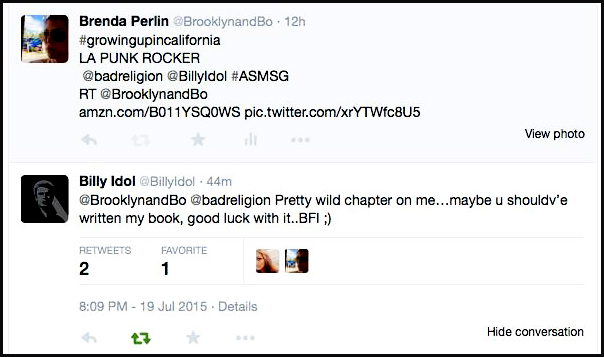
In the just-released LA Punk Rocker, an anthology produced by indie firecracker, Brenda Perlin, Barry contributed a short story on Billy Idol. With the book out only one day, the man himself Tweeted a “review” of Barry’s story:

2015-07-20-1437418052-3584550-LAPunkRocker_BillyIdol.jpg

Testimonials don’t get much better than that!

Photos by permission of Mark Barry.
Tweet image by permission of Brenda Perlin.

LDW w glasses


Visit www.lorrainedevonwilke.com for details and links to LDW’s books, music, photography, and articles.

Let’s Rethink ‘The Year of Women,’ Shall We?

women over books

Occasionally I sit outside certain issues, looking at how and why ideas emerged, if all parties involved explored the ramifications, and, if so, just how well thought out the process was.

A good example is the cause célèbre swirling around literary circles these days, the recent throw-down by author Kamila Shamsie in her piece titled, The year of women. Its thesis? An actual year in which only women will get published. Shamsie, after detailing statistical evidence of the clear and egregious gender bias in every category of the publishing world, articulates the challenge this way:

Now that the gender problem has been recognised, analysed, translated into charts and statistics, it is time for everyone in our literary culture to sign up to a campaign to redress the inequality for which all sectors of the culture bear responsibility. Last year readers, critics and at least one literary journal, the Critical Flame, signed up to a Year of Reading Women (YPW). Let’s take it a step further–let’s have a Year of Publishing Women. And 2018, the 100th anniversary of women getting the vote in the UK, seems both near enough and distant enough to be feasible.

So, 2018 will be the year in which, ostensibly, no male writers will be published. It’s believed (hoped) this will go a long way toward righting sexist wrongs. It’s also hoped that feminist-oriented males will go along with the program, with literary contest organizers, judges, and publishers, large and small, jumping on the bandwagon. Does anyone think this will actually happen? Well, so far, small press And Other Stories is on board, but we’ll see. 2018 is three years away and a lot can happen in that time. But still…

I found myself getting twitchy and all “devil’s advocatey” about the whole thing. Certainly I get the reason for such affirmative action — women are deeply under-represented in all areas of the arts, literature no exception — but what does it say that those taking on gender politics believe the way for women to rise is to literally remove men from the equation? Do we, as strong, female artists, really believe it’s necessary to excise men in order for fairness to reign? It seems many do. But I have a slight problem with that. Actually, several problems of varying degrees of slightness. Some maybe not so slight at all.

First of all, if you read Shamsie’s entire piece, you’ll see she makes note of the various gender-based proclivities women themselves fall victim to, ones that help perpetuate some of the very problems she’s railing against:

Of the 252 people who picked their books of the year, only 37% were women. In the past when the issue of women’s representation in literary pages has been brought up, it’s very often women editors who, while voicing their frustration, mention how much more likely men are than women to agree to review or judge or make lists of favourites. Suzi Feay, writing in 2011, stated: “You’d think it would be a pretty easy ask: a nomination for a (not the) book of the year. Yet in the first fortnight, not one female author approached said yes, while virtually all the men did. They had no trouble believing their views were worth having.

Or this:

I asked Ginny Hooker from the Guardian Review whether the comparative reticence of women writers was the reason the Books of the Year contributors were mostly men. She said: ” We always try to get a balance, and although I don’t have accurate records, my sense was always that more women said no to contributing than men did. But I suspect that if you looked at the number of people I’ve approached, it would probably be more than 50% men — something to do with who is in the public eye.” It’s a triple bind. More men than women get asked to judge, nominate, recommend–and of those who are asked, more men than women agree to do so, and those men are more likely to recommend yet more men.

So there’s that.

Women WritersThere’s also the fact that many “gatekeepers” in this industry — agents, publishers, publicists, marketers, etc. — are women, and they have much to do with which writers get agents, publishers, publicity; win contests, or, even, just get in the damn door. Personally, and from a strictly anecdotal perspective, I know countless female writers, many of whom are excellent writers, who cannot, for the life of them, get past the query letter stage with agents… and most of the agents rejecting them are women. As for publishers at the helm deciding which writers to push, which to give publicity, and which to send to various high-profile contests, may I ask: how many female publishers pushed their female writers with the same verve, and in the same numbers, as their male counterparts?

So there’s that.
Then there’s the fact that — again, anecdotally — a great many excellent male writers are just as frustrated and stymied in their efforts to advance their careers as female writers. I know several myself. They’re out there in the undulating white water of independent publishing, thrashing their arms in attempts to even be seen, much less reviewed and rewarded. Are we to make the literary marketplace just a little bit harder for them as a way to assuage gender imbalance, particularly when that imbalance is no fault of their own? Does that seem fair?

So there’s that.

Look, I’m a feminist, a strong voice for equality, parity, equal opportunity, and certainly equal pay. I’ve not been immune to sexism myself, nor am I unaware that it is deeply entrenched across many levels and layers of our global culture, often in ways that are far more egregious than literary exclusion. But each and every way in which women are marginalized, diminished, minimized, hurt, and dismissed is worth our loud, dissenting demand for change.

But I am also a humanist: the wife of a man, mother of a son, sister to five brothers, and friend to a great many wonderful men, many of whom are artists struggling to build careers and find footing in industries that are challenging for anyone, male or female. So, to suggest that a hardworking, talented male writer, by virtue of his gender alone, would not be able to get his book published in 2018, because that year has been deemed “a year of publishing women,” seems punitive. It seems unfair. It seems… sexist. Which inspires the question: is the only solution to gender bias reverse gender bias?

Women writers do need greater representation in the book world. We deserve greater representation. Women writing beautifully articulated, deeply moving and important books should be in the running for any literary prize, even those largely rewarded to men. They should be as reviewed, as featured; as respected and honored as men. But it’s not male writers preventing that from happening; it’s the gatekeepers, the key holders, the brandmakers, publicity wranglers, and star makers… male and female. It’s the people in power. And yes, some of those are male writers, the uber-famous, phenomenally successful male writers who wield great power in this industry. So we’ll put that rarefied group in with the rest of the power brokers. They are the ones with the power and obligation to right the wrongs of gender imbalance in publishing, not the average male writer.

So how about this? Instead of “a year of publishing women,” let’s have “a year of publishing parity.” TYOPP. Let’s throw down a challenge to demand parity in every aspect of publishing. Every aspect:

  • Agents will be obligated to sign as many female writers as male writers.
  • Publishers will be obligated to give deals to as many female writers as male writers.
  • Publishers (or anyone) submitting books to contests will, by virtue of the rules of TYOPP, submit as many by women as men.
  • Book reviewers will be required to review as many books by women as men.
  • Book sections of any media will be obligated to feature as many women writers as men.

And so on. Ah… wouldn’t it be lovely if that could actually happen?

Sophie Lewis of And Other Stories publishing, who, as mentioned above, is on board with the “year of women” plan, believes Kamila Shamsie’s challenge is an inspiring “provocation” …

We will have to start now, hunting for the women we want to publish, commissioning translations, and scheduling in the editing sessions. We will end up, we hope, publishing a few excellent women writers we might not otherwise have discovered. This will be a step in the right direction, and a source of pride for us.

But I must ask: why does any publisher need “a year of publishing women” to do that? Why aren’t they doing that already, every single day of the week, during any year, not just one called “a year of publishing women”? They should be. There are a lot of “excellent women writers” they haven’t discovered simply because they’re not looking hard enough, being inventive enough, or stepping outside industry norms enough.

Let’s rethink this, fellow women. We do deserve equal space at the table, but we don’t need male writers to be banished for us to succeed. What we need is for all those in positions of power to raise their consciousness, adjust their thinking, broaden their focus, and take more chances. Seek out more of those “excellent women writers.” Publish them, promote them, give them awards… just as they would the deserving men.

But let’s not wait until 2018. Let’s start “The Year of Publishing Parity” right now. Because every year should be a year for excellent writers, gender be damned.

Women & Book @ Vintage Women on Pinterest
Vintage Female Writer image by LDW
Original article posted at The Huffington Post

LDW w glasses


Visit www.lorrainedevonwilke.com for details and links to LDW’s books, music, photography, and articles.