Let’s Rethink ‘The Year of Women,’ Shall We?

women over books

Occasionally I sit outside certain issues, looking at how and why ideas emerged, if all parties involved explored the ramifications, and, if so, just how well thought out the process was.

A good example is the cause célèbre swirling around literary circles these days, the recent throw-down by author Kamila Shamsie in her piece titled, The year of women. Its thesis? An actual year in which only women will get published. Shamsie, after detailing statistical evidence of the clear and egregious gender bias in every category of the publishing world, articulates the challenge this way:

Now that the gender problem has been recognised, analysed, translated into charts and statistics, it is time for everyone in our literary culture to sign up to a campaign to redress the inequality for which all sectors of the culture bear responsibility. Last year readers, critics and at least one literary journal, the Critical Flame, signed up to a Year of Reading Women (YPW). Let’s take it a step further–let’s have a Year of Publishing Women. And 2018, the 100th anniversary of women getting the vote in the UK, seems both near enough and distant enough to be feasible.

So, 2018 will be the year in which, ostensibly, no male writers will be published. It’s believed (hoped) this will go a long way toward righting sexist wrongs. It’s also hoped that feminist-oriented males will go along with the program, with literary contest organizers, judges, and publishers, large and small, jumping on the bandwagon. Does anyone think this will actually happen? Well, so far, small press And Other Stories is on board, but we’ll see. 2018 is three years away and a lot can happen in that time. But still…

I found myself getting twitchy and all “devil’s advocatey” about the whole thing. Certainly I get the reason for such affirmative action — women are deeply under-represented in all areas of the arts, literature no exception — but what does it say that those taking on gender politics believe the way for women to rise is to literally remove men from the equation? Do we, as strong, female artists, really believe it’s necessary to excise men in order for fairness to reign? It seems many do. But I have a slight problem with that. Actually, several problems of varying degrees of slightness. Some maybe not so slight at all.

First of all, if you read Shamsie’s entire piece, you’ll see she makes note of the various gender-based proclivities women themselves fall victim to, ones that help perpetuate some of the very problems she’s railing against:

Of the 252 people who picked their books of the year, only 37% were women. In the past when the issue of women’s representation in literary pages has been brought up, it’s very often women editors who, while voicing their frustration, mention how much more likely men are than women to agree to review or judge or make lists of favourites. Suzi Feay, writing in 2011, stated: “You’d think it would be a pretty easy ask: a nomination for a (not the) book of the year. Yet in the first fortnight, not one female author approached said yes, while virtually all the men did. They had no trouble believing their views were worth having.

Or this:

I asked Ginny Hooker from the Guardian Review whether the comparative reticence of women writers was the reason the Books of the Year contributors were mostly men. She said: ” We always try to get a balance, and although I don’t have accurate records, my sense was always that more women said no to contributing than men did. But I suspect that if you looked at the number of people I’ve approached, it would probably be more than 50% men — something to do with who is in the public eye.” It’s a triple bind. More men than women get asked to judge, nominate, recommend–and of those who are asked, more men than women agree to do so, and those men are more likely to recommend yet more men.

So there’s that.

Women WritersThere’s also the fact that many “gatekeepers” in this industry — agents, publishers, publicists, marketers, etc. — are women, and they have much to do with which writers get agents, publishers, publicity; win contests, or, even, just get in the damn door. Personally, and from a strictly anecdotal perspective, I know countless female writers, many of whom are excellent writers, who cannot, for the life of them, get past the query letter stage with agents… and most of the agents rejecting them are women. As for publishers at the helm deciding which writers to push, which to give publicity, and which to send to various high-profile contests, may I ask: how many female publishers pushed their female writers with the same verve, and in the same numbers, as their male counterparts?

So there’s that.
Then there’s the fact that — again, anecdotally — a great many excellent male writers are just as frustrated and stymied in their efforts to advance their careers as female writers. I know several myself. They’re out there in the undulating white water of independent publishing, thrashing their arms in attempts to even be seen, much less reviewed and rewarded. Are we to make the literary marketplace just a little bit harder for them as a way to assuage gender imbalance, particularly when that imbalance is no fault of their own? Does that seem fair?

So there’s that.

Look, I’m a feminist, a strong voice for equality, parity, equal opportunity, and certainly equal pay. I’ve not been immune to sexism myself, nor am I unaware that it is deeply entrenched across many levels and layers of our global culture, often in ways that are far more egregious than literary exclusion. But each and every way in which women are marginalized, diminished, minimized, hurt, and dismissed is worth our loud, dissenting demand for change.

But I am also a humanist: the wife of a man, mother of a son, sister to five brothers, and friend to a great many wonderful men, many of whom are artists struggling to build careers and find footing in industries that are challenging for anyone, male or female. So, to suggest that a hardworking, talented male writer, by virtue of his gender alone, would not be able to get his book published in 2018, because that year has been deemed “a year of publishing women,” seems punitive. It seems unfair. It seems… sexist. Which inspires the question: is the only solution to gender bias reverse gender bias?

Women writers do need greater representation in the book world. We deserve greater representation. Women writing beautifully articulated, deeply moving and important books should be in the running for any literary prize, even those largely rewarded to men. They should be as reviewed, as featured; as respected and honored as men. But it’s not male writers preventing that from happening; it’s the gatekeepers, the key holders, the brandmakers, publicity wranglers, and star makers… male and female. It’s the people in power. And yes, some of those are male writers, the uber-famous, phenomenally successful male writers who wield great power in this industry. So we’ll put that rarefied group in with the rest of the power brokers. They are the ones with the power and obligation to right the wrongs of gender imbalance in publishing, not the average male writer.

So how about this? Instead of “a year of publishing women,” let’s have “a year of publishing parity.” TYOPP. Let’s throw down a challenge to demand parity in every aspect of publishing. Every aspect:

  • Agents will be obligated to sign as many female writers as male writers.
  • Publishers will be obligated to give deals to as many female writers as male writers.
  • Publishers (or anyone) submitting books to contests will, by virtue of the rules of TYOPP, submit as many by women as men.
  • Book reviewers will be required to review as many books by women as men.
  • Book sections of any media will be obligated to feature as many women writers as men.

And so on. Ah… wouldn’t it be lovely if that could actually happen?

Sophie Lewis of And Other Stories publishing, who, as mentioned above, is on board with the “year of women” plan, believes Kamila Shamsie’s challenge is an inspiring “provocation” …

We will have to start now, hunting for the women we want to publish, commissioning translations, and scheduling in the editing sessions. We will end up, we hope, publishing a few excellent women writers we might not otherwise have discovered. This will be a step in the right direction, and a source of pride for us.

But I must ask: why does any publisher need “a year of publishing women” to do that? Why aren’t they doing that already, every single day of the week, during any year, not just one called “a year of publishing women”? They should be. There are a lot of “excellent women writers” they haven’t discovered simply because they’re not looking hard enough, being inventive enough, or stepping outside industry norms enough.

Let’s rethink this, fellow women. We do deserve equal space at the table, but we don’t need male writers to be banished for us to succeed. What we need is for all those in positions of power to raise their consciousness, adjust their thinking, broaden their focus, and take more chances. Seek out more of those “excellent women writers.” Publish them, promote them, give them awards… just as they would the deserving men.

But let’s not wait until 2018. Let’s start “The Year of Publishing Parity” right now. Because every year should be a year for excellent writers, gender be damned.

Women & Book @ Vintage Women on Pinterest
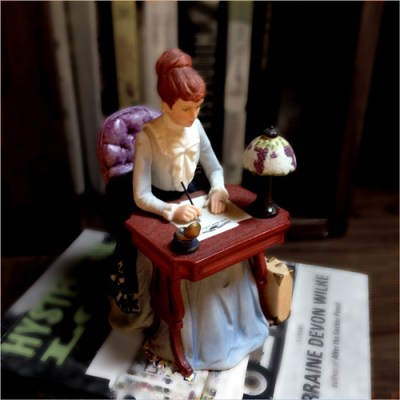
Vintage Female Writer image by LDW
Original article posted at The Huffington Post

LDW w glasses


Visit www.lorrainedevonwilke.com for details and links to LDW’s books, music, photography, and articles.

Sharing ‘Matters of the Mind’ with Dr. Peter Sacco and Todd Miller on ListenUP!TalkRadio

ListenUP!TalkRadio

There is a wide spectrum of events and circumstances that can contribute mightily to the joy of a writer’s life, but one of the nicest has to be the opportunity to talk about the work with smart, insightful people who are genuinely interested. I had occasion today to enjoy that experience when I was interviewed by Dr. Peter Sacco and ListenUp!TalkRadio President, Todd Miller, on their show, “Matters of the Mind.” 

These are two really great guys who approached the conversation with a holistic slant, interested in reaching below the surface to discuss the deeper threads that run throughout an artist’s experience and inspiration. Given my eclectic background, as well as the personal mission to explore the more humanistic, emotional aspects of life through my art, I appreciated the approach!

The interview will run tonight (March 25, 2015, at 8:00 EST) and will be podcast, as well, for future listening. The link with all the information is below. Please enjoy the listen and be sure to check out any of the books we discuss by going HERE!

“Tune in tonight at 8 pm (ET) for “Matters Of The Mind,” as Dr. Peter Sacco and Todd Miller have a great conversation with author, writer, actor and musician Lorraine Devon Wilke. Talk about a cultural gypsy!”

Thanks, gents; thoroughly enjoyed the conversation!

LINK: Announcement: Lorraine Devon Wilke, #author of “Hysterical Love” joins #MOTM at 8p tonight to discuss #writing, #music and MORE!

DIRECT LINK TO PODCAST: Vol 54 LORRAINE DEVON WILKE #Author Mar 25 2015

LDW w glasses


Visit www.lorrainedevonwilke.com for details and links to LDW’s books, music, photography, and articles.
A Trailer Sets the Stage… For the Book That Tells the Story

trailer image

There are a great many ways in which projects, businesses, organizations, movies, songs, and books are introduced to the world, marketed into the cultural zeitgeist. Media – in all its forms – is the medium: newspaper and magazine advertising, online press releases, repetitive social media alerts; blogs, interviews and radio spots. If the person involved is high-profile enough, or has a good enough publicity team, they appear on talk shows, do segments on news programs, or find a reason to participate in a cause… or a cooking show. 🙂

But in the specific world of movies and television, there are trailers. Those snappy, quick-cutting, eye-catching, can’t-turn-away mini-films intended to set the stage, pull you in, ensnare your interest to the point that you must watch to find out WHAT HAPPENS.

Personally, I love trailers. I love getting to the theater early enough to catch each and every one that unfurls before the main attraction, making note of those I’ll catch and those I’ll be sure to miss. Trailers – the good ones, anyway – are significant and effective as marketing tools because they show just enough visual, share just enough narrative, and cut it all together with just the right rhythm and pace to whet the appetite of the viewer, enough to make a future commitment to WATCH.

Or, in the case of book trailers, to READ.

The notion of authors and publishers using trailers to promote and market their books is a relatively new phenomenon. There’s no doubt that as e-books and the online purchasing of paperbacks, even hardcovers, came under the growing purview of online book retailers like Amazon, Barnes & Noble, and the like, the focus of book-lovers turned commensurately to online interaction. From there it was not difficult to steer their interests towards accompanying book trailers as a way to further entice their reading choices.

Brilliant! So fresh and cutting edge, trailers would surely be seen as innovation for books marketersright?

In fact, back in 2012 The Guardian published a piece titled, From page to screen: the rise of the video book trailer, that seemed to view the trend as a bit niche:

“These are terrific diversions, but their status next to the book is a little ambiguous.”

But the trend persisted and before long, more and more authors saw trailers as tools to help pull their books out of the pack, translate synopses without a document; thrill enough to grab attention (the goal, after all!). And as time passed, what was niche became notable, if not de rigueur:

Lindsay Mead, “YA author (soon-to-be), YouTuber and Full-Time Daydreamer,” runs a blog that focuses heavily on book trailers, with an accompanying YouTube page sharing those of authors she admires. Goodreads, the uber- (and now Amazon-owned) author/reader site, features a video option on authors’ profile pages. And writers swear by their trailers; author Brian Solis, for example, posted in A Visual History of Book Trailers:

“…the tradition of book trailers not only continues, it’s become standard practice as part of the book marketing checklist. From concept to script to treatment to music, I see trailers and book marketing in general as a creative challenge to engage readers beyond text.”

I agree with him, though I do think the accessibility to trailers could use some expansion. At this point, unless an author or publicity person directs you to the YouTube or Goodreads page of that author, or is vigilant about linking the trailer to every piece of promo sent out, their ubiquity as advertising tools is not necessarily matched by their actual access. Even Amazon, which allows authors to post book videos on their author pages, hasn’t yet created the algorithm to view those videos full screen… or even larger than the teeny box they appear in off to the right (I’ve talked to them and will see what can be done about getting that changed, dammit!). Frankly, I think trailers should be right there on the authors’ individual sales pages, just like the “look inside this book” feature. Hopefully, we’ll get there.

For now, I’m delighting in the fact that the medium exists… and that I’ve got one. A good one. One artfully created, produced, and edited by my phenomenally talented brother, actor/director/writer, Tom Amandes (in addition to the gorgeous book cover created by one of my other phenomenally talented siblings, designer Grace Amandes). Tom has a remarkable resume as an actor, and in recent years directed a number of high-profile television shows as well. I am truly fortunate to be the recipient of the prodigious skill and expertise he brought to this wonderful, artistic, mini-film for After The Sucker Punch. Already I’m hearing from new readers about it!

And so, with no further ado, the book trailer for After The Sucker Punch. Enjoy it… then enjoy the book!

LDW w glasses


Visit www.lorrainedevonwilke.com for details and links to LDW’s books, music, photography, and articles.

Hey, After The Sucker Punch, You Look REAL Good Up On That Book Shelf…

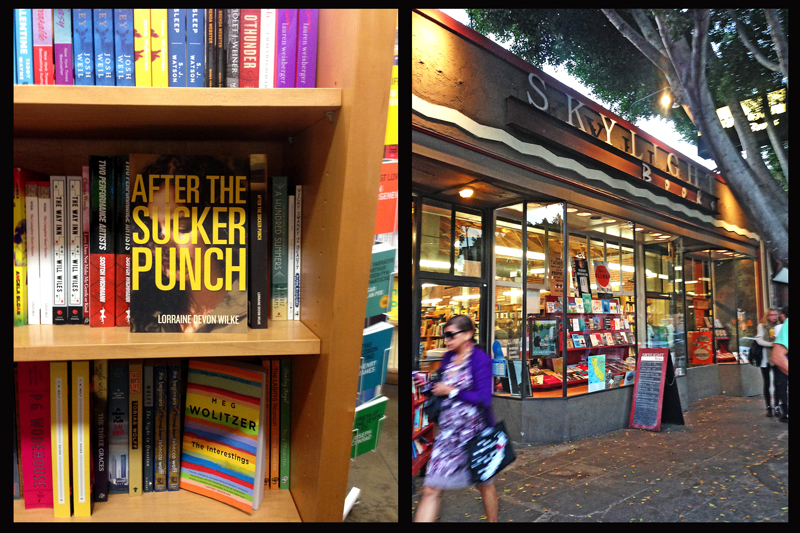
ATSP @ Skylight Bookstore

Oh, isn’t it just the dream of every writer to see their book up on the shelf of a real, live, brick & mortar bookstore, sitting there next to the famous writers with their famous books, looking not only like they belong in that spot but fit right in with the “big kids”?

Yep.

So given that I’m a leave-no-stone-unturned kinda dreamweaver, I decided to see just how successful I could be at getting my independently published debut novel, After The Sucker Punch, beyond Amazon and the online marketplace and actually into bookstores where perusing patrons could stumble upon it and, hallelujah, pick it up.

First I contacted Skylight Books in Los Angeles, “what a neighborhood bookstore should be,” to make a pitch. The contact person sent me straight to their book buyer to see if he was interested. Gulp…

He was interested! “I’d like to buy 2 copies for the store and see how it does,” said the book buyer, and off those two copies went. I visited them yesterday (see above) and they look mighty comfortable on the shelf right above Meg Wolitzer’s NYTimes Bestseller, The Interestings, don’t you think? I urge Los Angeles area book lovers to find their way into this very cool bookstore and pick up a copy (or two… there’s two, remember? :)… cuz I want to be sure “how it does” is some version of “it does really well”!

Here’s the information:

SKYLIGHT BOOKS
1818 N Vermont Ave, Los Angeles, CA 90027
(323) 660-1175

They don’t have a local authors section, so just find your way to the “W’s”… (hence, that Wolizter proximity!).

But I wasn’t about to stop there. Two books in one cool bookstore is a start, but I had to see what else I could stir up….how about Vroman’s in Pasadena?

Vromans bookstore

Known as “Southern California’s Oldest & Largest Independent Bookstore,” Vroman’s is another eclectic, beloved neighborhood bookstore that has a stellar reputation amongst writers for its support of the community in all its configurations… including independent authors (which isn’t necessarily the case with everyone in the book industry; see Who Do We Have To ____ To Get a Little Respect Around Here?).

I had spent time at Vroman’s earlier this year when Karrie Ross, the author of an art/essay book in which I participated as a writer and photographer — Our Ever Changing World: Through the Eyes of Artists: What Are You Saving from Extinction? — organized a reading at the store (something I’ll do after the holidays). It’s a very nice set-up, interesting and bursting with every kind of book and book-related item you can imagine, and it’s clear they are vibrantly engaged with the world of reading.

So I got in touch and was delighted to discover they have a  “Local Authors” program, which invited me to bring a total of 8 books to the store, 5 for the iconic Pasadena location, and 3 for the Hastings Ranch location, all of which should be on shelves this week. Just ask for the “local authors” section and you’ll find After The Sucker Punch there.

Here’s the information for both locations:

VROMAN’S PASADENA
695 E. Colorado Blvd
Pasadena, CA 91101
626-449-5320
(Fax) 626-792-7308
email@vromansbookstore.com 

VROMAN’S HASTINGS RANCH
3729 E Foothill Blvd
Pasadena, CA 91107
626-351-0828
(Fax) 626-351-0798
email@vromansbookstore.com

As all book lovers know, there’s a great debate out there regarding the burgeoning industry of online book sales and the impact of that inexorable trend on the shrinking population of bookstores, particularly of the independent variety. Since I am a champion of books, writing, and reading, whatever form, format, or delivery system is involved, I want to be sure to play my part in keeping all options as alive and well as can be managed! So if you live in or are visiting Southern California, I encourage you to visit one or all of these bookstores. And when you’re at the counter to pick up your paperback copy of After The Sucker Punch, be sure to tell them I sent you! 🙂

Next up: Book Soup on the Sunset Strip…

LDW w glasses


Visit www.lorrainedevonwilke.com for details and links to LDW’s books, music, photography, and articles.

Take A Moment To Visualize This With Me….

city street

Would you? Just sit back and take this in, this image above: a New York City bus stop with its large poster in bright, living color. What’s on that poster? The book cover image of After the Sucker Punch with its intriguing face tucked behind those bold, enticing letters.

I see it… don’t you?

For details and links to who created this image and why, hop on over to AfterTheSuckerPunch.com and find your way to reader and writer, Brenda Perlin, who not only took the time to read my book, but shared a few insightful thoughts about it… for which I am deeply grateful.

But don’t click over there just yet.

Take one more moment to visualize this with me… and… very nice. We’ll end with an amen of “so be it and so it is.”

Thank you. I felt the plates shift.

LDW w glasses


Visit www.lorrainedevonwilke.com for details and links to LDW’s books, music, photography, and articles.

About Those Book Reviews…

Woman praying for… excellent book sales? Lotsa “likes”? Good reviews?

Self-promotion. Ugh.

To the creative soul awash in inspiration, artfulness, and flights of fancy, there is nothing more antithetical to the Muse than blowing one’s own damn horn. “Shameless self-promotion,” as a friend of mine puts it, which comes replete with discomfort and the awkwardness of braggadocio. But still… it seems we must.

Back in the day – or if you have the sort of career in which these characters appear – publicists, marketing and promotion specialists, managers, agents, handlers, etc., did the heavy lifting when it came to the strutting of stuff. The artist was protected from this crass commercial cacophony by virtue of having a team, a cadre, a crowd of enthusiasts who knew just what to say, when and to whom, to get that artist a front cover, a high-profile radio interview, the best book tour, all the right appearances at all the right places. Now? That cadre? That team? It’s you.

Well, it’s you if you are one of the growing number of independent artists who revel in the passion of creativity but wearied of shuffling behind velvet ropes held tight by the gatekeepers. Or, in simpler terms: damn, it’s hard these days to get an agent, publisher, manager, publicist, any of those folks!!

So what’s an artist to do; an artist who trusts their own voice and is willing to walk their own road even if those gate won’t open? Well, those artists are doing it for themselves. Just like the sisters.

Musicians made the leap first. When big labels tumbled into the swirling eddy of the digital revolution and no one understood how to proceed when all previously held paradigms blew into bits, musicians, bands, and singer/songwriters figured out how to transcend; how to get into those Pro-Tools studios and get the job done with a level of excellence that used to drain bank accounts but could now be covered by Mom, Dad and your freelance fees. And when they had their records recorded, mixed and mastered exactly as they wanted, without interference from bean-counters and suits with no idea of artistry, they got busy promoting the living hell out of those records, creating viable, accessible, impossible-to-pigeonhole careers as independent musicians. Which meant lots of teeth-gritting but ultimately necessary – and often quite effective – self-promotion. Entire careers have been built on that.

Now it’s the writers’ turn. The writing/publishing industry is/has been going through a similar upheaval and the pain is starting to show. While the Big Six publishing houses (some say it’s now the Big Five) have struggled against the turbulence of changing tastes, trends, and delivery systems for the written word, companies like Amazon have rewritten the book, so to speak, on how books are sold, writers are advanced, and readers are supplied. Money in traditional publishing has become unpredictable and unsustainable, which has led to gatekeepers selecting only a few who are predicted to fit the mold, meet the formulas, and overcome the changing tides. Which left out the other talented folk who, heretofore, would have been amongst the chosen. Have you seen the new Noah movie yet? Picture the bulk of writers as those left behind on terra firma as Russell Crowe battened down the hatches and floated off with his handpicked horde.

So those of us left outside have taken a cue from the indie musicians. Courtesy of Amazon and other sites, independent writers have been given the power to move forward despite closed door. The demand remains for excellent,  extraordinary, really good work; for brilliant stories, goose-bumping prose, and unforgettable characters. But, lo and behold, it appears a great many writers who were not let in the gates can and do provide that standard of literature. How lovely that the industry has evolved to the point that these outliers now have a portal, a support system, a facility with which to publish their own work! It’s quite brilliant. But…

Back to self-promotion. Because even though Amazon and affiliates do quite a good job at the various and creative ways in which they promote their authors – clearly a win/win situation – there’s no getting around the fact that independent writers MUST blow their own horns. Which means a great many things, not least of which is asking readers who’ve read their books to leave their – hopefully – positive reviews on their Amazon page… or wherever else such things matter, like Goodreads or Shelfari or other book sites. Reviews are not requested for the sake of ego; they’re requested for the sake of algorithms that rank a book by many things, including the number of reviews those books elicit.

So when a writer asks you to leave a review, understand that they are being a good, independent artist, taking very seriously their commitment to do right by their work, their art; their business. And if you can, if you are so inclined, if you are interested in supporting that artist, and, in a bigger sense, the independent publishing industry, you will be happy to leave one.

And that artist will be very, very grateful.

Woman Kneeling in Prayer by Émile Plassan @ Wikimedia Commons

LDW w glasses


Visit www.lorrainedevonwilke.com for details and links to LDW’s books, music, photography, and articles.